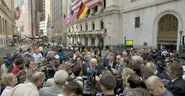
German Foreign Minister Frank-Walter Steinmeier said during a visit to Wall Street on Wednesday that European states had long tried to convince the United States to approve measures that would have averted the current financial market crisis.
In the latest dispatch of <b>Portnoy’s Stammtisch</b>, The Local’s column about life in Germany, Portnoy muses on how the current global financial crisis has brought Germany’s leftist populist Oskar Lafontaine and America’s cowboy capitalist George W. Bush together.
German Finance Minister Peer Steinbrück on Friday rejected the idea of a European stimulus plan to revitalize the economy, as EU finance chiefs gathered to map out a way to avert a recession.
German industrial output in July slumped 1.8 percent from June, more than three times the downturn analysts had expected, underscoring the chance that Europe's biggest economy could be in recession, official figures showed Friday.
German investor confidence hit a record low point in July, a key survey showed on Tuesday, but analysts skirted any recession forecast as high oil prices and the euro weigh on the economy.
The German government announced that it intends to lead a €1.5 billion bail-out of the German small business lender IKB. Minister of Finance Peer Steinbrück (SPD) said that the state would contribute €1 billion to save the bank.
Unemployment in Germany is at its lowest level in 15 years and was better than expected this January, despite stock market volatility and fears of a US recession. The number of unemployed increased in January by 253,000 to 3.66 million, according to a report by the Federal Agency of Employment (BA) on Thursday. January and February are usually slow months for the economy, however, the milder weather might have helped to soften the seasonal effect.
The Dax, an index of the top 30 German companies, made a 5 percent gain on Thursday, as good earnings in the real economy, as well as gains in Asian and American markets helped calm the mass panic on the bourses.
Shares prices fell and rose again in Frankfurt on Wednesday as the US Federal Reserve enacted an emergency 75 basis point cut. During the afternoon, the Dax, a composite index of the 30 biggest German companies, had fallen almost 6 percent and was at 6386 points, its lowest point since December 2006.
High level EU politicians have cautioned against panic after two days of turbulence on the financial markets. Jean-Claude Juncker, Prime Minister of Luxembourg and Euro group president said that while he is not ruling out the possibility of a recession in the US, he does not believe that the credit crisis will necessarily mean a slowdown for the Eurozone economy. He warned about exaggerated pessimism late Monday and said “In comparison to the US, the fundamental data in Europe is solid.”
Peer Steinbrück, the German finance minister, said that despite the financial crisis, fundamental economic data points to a robust economy for Germany and Europe. On Friday Steinbrüch said on Deutschlandfunk that the credit market crisis that burdens the US economy exists in Germany and Europe as well, but the economic European and German fundamentals are robust.