
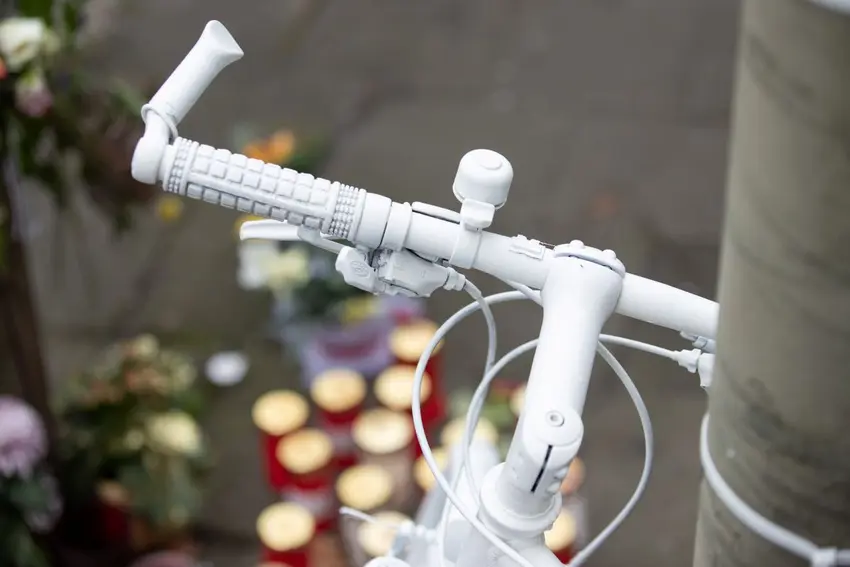
Thursday's top story: Germany sees increase in traffic fatalities
Last year, 2,814 people died on Germany's roads. This was about two percent more than in 2024 (2,770 fatalities), according to preliminary figures from Germany's statistics office.
Overall, the number of injured was similar to the year prior at around 366,000. There was a slight increase (about one percent) in the number of minor injuries, but the number of serious injuries fell by four percent to 48,400, which was the lowest value recorded since 1991.
Experts warn that Germany is taking steps backwards when it comes to road safety. Kirstin Zeidler, Head of Accident Research at the German Insurance Association (GDV) suggested that the figures show Germany moved further away from the goal of "Vision Zero", i.e. zero traffic fatalities, in 2025.
The German government had set itself the goal of making the country's roads significantly safer. The stated goal was that by 2030, the number of traffic fatalities should be reduced by 40 percent. The long-term goal is to achieve no deaths in road traffic.
Drivers and their passengers made up the biggest share of traffic fatalities last year (1,082), followed by cyclists (441) and pedestrians (355).
READ ALSO:
- German cities are designed for walking and it benefits everyone
- Where SUVs are most - and least - popular in Germany
After meeting Xi, Merz announces Chinese Airbus order
China will buy up to 120 aircraft from European aviation giant Airbus, German Chancellor Friedrich Merz said following talks with President Xi Jinping in Beijing on Wednesday.
Merz's visit comes as Berlin and Beijing seek to build on their decades-old economic ties to weather global uncertainty sparked by US President Donald Trump's tariff blitz and other erratic foreign policy moves.
China, the world's number two economy, overtook the United States last year to become Germany's biggest trade partner. At the same time, Berlin regards the Communist Party-run state as a systemic rival to the West.

Following talks with top Chinese leaders, Merz told reporters that China had agreed to purchase "up to 120" Airbus aircraft, adding that it "demonstrates how worthwhile such trips can be".
Other contracts were in the pipeline, Merz added.
Earlier in the day, Merz and Xi stressed their commitment to developing closer strategic relations, with the German leader saying he saw the trip as a "great opportunity" to boost economic ties.
READ ALSO: Germany's Merz meets Xi in China, seeking closer ties
Germany, Belgium warn Hungary to drop veto on EU loan for Ukraine
The German and Belgian foreign ministers criticised Hungary on Wednesday for blocking a major European Union loan to Ukraine as well as the latest round of EU sanctions against Russia.
"All I can say is that I remain appalled by Hungary's behaviour," Germany's Johann Wadephul said in Berlin, adding that Hungary's decision to veto the sanctions "betrays its own struggle for freedom".
The 27-nation European Union has been pushing to impose a new round of economic punishment on Moscow over the Ukraine war after Tuesday's fourth anniversary of the full-scale invasion.
But Orban has been stalling both the sanctions as well as a 90-billion-euro EU loan to Ukraine, demanding that Kyiv re-open a key oil pipeline first.
According to Kyiv, the Druzhba pipeline -- which carries Russian oil across Ukraine to Slovakia and Hungary -- was damaged by Russian strikes in late January.
Wadephul said that Orban himself had previously agreed to the EU-backed loan to Ukraine.
"Hungary cannot explain this inconsistency," Wadephul said, adding that the loan deal has "no connection to the damaged pipeline, which of course needs to be repaired".
Germany faces shortfall of 150,000 full‑day primary school places
Six months before a legal entitlement to full‑day care for primary school pupils comes into force, Germany is facing a significant shortage of places, according to a new study by the Institute of the German Economy (IW).
From August 1st, first‑grade pupils will have the right to a full‑day place, but researchers estimate that around 150,000 places are currently missing nationwide.
The gaps are particularly pronounced in western Germany. Based on parents’ stated childcare preferences in 2024, the IW calculates shortages of 45,300 places in North Rhine‑Westphalia and 42,300 in Bavaria.

READ ALSO: Administrators warn German schools are in urgent need of renovation
If demand rises as expected and around three in four children require afternoon care for homework, play or sports, the shortfall could increase dramatically to more than 570,000 places nationwide.
Bavaria stands out as especially affected, with only 34 percent of primary‑school‑aged children in full‑day care in 2024. By contrast, Hamburg and all eastern German states already provide full‑day care to more than 75 percent of pupils.
Researchers stress that full‑day schooling improves educational outcomes and helps parents better balance work and family life.
Trains between Stuttgart and Zurich are far more punctual since SBB stepped in
Switzerland's national railway company, SBB, has long reported punctuality problems with Deutsche Bahn (DB) trains that come extend over the border. On at least two connections, Swiss authorities have stepped in to stop DB trains at the border, suggesting that DB's perpetually tardy trains were creating problems for the SBB timetable.
Last autumn it was announced that some DB trains headed from Stuttgart to Zurich would be stopped near the border at Singen where passengers could transfer to an SBB train.
Now officials from DB and SBB have reported that the measure appears to have worked. Since December of last year, the punctuality rate of DB trains on the Stuttgart - Zurich connection has been above 80 percent (representing a 20 percent increase), according to a Swiss media report.
Authorities have therefore decided to continue the practice through to at least December 2026.
READ ALSO: Opening of Stuttgart's new train station delayed beyond 2026
With reporting by DPA and Tom Pugh.
Comments