
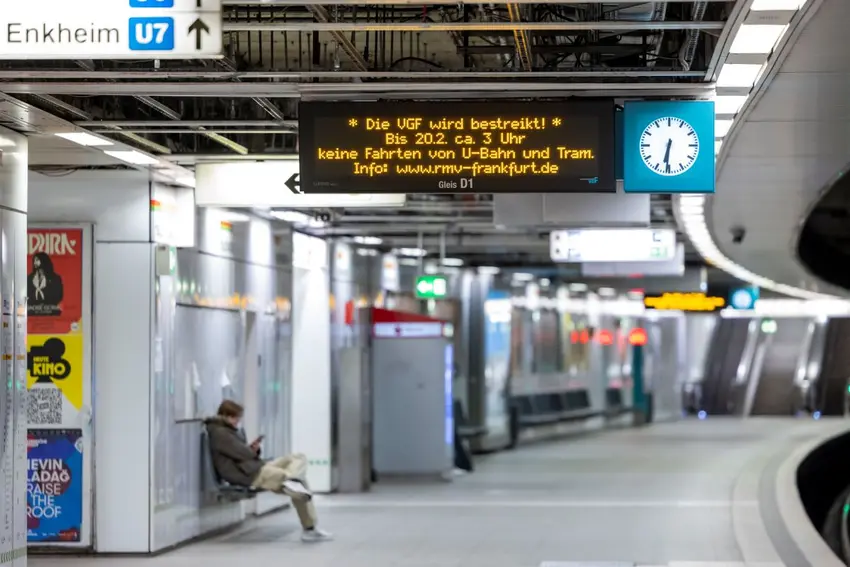
A warning strike by the Verdi trade union has brought Frankfurt’s local transport network to a halt on Thursday, leaving passengers without access to the city’s subway and tram services.
Anyone travelling around the city is being advised to look for alternatives and to allow extra time for their journeys.
No subways or trams
The strike began at the start of the early shift, when employees of the Frankfurt Transport Authority (VGF) walked off the job. As a result, all nine U‑Bahn lines and all ten tram lines are set to remain out of operation throughout the day.
The industrial action forms part of an ongoing wage dispute involving municipal transport companies and marks the third day of warning strikes in the current round of negotiations.
READ ALSO: Where strikes will hit drivers and commuters across Germany this week
Which services can you still use?
Despite the disruption, getting around Frankfurt is still possible with some forms of public transport – provided you avoid subways and trams.
According to Frankfurt’s public transport company, VGF, the following services are not affected by the strike and should continue running:
- S‑Bahn services
- Regional trains
- City buses
- Rail replacement services on the U2
- Regional and express buses
Passengers are advised to check online travel information as close to their departure time as possible.
VGF has also recommended hiding subway and tram connections in journey planners so that only services which are actually running – such as S‑Bahn trains and buses – are displayed.
Disruptions beyond Frankfurt
The Verdi union has warned of possible transport restrictions caused by strike action in the nearby cities of Giessen and Marburg, though these are expected to be less severe.
In Giessen, the local public utility company said that drivers from its transport subsidiary Mit.Bus were not called to strike, meaning regular bus services there should operate as normal.
Marburg’s municipal utilities made a similar announcement, confirming plans to run city buses as usual. But they cautioned that weather conditions, including forecast snow and ice, could still lead to cancellations or delays.
Why is the strike happening?
Verdi says the strike was triggered by developments during the third round of negotiations for local public transport workers. According to the union, employers introduced two new issues late in the talks which would result in cuts for employees.
In the state of Hesse, the dispute is focused not on pay, but on working conditions under the collective bargaining agreement. Negotiations are taking place simultaneously across Germany.
Further disruption is expected on Friday, when buses in Wiesbaden are set to be affected by strike action.
Q&A: What are the rules in Germany for being late to work due to strikes?
Commuters and school children
Employees in Germany are expected to find their way to work on time during strikes.
Similarly, children missing school days in Germany is only legally permitted in specific situations, and usually only with advanced agreement from teachers. In the case of a public transport strike, parents are generally expected to find a way to ensure their kids can get to school.
On this occasion, a number of schools in Hesse have simultaneously announced there will be no in-person classes today due to weather conditions. A list of schools which have confirmed they will remain closed is available here.
Comments