
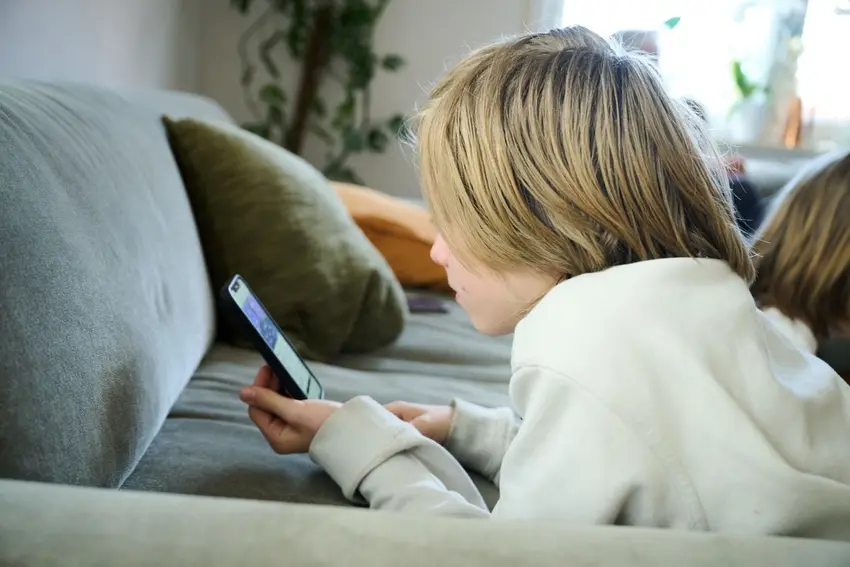
The debate about a possible ban on social media for children is gaining momentum in Germany, with a number of government leaders now actively advocating for it.
Members of the centre-left Social Democratic Party (SPD) have put together a proposal for a ban that they think would work in Germany. Meanwhile their senior partners in the government, the centre-right Christian Democratic Union (CDU), is also set to discuss the topic at its party conference. Some CDU members have already advocated publicly for similar measures.
The debate in Germany comes in the wake of lawmakers in both Spain and France having voted to approve social media bans for children. European Commission President Ursula von der Leyen has also expressed support for an EU-wide age limit for social media use.
Australia led the world in this regard, having set an age limit of 16 for social media use that took effect in December. The ban there applies to Instagram, Facebook, Threads, Snapchat, TikTok, YouTube, X, Reddit, Twitch and Kick, and the list of platforms may be amended.
What would a social media restriction look like in Germany?
So far the SPD has been the only party to put forward a concrete proposal for exactly what would be limited in Germany and how it might function.
The party's idea is that anyone who sets up a social media account in the country would first need to verify their age with a digital wallet (called Perso) that is set to launch by the beginning of 2027.
READ ALSO: What are the digital IDs you can get in Germany?
According to the SPD's proposal, children up to the age of 14 would not be allowed to create an account.
Those aged from 14 to 16 years old would be able to use social media that is available without algorithmically controlled feeds, and with "child-friendly pre-sets" that exclude endless scrolling, for example.
For everyone aged 16 and over, algorithmic functions to suggest videos or other content should be opt-in settings.
A spokesman for the Ministry of Digital Affairs told DPA that in principle, it would be possible to implement an age check with the digital wallet.
EU rules
Complicating any Germany-wide proposal is the fact that the German government would have to comply with the European Digital Services Act (DSA), which determines how platforms like YouTube, Instagram, and Tiktok should operate in the bloc.
The EU law has so far explicitly stated that providers are not obliged to process additional personal data to determine the age of users.
It is still unclear exactly what a national age limit could look like that is compatible with the previous requirements and also stands up in court.
The EU Commission would therefore prefer a European solution, but is still deliberating on the pros and cons of a ban.
Not likely to move forward until summer
While Germany's leaders seem to be leaning in favour of pushing forward with a ban, measures are not expected to be announced until summer at the earliest.
Until then, a commission of experts appointed by the federal government is to present recommendations on the topic.
A proposal for a ban would then need to be written as a draft law, approved by the Cabinet and then passed by Germany's two legislative bodies (Bundestag and Bundesrat) before it could be signed into legislation.
Headwinds and critical tones
Not all of Germany's leaders and relevant authorities think an outright ban is the right way to limit the harm done by social media use on young people.
The office of the Federal Data Protection Commissioner Louisa Specht-Riemenschneider told Handelsblatt that a blanket ban would "lump all platforms together" and impose disproportionate hurdles on smaller networks.
Leader of the SPD's youth wing, Philipp Türmer, also expressed scepticism, telling Der Spiegel: "In practice, this won't work completely as young people are smart and find ways."
He added, however, that he was "clearly in favour of consistently holding the platforms accountable".
Another aspect of the argument against a ban is that social media use can also be educational, and is inherently tied to freedom of information and expression.
READ ALSO: Where are smartphones banned in primary schools in Germany?
Why limit social media use for children?
Social media use is known to be associated with depression, addiction and other harmful outcomes, especially among adolescent users.
Current survey data from the health insurance company DAK show an increasing addictive behaviour among children and adolescents.
Last autumn, a good quarter of Germany's youth population showed risky or even addictive use of social media according to DAK.
With reporting by DPA.
Comments (1)