
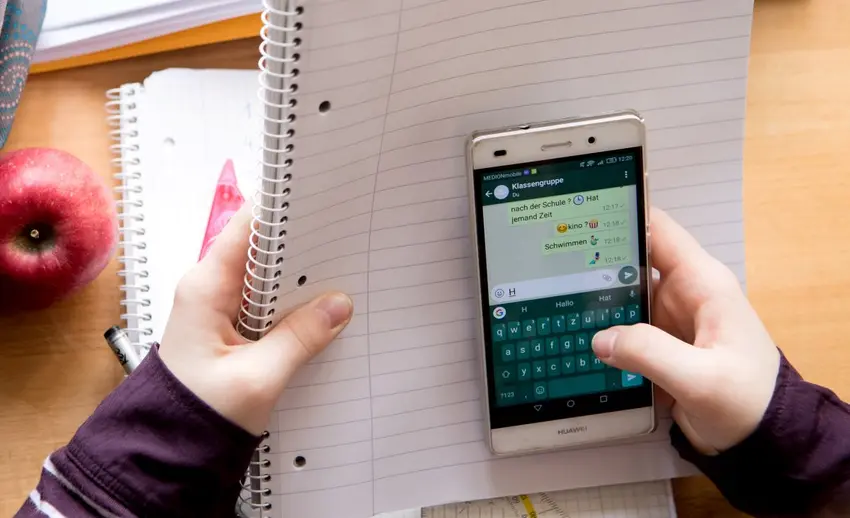
Smartphone rules in German schools have developed rapidly in recent months and years.
Saxony is the German state to have brought forward a ban on smartphones in schools most recently. Starting February 21st, a ban across all of the state's primary schools is to take effect.
In doing so Saxony joins a growing number of German states – including Hesse, Schleswig‑Holstein and Thuringia – which have also introduced their own state-wide bans or far-reaching restrictions for younger pupils.
In other regions, individual schools may choose to impose their own bans on phones during class time or even throughout the school day on campus.
Although comprehensive nationwide data is still missing, these earlier start dates provide insights into what effect the bans are having.
What are the rules on smartphones in school across Germany?
As of early 2026, there is no nationwide policy, but several states have adopted strict measures.
Bavaria has a legally regulated ban: private smartphone use is generally prohibited in primary schools and restricted in secondary schools.
Brandenburg requires primary and special school pupils to keep phones switched off during lessons.
Bremen bans mobile phone use in primary schools and applies restrictions from Year 5 upwards.
Hesse introduced one of the broadest bans at the start of the 2025/26 school year. Private use of smartphones, tablets and smartwatches is banned in all public schools, with exceptions only for emergencies, medical needs or teacher‑approved lessons.
Saarland is already implementing bans in primary schools.
Schleswig‑Holstein has banned private use in primary schools since 2023, with plans to extend this to Year 9 in the current school year.
Thuringia introduced a statewide ban in summer 2024, covering all types of schools.
Baden‑Württemberg does not have a statewide ban in place, but a new law (December 2025) requires every school to create smartphone rules by the start of the 2026/27 school year.
North Rhine‑Westphalia strongly recommends restrictions but does not impose a state-wide ban.
Lower Saxony restricts primary school use but otherwise leaves the details to individual schools.
READ ALSO: Government confirms plans to invest five billion euros in digital education
Other states including Berlin, Hamburg, Rhineland‑Palatinate, Saxony‑Anhalt and Mecklenburg‑Western Pomerania leave decisions entirely to schools.
What do people think about smartphone bans?
In states where bans are already in place, many teachers report noticeably calmer classrooms and a clearer framework for dealing with mobile devices.
In Hesse, where a comprehensive ban on the private use of smartphones, tablets and smartwatches has been in effect since the start of the 2025/26 school year, feedback from schools has been “very positive” according to the state's Ministry of Education.
The ministry’s spokesperson also said the distracting effect of smartphones in class has “come to an end”, arguing that the previous “excessive presence of cell phones” contributed to issues such as cyberbullying and mental health problems.
Teachers interviewed for Hessenschau appeared to confirm this perception, noting that lessons and breaks feel calmer without phones competing for attention.
Frank Wrabletz, principal of the Lichtberg School in Eiterfeld said he rated the introduction of the ban as “good, with a clear tendency toward very good”.
Before the statewide regulation, his school had its own rules — phones and tablets had to remain switched off in bags — but “many students continued to carry their cell phones in their pockets”, leading to repeated confiscations and disagreements with parents.
Wrabletz said the statewide ban, “has practically silenced discussions with parents”, and teachers report that phones are “hardly visible in everyday school life anymore”.
He also stressed that concentration levels have improved, describing the regulation as “well accepted and effective”.
READ ALSO: 'Weeks of wild uncertainty' - The stress of choosing the right school in Germany
Students’ views
Reactions from students are mixed. In the above mentioned Hessenschau report, state student council spokesperson Laurenz Spies argued the Hesse ban has not reduced dangerous media consumption and called instead for stronger media education.
Wiesbaden student Isabel said the ban had reduced distractions but made daily communication harder – for example, when it came to checking last‑minute timetable changes.
She also criticised teachers who continued to use their phones, saying pupils notice the double-standards.
Parents can be part of the problem
In several reports, school leaders and experts emphasised that parents played a significant role in shaping children’s digital habits – occasionally in ways that undermined school policy.
For example, one Leipzig headteacher said that parents frequently used their own smartphones inside school buildings, even as teachers tried to discourage pupils from doing so, according to a report by MDR Aktuel.
In an interview with WELT, Silke Müller – a former principal, argued that part of the wider educational crisis could be traced to the fact that families have “become quiet”, with many households characterised by family members staring at their own devices.
Müller added that schools increasingly found themselves stepping into roles traditionally fulfilled at home — not only teaching academic content, but also modelling communication, values and even basic manners.
Comments