
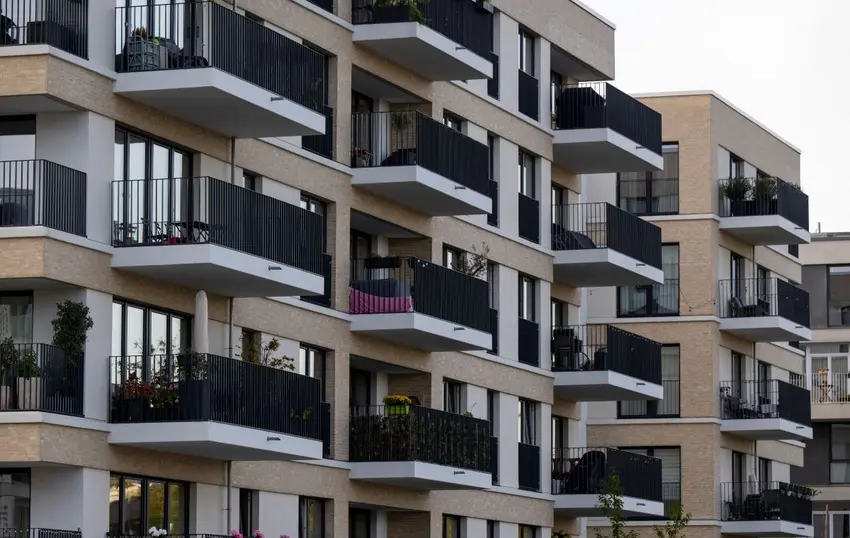
While buying an apartment in Germany has become slightly more affordable in recent months, for many – especially in the country’s largest cities – home ownership remains a distant dream, even those with above-average incomes.
For those willing to look beyond the big cities, however, there are still regions where buying an apartment is a realistic goal.
New research, published on Monday by the economic research institute IW Köln and commissioned by mortgage broker Interhyp, focuses specifically on the affordability of apartments – often the first step towards home ownership for many households.
The least affordable cities in Germany
The study reveals that, nationwide, buying an apartment has become slightly more affordable in recent months. The average burden for high earners now stands at 29 percent of disposable income – well below the 35 percent threshold which experts identify as the point at which buying becomes challenging or unaffordable.
READ ALSO: The German words you need to know when buying property
For the purposes of creating an “affordability index”, the income threshold of 35 percent is given a corresponding value of 100 points. The higher the score above 100, the more affordable it is to buy an apartment.
This autumn, the index stood at 128 points – a noticeable improvement on autumn 2023 (118) but still a far cry from a decade ago when the index peaked at 221 points.
But this improvement is not felt everywhere. In five major cities – Munich, Hamburg, Berlin, Frankfurt and Cologne – the affordability index remains below 100, meaning that even high earners struggle to buy property.
Munich stands out as the most expensive city in the country, where buyers from the top 30 percent of households must spend an average of 43 percent of their disposable net income on financing an apartment.
It’s not just Munich itself that is unaffordable; the surrounding areas, such as Miesbach, Erding and Fürstenfeldbruck are even more expensive, with buyers there spending up to 47 percent of their income.
The only place in Germany where buying is even less affordable is the district of North Frisia (including the popular islands of Sylt and Amrum), highlighting that while city prices are high, some tourist and second-home destinations can be even more expensive.
READ ALSO: REVEALED - Where buyers can find the most property for sale in Germany
Where in Germany are apartments more affordable?
Among Germany’s seven largest cities, Düsseldorf and Stuttgart are the most affordable in relation to income, with affordability index values of 118 and above. This means that buyers would have to spend just under 30 percent of their disposable net income on financing the purchase of an apartment.
The further buyers move into the countryside, the cheaper it becomes: in rural regions, an average model household spends just 26 percent of its disposable net income on paying off an apartment.
The study also found that the highest affordability can be found in districts such as Werra-Meißner (Hesse), Hof (Bavaria), Northeim and Goslar (both Lower Saxony), where the index reaches well above 200 points.
READ ALSO: How much do you need to earn to buy a home in Germany in autumn 2025?
How the affordability index works
The study’s findings are based on the Interhyp-IW Affordability Index, which systematically compares typical purchase prices, financing conditions and net household income for a representative sample household.
The calculations focus on just the top 30 percent of German households by income, as these are considered the people most likely to buy property.
Comments