
Over the past two years, Germany's once booming housing market has been in a state of decline. High interest rates have made getting on the property ladder far less affordable, and many would-be buyers have returned to the cut-throat rental market instead.
In 2025, however, noises from economists and real estate experts have become more positive. Inflation has been dropping, and interest rates are following suit.
This means prices are rising again in some areas. Speaking at presentation for investors in Berlin in January, Michael Voigtländer, a real estate specialist at the German Economics Institute (IW) declared: "2025 will be a better property year than 2024."
Explaining his view, Voigtländer pointed to sluggish construction rates and high immigration.
"The growing population and rising real wages are increasing demand, which is being met by a smaller supply due to a decline in completions," he said. "In addition, the market will become more attractive due to slightly falling interest rates."
READ ALSO: What changes for renters and homeowners in Germany in 2025
Though there's unlikely to be a huge property boom this year, experts are now forecasting an increase in prices in areas where demand is high and supply is low - in other words, in most German cities.
According to the Federal Statistics Office (Destatis), property prices rose by 0.5 percent in major cities in the last quarter of 2024, and also increased on average in all urban areas. In contrast, sparsely populated areas saw dips of around two percent.
For people looking to get on the property ladder, this creates a tricky situation. In areas where prices are going up, there also tends to be a low number of properties on the market.
Helpfully, a new analysis by real estate agents eXp Germany has tracked the regions with the most active property markets and the highest number of properties for sale. State by state, the survey tracks data from property portal ImmobilienScout24 to reveal where buyers are spoilt for choice, and where there's a dearth of options.
North Rhine-Westphalia tops this list
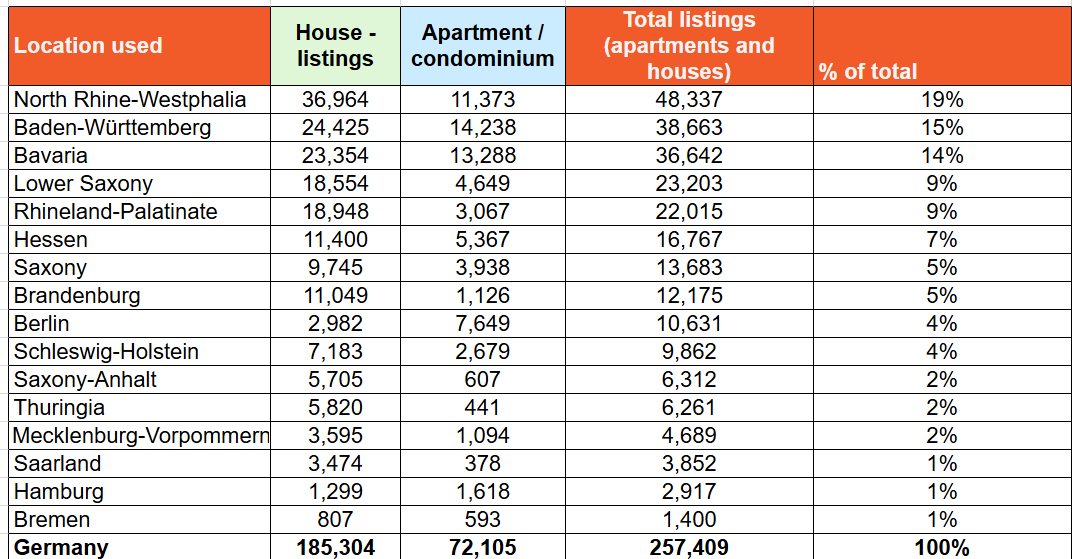
With almost 50,000 homes for sale, the western state of North Rhine-Westphalia (NRW) has by far the most properties on the market. Divided by property type, Germany's most populous state has 36,964 houses and 11,373 apartment listings at present, adding up to 48,337 properties in total.
"Almost one in five houses for sale throughout Germany is located here," eXp notes. Around 250,000 are current on sale across the country as a whole.
READ ALSO: Do rising rents make buying a home in Germany a better option?
With just over 18 million residents, North Rhine-Westphalia is known as an industrialised region that's home to a cluster of German cities like Essen, Dortmund, Düsseldorf and Gelsenkirchen, all within spitting distance of one another. In that sense, it's no wonder it punches above its weight when it comes to housing.
The southern states of Baden-Württemberg and Bavaria came second and third on the list respectively. Accounting for 15 percent of the German property market at present, Baden-Württemberg currently has 24,425 family homes and 14,238 apartments up for sale. That's a total of 38,663 listings.
Meanwhile, Bavaria has a total of 36,642 listings, comprised of 23,354 houses and 13,288 flats.
Fourth on the list was Lower Saxony, with 23,203 properties on offer, followed by Rhineland-Palatinate, with 22,015 homes on offer. Each of these states accounts for around nine percent of the current German market.
Hesse, which is home to the metropolis of Frankfurt, came sixth on the list. Here, 16,767 properties were up for sale, accounting for seven percent of the property market.
City-states have competitive markets
Exerting an irresistible pull on newcomers, Berlin is in a league of its own when it comes to property. Despite the challenges of the market, the capital saw prices for newbuild properties rise by 2.5 percent year-on-year in the final quarter of 2024, with prices for existing properties increasing by 2.1 percent.
This could have something to do with the level at which demand is currently outpacing supply. At the time of the eXp analysis, 10,631 homes were on sale in Berlin, with 2,892 houses and 7,649 flats on offer.
Interestingly, this trend held true for Germany's other two city-states: Hamburg and Bremen. In fact, both of these cities came in at the bottom of the list, with 2,917 and 1,400 properties on sale in each of the cities respectively.
Of course, both of these cities are far less populous than, say, the states of Baden-Württemberg or Bavaria. That said, it appears to hold true that supply in German cities is unable to keep up with demand.
READ ALSO: When (and how) you can back out of a property purchase in Germany
Low supply in the eastern states
Compared to the western states, the eXp research found that Germany's eastern states consistently had a lower supply of housing on offer.
Coming in at seventh place on the list, Saxony had the most choice for buyers of all the so-called 'new' German states.
In Saxony, there were 9,745 flats and 3,938 houses for sale, reaching a total of 13,683 properties - or five percent of Germany's total housing supply. Brandenburg followed with 11,049 flats and 1,126 houses, totalling 12,175 properties on offer, or around five percent of the market.
The supply drops further in Saxony-Anhalt (6,312 properties), Thuringia (6,261 properties), and Mecklenburg-Western Pomerania (4,689 properties). These states, which each account for around two percent of the German property market, came in at 11th, 12th and 13th place on the list.
READ ALSO: EXPLAINED - The hidden costs of buying a house in Germany
Though the supply of housing in these regions may seem small, it's worth noting that many former GDR states are more rural and have lower populations in general. That means that while there may not be much on the market, these states are also known for being much more affordable for buyers.
Comments