
Just four months after taking office, Merz's conservative Christian Democrats (CDU) and the centre-left Social Democrats (SPD) have been openly clashing over Merz's plans for cuts in what he says is an "unaffordable" welfare system.
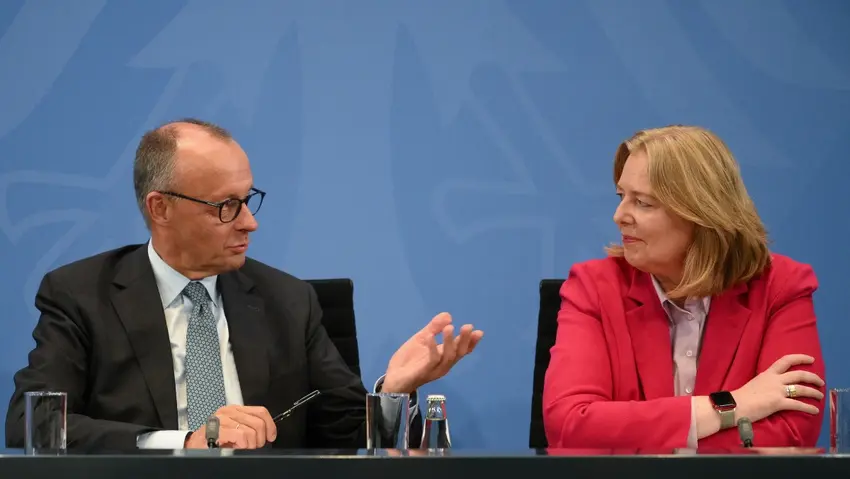
Speaking at a press conference alongside the SPD Vice Chancellor and Finance Minister Lars Klingbeil as well as SPD co-leader and Labour Minister Baerbel Bas, CDU leader Merz said both parties agreed that Germany should maintain a welfare state.
"We don't want to erase it, we don't want to abolish it," he said. "But we want to preserve the most important aspects of it and that means we need to reform it."
The coalition would likely agree on the basis of reform proposals "within the year", he added.
Bas, who days earlier said at a youth party conference that it was "bullshit" to suggest Germany could not afford its welfare state, said that she and Merz were "on the same course."
"The debate, which was a matter of public record, was about finding a position and bringing some clarity," she added.
As well as Klingbeil and Bas, Merz is meeting with Markus Soeder, head of the CSU, the CDU's Bavarian sister party.
Over the next few weeks the coalition will have to finalise the budget for this year and sign off the one for 2026, while deciding how to plug a budget gap projected to reach €30 billion in 2027.
The friction between the two parties has sparked memories of the fractious three-way coalition under previous SPD chancellor Olaf Scholz, which fell apart last year after constant internal bickering over fiscal policy.
The CDU/CSU won the resulting early general election in February but was left with only the SPD as a viable coalition partner.
The two parties have agreed on some major changes, such as amending Germany's constitution to allow massive borrowing to rebuild the armed forces and upgrade national infrastructure.
But tensions within the coalition have also caused public spats, including a row in July over what should have been the routine nomination of a new judge to Germany's highest court.
The CDU/CSU withdrew support for the SPD's nominee Frauke Brosius-Gersdorf after a right-wing media campaign accused her of being a left-wing activist on issues such as abortion.
That sparked fury in the SPD ranks, where many have also chafed against Merz's hard line on immigration and his limited enthusiasm for climate protection.
READ ALSO: 'Scarier things to come' - How foreigners view Germany's immigration crackdown
At the press conference, Merz said that he expected there to be "quick agreement" in the coalition on the next person to be put forward as a judge and a vote to take place "shortly".
Comments