
In the summer haze, last week’s latest Bundestag bombshell might well have passed you by – or
elicited a yawn: “Oh, yet another parliamentary procedural…”
Last Friday, July 11th, a vote on three replacement judges at Karlsruhe was deferred at the last minute.
Too many conservative party (CDU/CSU) members of parliament (MPs) had signalled that they wouldn’t vote for Frauke Brosius-Gersdorf, a senior professor of public law at the University of Potsdam, meaning she'd likely not get the necessary two-thirds majority to be elected.
And since not electing a candidate to the bench would have added yet another depressing first to the Bundestag’s growing list for the year - including the first ever Bundestag majority secured with the AfD, and the first ever botched vote for Chancellor - the motion was pulled indefinitely.
A cynic might say, “Well, at least they called it off. Nothing will happen until after summer.
Now, pass me my Weißweinschorle…”
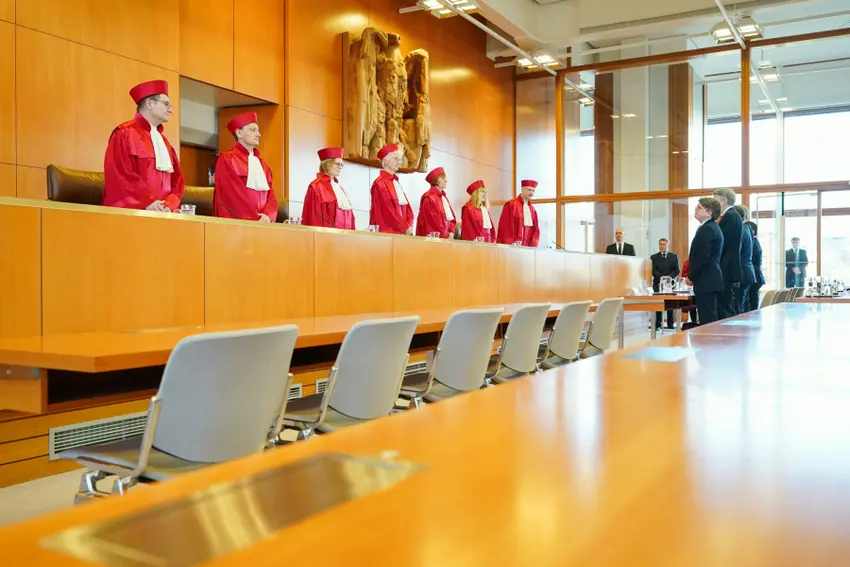
But there is good reason to sit up in your holiday Strandkorb and take note. While this may seem like bone-dry, small-print stuff, Germany's Constitutional Court (Bundesverfassungsgericht) is actually hugely important for us all.
Why is Karlsruhe so crucial?
The main reason this matters so much is that no other office or institution in Germany enjoys the same level of trust as Karlsruhe - the Constitutional Court is the one voice everyone still respects, even on the most controversial issues.
Is this piece of legislation legal? Can the government actually do that? Does a citizen have the right to act this way? These are the kinds of questions that parties, interest groups, and private persons put to Karlsruhe.
Uniquely for a high court, anyone (including you) may make a deposition to the Court, and its word is considered binding by all – even by the AfD, which regularly appeals to Karlsruhe (and sometimes wins).
Karlsruhe derives this authority from the fact that it largely transcends day to day partisan politics.
In contrast to comparable institutions elsewhere such as the US Supreme Court, its judges are rarely high-profile and do not wear party affiliations on their sleeves. Moreover, they are not nominated exclusively by whoever happens to be in power at a given moment. In fact, one of the previous Bundestag’s last acts was to adopt legal protections for the court in an explicit effort to prevent the AfD or other extremists from ever being able to stack the court with yes-men and rob it of its legitimacy (as has happened in Poland and Hungary).
Instead, Karlsruhe candidates have always been nominated by parties of government on rotation, and then voted in by a parliamentary super-majority.
READ ALSO: What protection does Germany have against future dictatorships?
What went wrong?
Requiring compromise candidates and behind-the-scenes negotiation, this system may appear somewhat opaque. Yet the overall thinking has, thus far, proved sound: although a Constitutional Court can never actually be wholly insulated from politics, it – and its prospective judges – can be protected from open political wrangling.
That’s why, until now, whenever one party proposed someone about which another had genuine qualms (e.g. the SPD’s Herta Däubler-Gmelin or the CDU’s Günther Krings), negotiations were held well before it came to a vote. As a result, Karlsruhe’s benches reflect a range of opinions and expertise – and reliably interpret the law in a way most of the country can agree with.
Worryingly, this tried-and-tested way of working has now broken down. Despite the usual consultations, the CDU/CSU failed to realise that many in their own ranks were uneasy about Brosius-Gersdorf; it then failed to alert its partner in government to the controversy; and finally, it failed to convince its own sceptical MPs that supporting her would be in the common interest. This is a clear indication of how unstable the once reliable CDU/CSU formation has become – and further proof (if any were needed) that Berlin politics is now as dysfunctional as its counterparts in Washington, London, Paris...
It would, however, be too simple to point the finger solely at parliament. Brosius-Gersdorf had also been the object of a targeted campaign discrediting her with absurd accusations ranging from supposed plagiarism (for which there is no proof) to alleged extremist opinions. (There are claims, for instance, that she thinks abortion should be legal at any point in a pregnancy; in fact, she is simply in favour of decriminalising it during the early stages.) Mud sticks.
So as the German-speaking world’s growing ranks of right-wing agitprop outlets lined up to
brand the respected legal-eagle a loony-left activist and orchestrate “Write to your MP!” drives, many CDU/CSU leaders, who otherwise would have given more thought to what’s for lunch than the vote, became reticent.
Their fears are baseless: of course Brosius-Gersdorf can be trusted to work at the Court informed, but not limited by her opinions. Moreover, Karlsruhe rulings are always made by panels, and previous judges with openly conservative stances (such as Udo di Fabio) did not lead to major changes in jurisprudence. Yet in an attempt to argue these points, Brosius-Gersdorf has taken to talk-shows, meaning that we have now been treated to another first in 2025 - a potential Karlsruhe judge getting worked up on prime-time TV.
What would damage to Karlsruhe mean?
British readers might recall the Daily Mail’s “enemies of the people” campaign against the UK’s High Court judges during the Brexit years - a worrying example of what concerted attempts to delegitimise the judiciary could bring: in the eight years between 2016 and 2024, Britain was consumed by internal strife and lost much of its international reputation for good governance.
The most frightening example of where damage to the institution of Karlsruhe may lead, however, comes in real time from across the Atlantic, where the US Supreme Court has long been a political football with openly partisan judges.
Pushed rightwards by President Trump (who has managed to appoint three of the court's nine serving judges - securing a conservative majority in his favour) the Supreme Court is now routinely ruling on challenges brought against Trump's executive overreach. Unsurprisingly, it has proven reluctant to limit him. In fact, in a landmark ruling last year the court effectively ruled that presidents have immunity from prosecution for any "official acts".
Let’s carry out a thought-experiment in which a future AfD Chancellor decides to ‘do a Donald’, making good on the remigration promise and booting out immigrants. Like the US Immigration and Customs Enforcement (ICE), the Bundespolizei would be tasked with accessing records held on foreign-born residents and arresting them to be deported. There would be challenges to Karlsruhe on the legality of all of this. How would it decide? And would everyone agree to accept its ruling?
Let’s then further imagine that, just like in Los Angeles, this drive to deport leads to civil disobedience in a major German city. The AfD Chancellor then decides to send in the military – the use of which is constitutionally prohibited inside Germany except in cases of extreme jeopardy. As in California, the German state affected would appeal to the court in an effort to get troops withdrawn. Karlsruhe would then have to rule on the constitutionality of Bundeswehr deployment – and the AfD administration, armed forces, and wider public would then have to abide by the judgement…
READ ALSO: INTERVIEW - Is Germany at risk of repeating its dark history?
Yes, if it ever comes down to it, Karlsruhe will be the last guarantor of the rule of law. Yet it will only be able to exert that function if everyone in politics and public life continues to respect it. And this respect is founded on a fragile consensus which must be continually cultivated by keeping our Constitutional Court above the fray.
As such, allowing it to become the object of needless and prolonged controversy for the rest of this summer is nothing short of political vandalism. The rot must not be allowed to set in.
In fact, in the interests of protecting Karlsruhe, maybe everyone in Germany should switch off from this sorry spectacle and enjoy a refreshing glass of Weißweinschorle. Or several.
Comments