

1,500 gather at commemoration of car-ramming in Mannheim
One week after a car drove into a crowd in the city of Mannheim, killing two people and injuring 14 others, a crowd of roughly 1,500 people gathered in the city centre to commemorate the victims.
DPA reported that attendees joined in interreligious prayers for peace and laid flowers at the scene.
"We have experienced horrific violence. It stands against everything that is sacred to us," said Protestant Dean Ralph Hartmann. He was joined by leaders from local Catholic, Jewish and Islamic faith groups, among others.
According to investigators, a 40-year-old German had raced his car at high speed hundreds of meters through Mannheim's pedestrian zone on Monday last week and deliberately hit people.
The public prosecutor's office said the suspect has still not commented on the crime and the accusations against him.
READ ALSO: What we know so far about the fatal car-ramming incident in Mannheim
Air traffic resumes as public sector strikes turn to other industries
Air traffic in Germany is starting up again on Tuesday morning following a 24-hour warning strike that saw more than 3,500 flights cancelled nationwide.
But other public sector worker strikes are starting now in local transport and daycare centres among other regional services.
Der Spiegel reported that warning strikes in public transport in Hesse are continuing on Tuesday with major transport companies in Frankfurt, Wiesbaden and Offenbach affected.
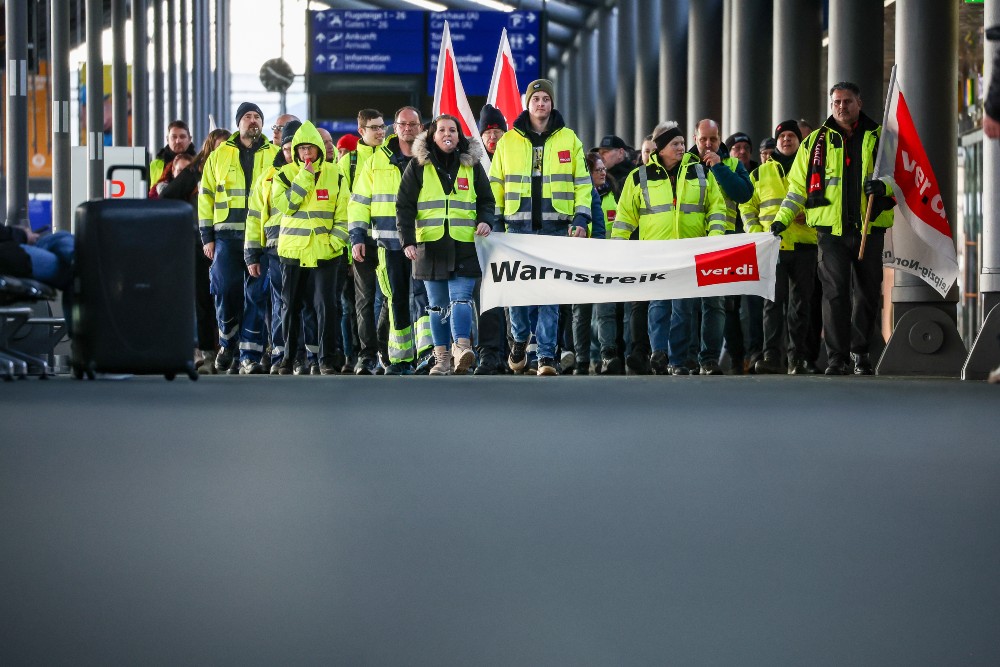
In the north-eastern state of Mecklenburg-Western Pomerania, there is a threat of work stoppages in daycare and after-school care centres.
In Rhineland-Palatinate daycare centres are also affected as well as public transport and garbage collection.
Berlin's waste removal service is also on strike this week, with garbage collection expected to be stopped from Wednesday to Friday.
Regional express train loses door mid-journey near Mannheim
Federal police on Monday were examining an incident where a regional express train lost a door during the journey between Mannheim and Heidelberg.
The SWEG train (a regional train company serving Germany's south-west) lost the door while it was passing over the Mannheim Maimarkt grounds.
On this section, trains usually travel at 160 kilometres per hour, a spokeswoman for the Federal Police told SWR.
It is still unclear exactly how fast the train was traveling during the incident. No one was injured.
Local bus and train services on the decline in major German cities
According to a survey commissioned by Greenpeace, the expansion of bus and train services is making little progress in most major German cities.
In Berlin and four other cities, local public transport has even been cut back in the past two years, according to the study, which was made available to DPA.
Only a third of the cities have expanded local transport by more than one percent since 2023.
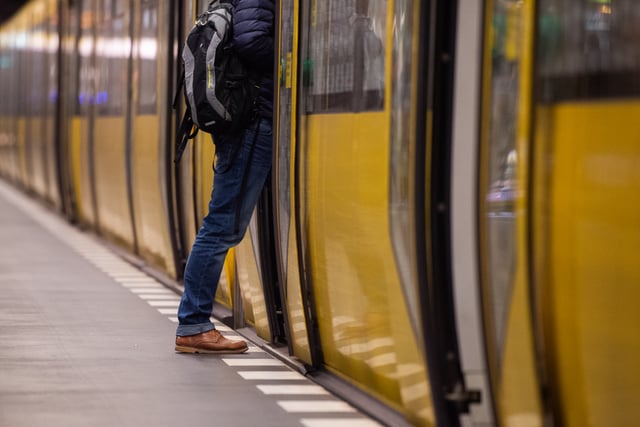
The decline was highest in the capital Berlin, which saw a reduction of 7.1 percent. But the supply also shrank significantly in Kiel (down 3.7 percent), Cologne (-3.1), Frankfurt am Main (-2.8) and Karlsruhe (-2.5).
In twelve cities, the increase or decrease was plus or minus one percent.
Cities that increased their transportation offering included Leipzig, where it increased by 14.6 percent, as well as Nuremberg (+5.4), Aachen (4.3), Münster (3.9) and Dresden (3.1).
According to Greenpeace, the most important reasons for decline and stagnation are a lack of staff and insufficient funding. In Berlin, for example, there is a shortage of bus drivers in particular.
"Public transport is the backbone of clean, climate-friendly transport, but in most cities the expansion is in the creeping lane," said Greenpeace transport expert Lena Donat. "Germany's cities need a booster for buses and trains, and the federal government must provide them with financial support."
READ ALSO: Train travel: What's the secret behind Germany's most punctual railway line?
German industrial output rises but exports fall in January
German industrial production rose slightly in January even as exports fell, official data showed Monday, a sign that Europe's biggest economy could be ready to turn the corner after a prolonged slump.
Industrial production rose two percent in January on the previous month, federal statistics agency Destatis said, with exports falling 2.5 percent over the same period.
Analysts polled by financial data firm FactSet had expected a rise of just 0.9 percent in industrial production.
The data was an indication that Germany's industrial slump was "bottoming out", ING bank analyst Carsten Brzeski told AFP.
"However, it is too early to call any substantial turnaround," Brzeski added, pointing out that industrial production was still about 10 percent below pre-Covid pandemic levels.
Production rose particularly strongly in the car, food and machine-building industries, according to Destatis.
Meanwhile, the fall in exports was driven above all by declining business with other EU member states and the US, which last year overtook China to become Germany's largest trading partner.
Exports could continue to struggle in the short term as US President Donald Trump has repeatedly threatened to slap tariffs on exports from Europe.
Ford to give struggling German subsidiary cash boost
US auto giant Ford announced plans Monday to give its German subsidiary a multi-billion-euro cash injection as it struggles amid sluggish demand for electric vehicles.
It said it will inject up to €4.4 billion into the operation to help it pay down debt while also seeking to further trim production costs.
"To be successful in Europe in the long term, we must continue to simplify our structures, reduce costs and increase efficiency," said John Lawler, Ford's vice chair.
Ford has spent $2 billion converting a Cologne plant for the production of electric cars, but sales of the vehicles (EVs) in Europe have tailed off in the face of high up-front costs and sparse charging infrastructure.
In November last year Ford announced it was cutting 4,000 jobs in Europe, mostly in Germany, saying it was seeking to ensure the company's future competitiveness on the continent.
Meanwhile German auto giant Volkswagen said Tuesday its net profit nosedived last year, as it struggled with high production costs and fierce Chinese competition.
At €12.4 billion in 2024, net profit fell 30.6 percent compared with the previous year, even as overall sales grew slightly to reach €324.7 billion.
With reporting by DPA and AFP.
Comments