
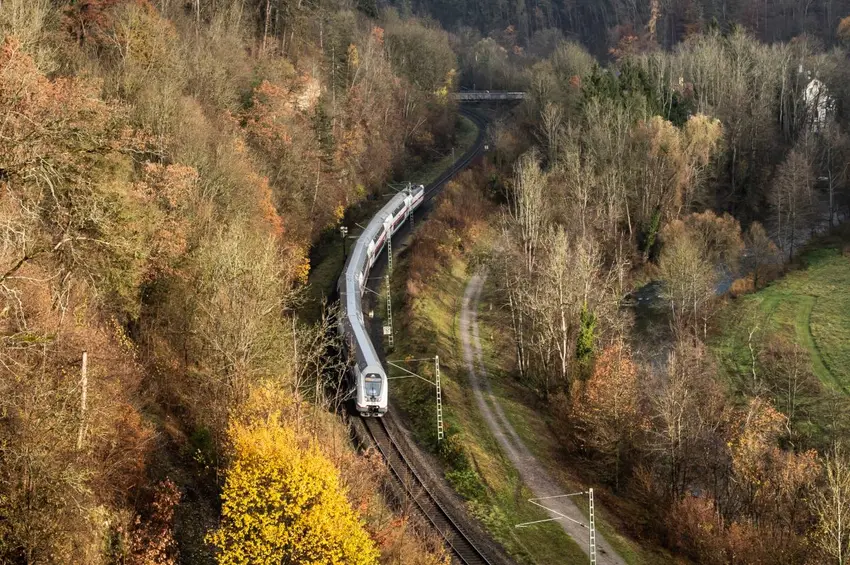
Rail passengers in Germany are used to seeing regular disruption caused by delays.
But let's give credit where it's due: one line in Germany is doing pretty well when it comes to being on time.
Line 87 - known as the 'Gäubahn' which connects Stuttgart and Zurich - is the most punctual part of the German rail network.
While an average of one in three trains in Germany is late, 81 percent of trains on this line arrive on time.
Is train punctuality in Germany really that bad?
Travelling by train in Germany is certainly getting a bad reputation. The punctuality rate for German rail operator Deutsche Bahn's long-distance services in 2024 was 62.5 percent - the lowest figure since statistics began getting recorded in 2001.
DB said train cancellations due to strikes, extreme weather events and construction all helped the network reach this historic low. A train is classed as being punctual when it is no more than six minutes late, according to Deutsche Bahn (DB).
However, figures - along with complaints from passengers - show things have been going downhill for a while.
That's why railway bosses last year vowed to take action. By 2027, DB aims for the punctuality rate to reach more than 75 percent.
READ ALSO: How Deutsche Bahn plans to make German trains more reliable
Why is this railway line an outlier?
You're probably wondering what's going on in the south west of the country. Just why are trains there so reliable?
German magazine Spiegel took a trip on an Intercity train from Stuttgart to Zurich to find out what is special about this part of the train network.
The line, which is 240 kilometres long and runs through Böblingen, Horb and Rottweil, is one of the most scenic routes in the country.
When asked what makes the line so punctual, Peter Füglistaler, former Director of the Federal Office of Transport in Switzerland, told Der Spiegel that there is "little traffic" on the rails as well as "no complex railway junctions en route". This makes for a smoother journey.
But here's the kicker: it may also be the Swiss effect. Füglistaler pointed out that "a quarter of the route runs through Switzerland".
In Switzerland, more than 90 percent of trains arrive on time, making them among the most punctual in Europe.
Füglistaler said it's mainly because of funding - four times more money per capita is invested in rail modernisation in Switzerland than in Germany.
It's no wonder that in 2023, Swiss authorities made headlines with a proposal to ban German trains on their side of the border due to their unreliability.
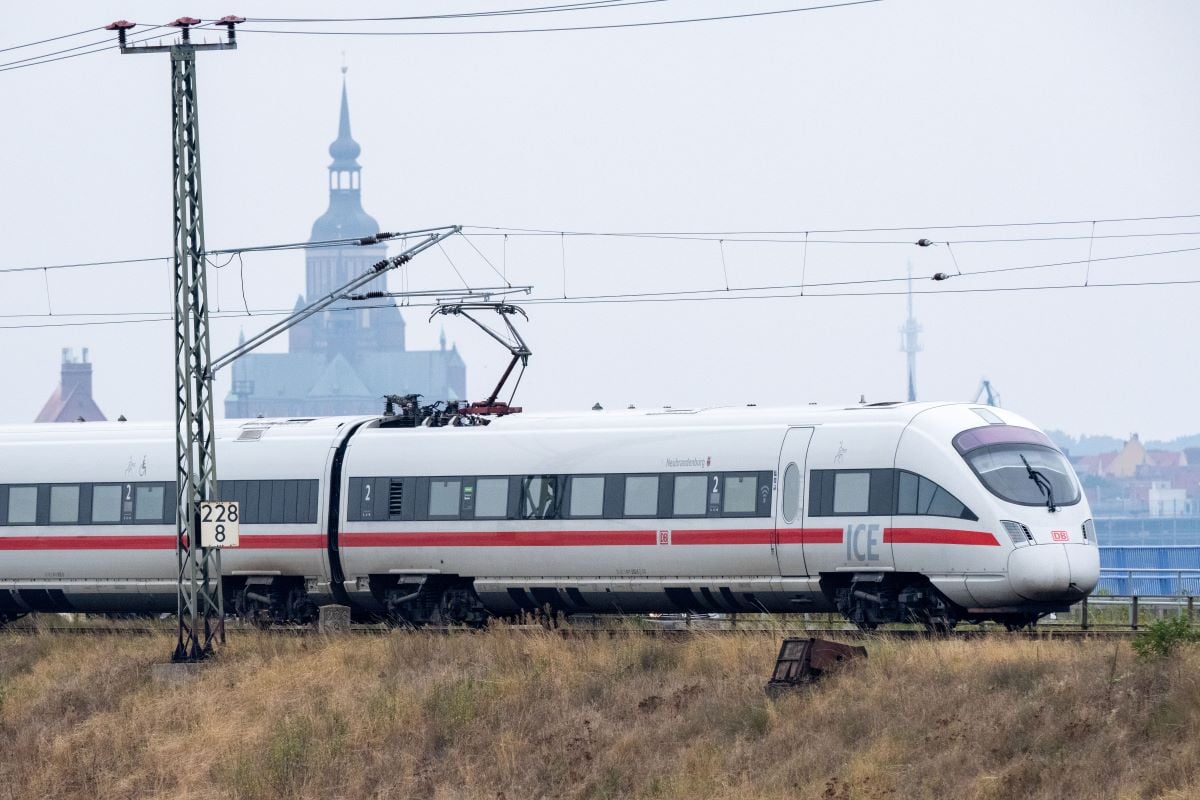
So could Germany learn from its neighbours?
In the interview, Füglistaler praised the interior of German trains, including the many power sockets for charging phones and laptops.
But he had some points on how Germany could learn from the Swiss on reliability matters. Füglistaler believes that getting to a 90 percent punctuality rate requires a lot of investment and government policies that are "100 percent" behind rail travel. He added that a "rethink" is also needed among management at Deutsche Bahn and its subsidiaries.
Füglistaler said DB had "got too bogged down" with various business projects and advises the German state-owned company to focus solely on the German rail network.
Deutsche Bahn has perhaps already taken a step in this direction. It was announced last year that the logistics subsidiary DB Schenker is being sold to the Danish logistics group DSV for €14.8 billion.
Füglistaler said it would take at least a decade before transport would run smoothly in Germany again following the planned refurbishments.
READ ALSO: 'Four-hour delays': How travelling on German trains has become a nightmare for foreigners
But the most punctual line in Germany does not have a bright future ahead - at least in the medium term.
The Stuttgart-Zurich line is to be controversially interrupted for several years ahead of Stuttgart's new main station opening (which has been pushed back to December 2026).
According to Der Spiegel, the Gäubahn cannot be routed together with S-Bahn trains towards the airport and on to the city centre. An 11 km tunnel from Böblingen to Stuttgart Airport, which will cost at least a billion euros, is set to be built to solve the problem.
As things stand, the line will face various closures in spring 2026 with the earliest completion date estimated for 2032.
Comments