
There is just over two months to go until Germans cast their votes in the ballot box to elect a new parliament.
As the official process has started, here are the steps you need to know about.
What's happening?
Scholz's 'traffic light' coalition - which formed after elections in September 2021 - collapsed on November 6th in a bitter dispute over fiscal policy between his Social Democrats (SPD) and the liberal Free Democrats (FDP), who left the alliance.
This has left the embattled SPD in a minority government with the Greens and struggling to pass legislation through the Bundestag (German parliament).
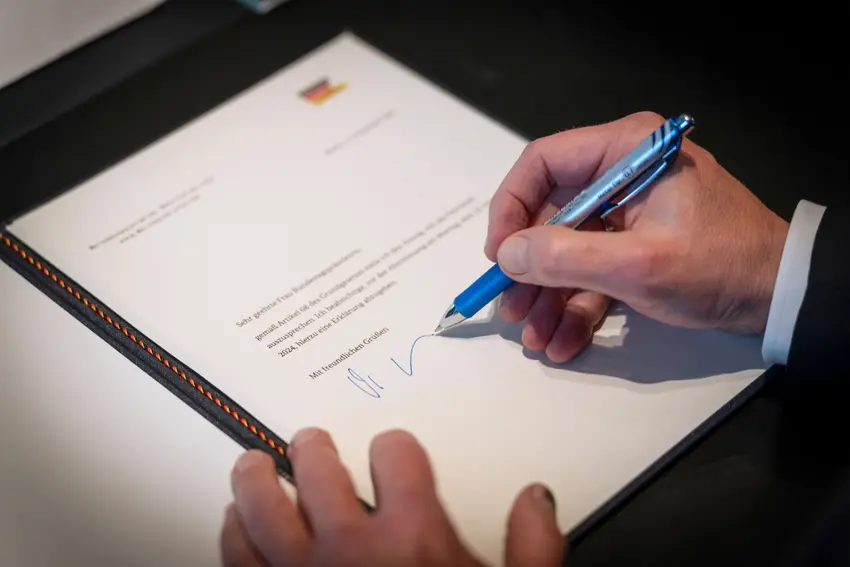
On Wednesday, Chancellor Olaf Scholz started the countdown to elections by writing a letter to request a confidence vote in the Bundestag next week, which he is expected to lose.
The formal step is designed to force the dissolution of parliament and early elections in Germany.
Scholz will face the vote of confidence in the Bundestag on Monday December 16th.
The letter contains just two sentences. It says: ‘Dear Madam President of the Bundestag, in accordance with Article 68 of the Basic Law, I request a vote of confidence in me. I intend to make a statement on this before the vote on Monday, 16 December 2024.'
It was delivered to Bundestag President Bärbel Bas (SPD).
In a brief televised statement, Scholz said he wanted "to clear the way" for the elections and stressed that until then his government and the legislature would remain "fully capable" of steering the ship of state.
During the transition period, the government is in 'caretaker mode' until a new coalition eventually takes over.
READ ALSO: How new German citizens can vote in upcoming elections
After Scholz loses this vote, Germany's President Frank-Walter Steinmeier will have 21 days to dissolve parliament, and then elections will have to be held within 60 days. Steinmeier is expected to dissolve the Bundestag on Friday December 27th.
This is expected to lead to a fresh federal election in Germany on Sunday February 23rd next year. This date has been agreed on by mainstream parties but can be subject to change. However, Steinmeier has previously said that he considers this to be a realistic goal for the date of the next election.
READ ALSO: What happens if Germany doesn't agree on a budget for 2025?
What's the current political mood?
It's dicey out there, as the country is stuck in political uncertainty and economic troubles.
The conservative opposition CDU/CSU, led by Friedrich Merz, has been consistently soaring ahead in polls. The bloc is polling at around 32 percent, followed by the far-right Alternative for Germany (AfD), which is hovering around 18 percent of the vote.
The centre-left SPD is polling at around 15 percent, and two points higher in a recent survey, but Scholz hopes to repeat his performance from 2021 elections when he made a late comeback to win the race.
The left-leaning Greens under Robert Habeck, 55, are polling at around 12 to 14 percent, making them a likely partner in the next government, even though the CSU has strongly opposed this so far.
Smaller parties include the Free Democrats (FDP) of former finance minister Christian Lindner, which has been badly bruised by revelations that its leadership had carefully plotted the break-up of the coalition.
On the far left, the Alliance Sahra Wagenknecht (BSW), with a nationalist, anti-immigration and Russia-friendly stance, will compete with Die Linke party which Wagenknecht split away from early this year.
Campaigning has already started, centred on the flagging economy, how to support Ukraine in its war with Russia and a resurgent immigration debate amid upheaval in the Middle East.
READ ALSO:
- German chancellor proposes lowering VAT ahead of snap elections
- Citizenship to Bürgergeld - the laws the CDU wants to scrap if they win power
Berlin's political crisis comes at a turbulent time after the French government of Michel Barnier was ousted in a no-confidence vote last week and as Donald Trump returns to the US presidency on January 20th.
With reporting by AFP
Comments