

Next year, British citizens will vote in a referendum on whether the country should remain a part of the European Union.
According to The Guardian, Brits abroad are so concerned over a possible ‘Brexit’, they’re getting dual citizenship throughout Europe, including in Germany.
The uncertainty of it all
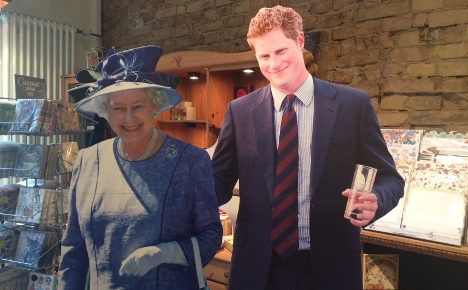
Cardboard cut-outs of the Queen and Prince Harry at Broken English shop before the Queen's visit in June. Photo: DPA
Robin Campbell is one of the over 100,000 British nationals living and working in Germany.
His wife owns Broken English, a business based in Berlin that sells British goods.
“Several of our customers have made the move and already got dual citizenship. Others talk about it too,” he told The Local.
Campbell said going back to Britain isn’t an option for some.
“Britain is no longer your home. If you go back it has changed so much that it’s like looking at a foreign land.”
Campbell isn’t too worried about his status in Germany. He’s lived in the country for over 27 years and can apply for citizenship. The minimum to apply is eight years.
Instead, it’s the 62-year-old's retirement plans that are up in the air.
He’s uncertain whether his desire to retire to Spain will even be possible with a ‘Brexit.’
“I want to make sure I have the flexibility that being a part of an EU country gives you.”
The privilege of EU membership
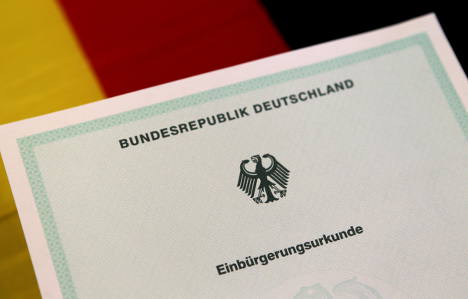
A German citizenship certificate. Photo: DPA
James Glazebrook has only lived in Germany for five years.
He told The Local via email that though he doesn’t think a ‘Brexit’ will actually happen, he is worried he’d have to leave Berlin if it does.
“We feel about as settled as it’s possible to be, without concrete roots like citizenship, children or other German family… We have a dog, a popular blog, and a business we run out of Graefekiez in Kreuzberg."
Glazebrook and his wife Zoë Noble own uberlin, a co-working rental space and photography studio.
Like many Brits abroad, particularly from London, they moved to Berlin thanks to the lower cost of living.
“We sensed we could have a better quality of life here, and more opportunities to create something without having to take massive financial risks,” he wrote.
“We’re definitely lucky that we [were] able to move here with very little in the way of money, job prospects and other reliable opportunities, and make it work. I’d hate to lose that promise, or to have to jump through hoops for it…”
If a Brexit were to happen, people like Glazebrook would likely have to apply for a residency permit, a document now issued to non-EU citizens that can also require proof of employment.
However, some speculate Britain would still be subject to some sort of preferential treatment.
“There is no definite answer right now but I believe the political ties will still stay close between the UK and the EU, that there will be a regulation that would allow a similar approach or similar opportunities or possibilities in terms of residence and free movement,” said immigration lawyer Albert Rühling.
Citizenship is more than just a practical decision
Alex Platt, 24, has lived in Germany for a little over a year. He arrived in the country as a fresh university graduate thanks to a job in the banking industry.
Though he says he might feel differently if he was more settled and lived in Germany longer, he thinks seeking German citizenship should go beyond pragmatism.
“I think it isn’t right to apply for citizenship of a place if the only reason for doing it is so I can stay living in Berlin and enjoy going to Berghain [a popular night club]. There are reasons why you become a citizen of a place. It’s not just practical… It’s important that you identify with a place.”
Time may be running out
For those deciding to apply for dual citizenship now, time may be running out.
Alexander Baron von Engelhardt, a lawyer based in Berlin, told The Local that you’re safe if you receive your dual citizenship before a possible ‘Brexit.’
“That will not be touched. But for those who just applied and have not yet received their [German citizenship] and the Brexit comes in between. That will become touchy.”
Dual citizenship might not be possible for British citizens who don’t get their applications approved in time. Unless you’re a member of the EU, to become a naturalized German, you have to renounce your old citizenship.
Von Engelhardt stresses that this, along with what would happen to other British citizens living in Germany, is all very hypothetical right now. Obviously, the referendum hasn’t happened yet. It’s also unchartered territory in Germany because, as he put it, “no one ever dreamt that the EU might fall apart.”
By Debbie Pacheco
Comments