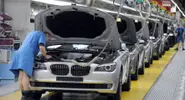
Roaring auto output pushed German industrial production higher in May by the biggest margin since August 1993, official data showed Wednesday, signalling the country's deep recession might be near an end.
Markets welcomed unexpectedly good German industrial output data on Friday after Europe's biggest economy posted a slight rise in trade, signs it was not finished with recession but was starting to see some hope.
The German industrial group Siemens on Wednesday lowered its full-year operating profit forecast by 17.5 percent even as it presented strong quarterly results.
An important economic sentiment index posted a surprising rebound on Tuesday, but Germany is still reportedly expecting the worst recession since World War II.
German industrial output fell 2.9 percent in February from January, the economy ministry said Thursday, as demand for goods from Europe's largest economy dried up amid the global recession.
As demand booms for ever dwindling stockpiles of rare metals used in high-tech appliances, industries and countries are scrambling to secure their supplies, according to German research.
A new study released on Saturday suggests that over 11 million German jobs could be moved abroad, more than twice as many as in comparable countries like Switzerland and the United States.
Steelworkers union and their employers agreed to a two percent wage increase and a €350 one-time payment for workers in a second round of negotiations in Düsseldorf late Tuesday night, according to a spokesperson for industry labour union IG Metall.
German industrial conglomerate ThyssenKrupp plans to cut another 3,000 jobs - more than previously expected, the <i>Financial Times</i> reported on Friday.
Orders for German machine tools, a key export product for Europe's biggest economy, fell by another 42 percent in January, the sector federation VDMA said on Wednesday.
The world's biggest chemicals company, BASF, saw business slide in the last quarter of 2008 due to the global economic slump and warned Thursday 2009 could be be equally grim.
The German industrialist family Schaeffler, creator of the eponymous auto parts group, collaborated with the World War II Nazi regime in Poland, according to a report in <i>Cicero</i> magazine.
The German government is set to give auto maker Opel credit to survive the global slump and financial distress at Opel's US parent, General Motors (GM), a press report said on Tuesday.
The head of German chemical giant BASF sought to prepare staff for possible job cuts stemming from the global economic crisis, in an interview to appear on Thursday.
With industrial orders in a freefall, Germany's key machinery engineering sector could shed 25,000 jobs this year, the VDMA trade association warned on Tuesday.
German industrial giant Siemens plans to confiscate stock options belonging to former boss Heinrich von Pierer who has been accused of ignoring corrupt practices at the company, a press report said on Friday.
The world’s largest steel producer ArcelorMittal is planning to lay off several hundred workers in Germany, according to financial daily <i>Handelsblatt</i> on Monday.
The global financial crisis could mean up to 215,000 lost jobs in the next year for Germany according to an industry study released by daily <i>Bild</i> on Friday.
The German metal and electronics industries averted a potentially crippling strike after agreeing to a new wage deal with trade union IG Metall on Wednesday.
The international financial crisis will now make credit conditions tougher for German companies, the head of the national industrial federation BDI said on Tuesday in a press interview.
Germany's biggest industrial trade union IG Metall started wage talks with employers Thursday seeking an eight-percent pay hike for 3.6 million workers in the metalworking and electronics industries.
Greek telephone company OTE reportedly wants a German court to force engineering giant Siemens to reveal whether it paid bribes to OTE employees to secure a $1-billion contract.