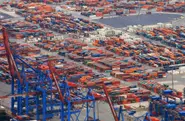
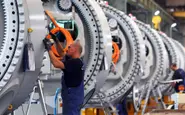
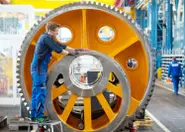
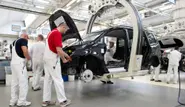
The German government is set to upgrade its growth forecast for this year as industry holds up well to the economic fallout from the coronavirus pandemic, Economy Minister Peter Altmaier said on Saturday.
German economic growth plummeted in
2019, official data is expected to show Wednesday, stoking renewed debate about how to use fiscal surpluses to boost gross domestic product.
Germany has bounced back from an early 2018 slowdown, official data showed Tuesday, as the pace of growth
accelerated despite the rumblings of a trade war that could trip up its export-led economy.
The German economy grew slower than
analysts had forecast in the first three months of 2018, federal statistics authority Destatis said Tuesday, in a result likely to stoke fears of a eurozone slowdown.
Analysts said Wednesday that Europe's largest economy Germany will likely maintain or pick up its pace of growth this year, after booking a 0.6-percent expansion between October and December.
The German economy grew 2.2 percent
in 2017, enjoying its fastest rate of expansion since 2011, official data for Europe's top economy showed on Thursday.
The German economy expanded sharply in the first three months of 2017, official data showed Friday, putting Europe's powerhouse on track to beat a late-1970s record for its longest-ever recovery.
The German economy grew by a healthy 1.9 percent in 2016, as the motor of the European economy purred along. But the areas which really boomed weren’t the expected ones.
A massive influx of refugees, and accompanying billions in public spending, have provided Germany with a long-awaited answer to partners' calls for it to do more to jumpstart the eurozone economy.
The German economy posted firm growth for the third quarter, boosted by consumer spending which is fast becoming a
cornerstone for German economic expansion, data published Tuesday showed.
German business confidence slipped fractionally from its previous high level in May, as the upturn in Europe's biggest economy continues, the Ifo economic institute said Friday.
Germany's total debt increased slightly in 2014, but because the economy grew, its proportion of overall output fell, the Bundesbank (central bank) said on Wednesday.
Germany's economy is expected to continue growing in 2015, new forecasts from the European Commission (EC) showed on Thursday, although progress is set to remain sluggish.
The German economy, Europe's biggest, shrugged off global weakness to expand by a solid 1.5 percent in 2014, and could see growth accelerate this year, analysts said on Thursday.
The German economy, Europe's biggest, will continue to show little sparkle at least until the end of the year, the central bank (Bundesbank) predicted on Monday.
UPDATE: Growth of the German economy was driven exclusively by booming domestic demand in the first quarter, while foreign trade put a brakes on activity, data showed on Friday.
German economic growth is heading for a significant slowdown in the second quarter of 2014 after a robust first three months, the German central bank said on Monday.
UPDATE: Growth of the German economy, Europe's biggest, picked up fractionally at the end of last year, propelled by buoyant exports, official data showed on Friday.
The head of Germany's biggest police union said it would be launching a “safety alliance” between different states' forces as there were parts of the country where people justifiably no longer felt safe.
Germany on Wednesday gave an upbeat forecast for its public deficit this year, with the finance ministry saying it would hit 0.2 percent of gross domestic product.