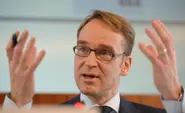
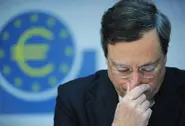
A rejection by Germany's highest court of the European Central Bank's controversial OMT bond purchase programme would have serious consequences for the eurozone, a top German ECB official warned on Monday.
Thousands of protesters rallied in central Frankfurt on Saturday to voice growing European discontent against a string of austerity measures that have been applied across the continent over the debt crisis.
More than 1,000 people took part in multiple anti-capitalist demonstrations in Frankfurt on Friday, targeting among others the European Central Bank and banking giant Deutsche Bank, organisers and police said.
The head of the German central Bundesbank Jens Weidmann said on Friday that eurozone countries should be able to default, a possibility which the EU has gone to great lengths to avoid during the current crisis.
The Bundesbank started issuing a new €5 note on Thursday which will gradually replace the bill that has been in circulation since the introduction of the single currency in 2002.
German Chancellor Angela Merkel said Thursday that her government backs a proposed European banking union but rejects for now a plan for common deposit guarantees.
German business confidence took a tumble this month, according to data Wednesday, putting speculation of a possible interest rate cut by the European Central Bank back on the table, analysts said.
The European debt crisis could take a decade to overcome, according to Bundesbank president and ECB council member Jens Weidmann, who added that the ECB could cut interest rates if new information warranted such a move.
The Frankfurt-based European Central Bank (ECB) is set to create 2,000 new jobs in the very near future as its role expands to include supervision of the EU's biggest banks, it was reported on Wednesday.
German Foreign Minister Guido Westerwelle said on Friday that Europe is "ready to help" Cyprus tackle its debt troubles - but only if the country commits to key structural reforms and an austerity budget.
As talks drag on over a proposed EU-wide bank supervisor, Europe's paymaster Germany seems to be dragging its feet as it seeks to cast the new body in its own image.
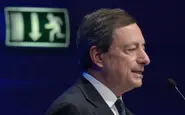
The head of the European Central Bank (ECB) launched a fierce defence of his euro-crisis strategy in front of German MPs on Wednesday, telling them the bank's bond-buying plan was neither inflationary nor covert aid to governments.
European Central Bank President Mario Draghi will hold talks with German lawmakers next month, parliament said Thursday, amid uproar over his plan to buy up the bonds of struggling eurozone countries.
German central bank chief Jens Weidmann defended his criticism of the European Central Bank's latest anti-crisis strategy after a tongue-lashing from Finance Minister Wolfgang Schäuble.
European Central Bank President Mario Draghi has offered to come to the lower house of the German parliament to explain his euro rescue plans. But MPs do not want him to speak in the chamber.
A prominent German eurosceptic Sunday filed a complaint against the European Central Bank's new bond-buying programme at the country's top court in a fresh bid to block the eurozone's rescue fund.
The European Central Bank's masterplan to help prop-up the battered eurozone countries prompted scathing criticism among German commentators Friday, who questioned the government's muted response.
Angela Merkel welcomed on Friday the conditions imposed by the European Central Bank under its new bond-buying programme aimed at solving the euro crisis, saying governments also had work to do.
A highly anticipated meeting of the European Central bank ended in disappointment on Thursday, with ECB head Mario Draghi failing to announce any concrete measures to stop the Eurzozone crisis.
The European Central Bank (ECB) could take on the key role of supervising the eurozone's strained banking system very quickly if necessary, a German financial daily reported on Tuesday.
Greece, which is teetering on the brink of bankruptcy, is "no threat to the world economy," Germany's European Central Bank executive board member Jörg Asmussen said on Monday.
Germany’s first contribution to the eurozone’s rescue fund is likely to be double the amount previously expected at €8.6 billion, daily <i>Die Welt</i> reported on Tuesday.