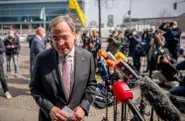
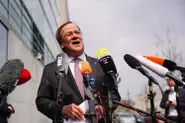
Angela Merkel's conservative party early on Tuesday firmly backed Armin Laschet to be the conservative bloc's chancellor candidate at Germany's upcoming elections, hoping to draw a line under a bitter battle with challenger Markus Söder.
The leader of Angela Merkel's party warned of a "polarising" election campaign Monday as Germany's conservatives prepared for fresh talks over the bitter battle to succeed the chancellor at upcoming elections.
Two conservative leaders locked in battle for Angela Merkel's crown failed to reach a deal by their self-imposed
deadline, pushing the chancellor's CDU-CSU alliance deeper into crisis Monday
months before elections.
Corruption allegations and a series of pandemic setbacks have plunged German Chancellor Angela Merkel's conservatives into turmoil, just days before two regional polls kick off a key election year.
Bavarian state premier Markus Söder established himself as a leader in the coronavirus crisis in Germany. Now a new poll places him as top choice to take over as chancellor after Angela Merkel.
German Chancellor Angela Merkel's centre-right CDU braces for a tumultuous two-day party congress in Leipzig from Friday,
with members smarting from recent local election drubbings and bickering over
her successor.
Despite the growing Fridays for Future climate protest movement, which calls for less plane travel, the number of flight passengers in Germany is increasing.
The CSU state group in the Bundestag is demanding a "penalty price tax" on cheap flights within Europe in order to cut carbon emissions, according to a Friday media report.
From Merkel’s successor Annegret Kramp-Karrenbauer defending her contentious carnival toilet joke to leaders attacking right-wing populism, there wasn’t a dull moment during Germany's political Ash Wednesday.
Horst Seehofer has announced he will step down as leader of the Bavarian Christian Socialists (CSU), the sister party of Angela Merkel’s Christian Democrats (CDU). It's the latest shake-up in the changing landscape of German politics.
Just over three weeks ago, the Christian Socialists (CSU) suffered major losses in the Bavarian state election. Now they've formed a new coalition, with a familiar face at the helm. Can they stay afloat?
A poll published on Friday says Germany's governing coalition parties - the CDU/CSU and SPD - would receive just 39 percent of the vote if there were Bundestag elections on Sunday, the lowest ever combined result.
The historic Bavarian election is causing ripples throughout German politics. From explaining who the Free Voters are to finding out if the AfD actually did well, we breakdown the important points.
As the state election campaign in Bavaria draws to a close, the embattled CSU and SPD are launching major rallies on Friday in a last desperate push to draw in voters.
The news that a key ally of Angela Merkel lost his post as the CDU’s parliamentary chief dropped like a political bomb in Berlin. It has sent the German media into overdrive, as they speculate what it means for the Chancellor and her party.
A poll published on Friday says Alternative for Germany (AfD) would take 18 per cent of the vote if there were Bundestag elections on Sunday, making them the the second-strongest party in the country after the Union.
Few parts of Germany conjure up as many cliches in the minds of outsiders like Bavaria. Internationally, Bavarian tradition is almost synonymous with Germany. But as the wealthy state gears up for elections, a lot is changing there.
If Germany Interior Minister Horst Seehofer had been in Chemnitz during mass protests last week, “I also would have been going onto the streets," he said in a Thursday interview.
There have been few points in the recent history of Germany when so much was at stake politically. Few claim to know whether Germany will even have a government by the end of the week. Here are the key facts in the dispute.
On Sunday the Christian Social Union (CSU) are set to meet to vote on whether to back Horst Seehofer in his plan to turn asylum seekers back at the German border. If Seehofer follows through, the move will have incalculable consequences for German politics.
Most Germans support an EU solution for dealing with asylum seekers who arrive on the continent. At the same time they back a proposal to turn people back at the German border, a survey showed on Thursday.