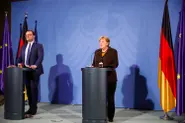
Health Minister Jens Spahn has said the priority order for the AstraZeneca vaccine will be lifted so that all adults can apply for it across the country if they want it.
Germany would support legal action against
AstraZeneca for under-delivering Covid-19 vaccine doses to the EU, but the
priority now should be on securing the jabs, Health Minister Jens Spahn said
Friday.
Denmark is to give 55,000 doses of its AstraZeneca Covid-19 vaccine to the neighbouring German state of Schleswig-Holstein after dropping the jab from its vaccination programme amid concerns about side effects.
Chancellor Angela Merkel on Friday received
the first dose of AstraZeneca's Covid-19 vaccine, more than two weeks after
German authorities recommended use of the jab only for people aged 60 and over.
People aged under 60 who have been given a first dose of the Oxford-AstraZeneca coronavirus vaccine in Germany will receive a different jab for their second dose, federal and regional health ministers agreed.
Germany's vaccine committee is standing by its recommendation to restrict the use of the AstraZeneca Covid vaccine in the under 60s, despite the European Medicines Agency calling for it to be used in all age groups.
The European Medicines Agency has come to the conclusion that the unusual blood clots suffered by numerous people around Europe should be considered as rare side effects of AstraZeneca's Covid-19 vaccine, but that overall the benefits of the jab outweigh the risk.
German President Frank-Walter Steinmeier on
Thursday received the first dose of AstraZeneca's Covid-19 vaccine, just two
days after authorities recommended use of the controversial jab only for
people aged 60 and over.
The AstraZeneca vaccine has been on a rollercoaster ride of stops and starts since its initial approval and, in view of the latest developments, it doesn’t look like that's going to change any time soon. We explain what it means for you.
Chancellor Angela Merkel has defended Germany's decision to advise against the use of AstraZeneca for under-60s in the country, saying findings could not be ignored.
Germany will deploy AstraZeneca's
coronavirus jabs for general use only for over-60 year olds, ministers decided
Tuesday, placing restrictions for younger people after several severe clotting cases.
Chancellor Angela Merkel said Friday that
she was ready to be vaccinated with AstraZeneca's coronavirus jab if offered
when it is her turn to be inoculated.
Germany will resume vaccinations with AstraZeneca's Covid-19 jabs from Friday, Health Minister Jens Spahn said, after the European regulator EMA assessed it was "safe and effective" to use.
The European Medicines Agency (EMA) concluded on Thursday that the AstraZeneca vaccine was a "safe and effective" tool in the battle against Covid-19 but its investigation could not rule out whether the jab had caused rare cases of blood clotting.
The EU's medicines regulator said Tuesday it was "firmly convinced" the benefits of AstraZeneca's vaccine outweigh potential risks, insisting there was no evidence linking it to blood clots after several nations suspended the shot over health fears. It came as Brussels sealed a deal for 10 million more Pfizer doses.
The German Health Ministry accounted on Monday that it was suspending the use of the AstraZeneca Covid-19 vaccine due to concerns about a possible link to blood clots. Here is everything we currently know about the decision and its implications.
The German government has previously said that the speed of the country’s vaccination rollout has been hampered by a lack of supply, but new figures show that many states have thousands of AstraZeneca doses that aren’t being used. We try to explain why that is.
Germany has made international headlines in recent weeks over its painfully slow rollout of Covid-19 vaccines, along with a build up of AstraZeneca doses. Here's how states plan to speed up the process.
Already facing a daunting Covid vaccination challenge, French and German authorities are fighting to convince more people that a jab from the pharma giant AstraZeneca is just as effective as others.
Communication issues and and reports that AstraZeneca is less effective than other available Covid-19 vaccines have resulted in people in Germany refusing it. What should happen to the leftover doses?