
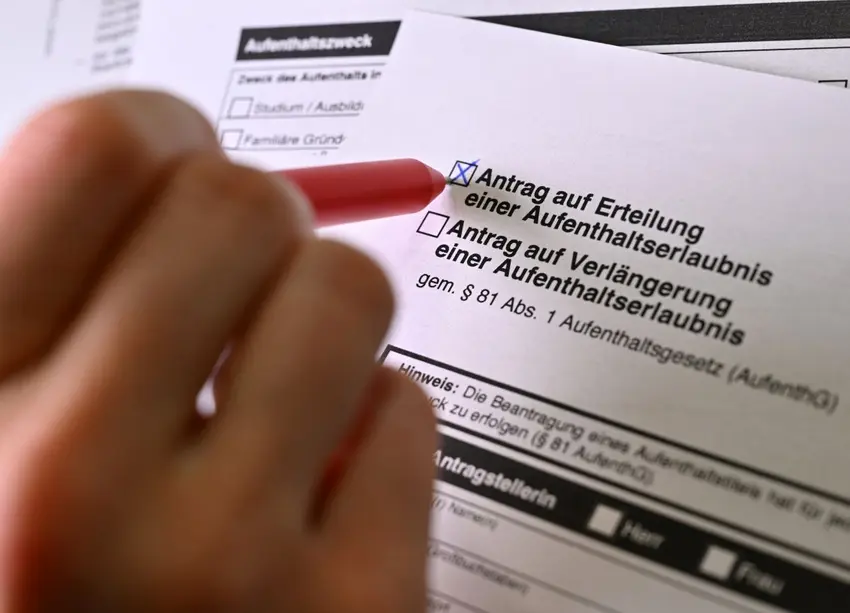
If you’ve ever applied to extend your residence permit in Germany, there’s a good chance you’ve been issued a document called a Fiktionsbescheinigung – a temporary certificate that confirms your legal right to stay in the country while your application is processed.
Originally intended to be used occasionally, as a short-term fix while paperwork was processed, these documents have now become commonplace, and their widespread use leaves some foreign residents in a kind of legal limbo that can last for months or longer.
For many, that shift is having real and lasting consequences on everything from their job prospects to their ability to travel.
The Local spoke to government officials, immigration lawyers and student representatives to better understand Germany's 'fictional certificates', what they're used for and why more and more foreigners seem to be getting them.
What is a Fiktionsbescheinigung?
A Fiktionsbescheinigung, sometimes called a Fiktion for short, or a 'temporary stay permit' in English, is a document that may be issued by Germany's immigration authorities after someone has applied to extend or change their residence permit.
The name comes from a legal concept in German law known as Fiktion, or "legal fiction". In this case, it means that the law treats your previous residence status as if it were still valid, even after its official expiry date, until a decision is made on your next residence permit application.
A BMI spokesperson told The Local that these temporary permits are “very much in the interest of the applicants” because they guarantee legal residence during processing.
READ ALSO: 'I did everything right' - Syrian student fights deportation from Germany
But that legal clarity hides a more complicated reality.
Increasingly, it appears that Fiktions are becoming more common and are often issued repeatedly.
In Berlin, for example, the State Office for Immigration (LEA) told The Local that these interim certificates account for around one in five of all residence permits issued in the city – and that this has been the case for a number of years.
Legal practitioners are also seeing more and more temporary permits handed out nationwide.
A spokesperson for Migrando, which specialises in supporting foreigners with citizenship and residence permit applications, reported having seen a "noticeable increase" in cases involving Fiktions.
What does this mean for foreign residents in Germany?
The key issue here is not so much legality, as usability. The consequences tend to appear in three areas: work, daily administration and travel.
A Fiktionsbescheinigung may preserve your rights on paper, but it lacks the formality and universal acceptance of a standard residence permit.
In fact, there isn't even a uniform format for these temporary permits across Germany: some authorities issue the permits on a small foldable green slip, others simply as a computer printout on white paper.
Employment is often the first hurdle. Johannes Glembek, Secretary-General of the Federal Association of Foreign Students (BAS), told The Local that many employers simply don't recognise the document, especially SME's which "often lack legal departments".
Similar issues arise in everyday life. Christin Schneider, Head of Content at law firm Migrando, noted that landlords and banks sometimes refused to accept the certificate as reliable proof of status.
Even automated systems can cause problems: when a residence permit expires in a database, the legal extension provided by the certificate may not be recognised.
READ ALSO: Can you go home for the holidays if you're waiting for a new German residence permit?
Travel brings the sharpest edge of this gap between law and reality. Schneider described it as "the most serious problem in practice".
Without a valid residence card – which may be unavailable or even confiscated – leaving Germany can be difficult and re-entry uncertain.
Many non-EU countries do not recognise the document at all, which means that passengers can be barred from boarding a return flight to Germany if the border staff they encounter don't recognise their temporary permit.
Are some groups more affected than others?
Students on temporary stay permits may encounter barriers to the job market, largely because employers are unfamiliar with the document.
Families can also be caught in prolonged uncertainty. Case workers at Migrando say they've seen children born in Germany repeatedly given temporary certificates due to unresolved administrative issues.
READ ALSO: Expert tips for your next appointment at a German immigration office
For those applying for citizenship, the implications can be longer-term. In most cases, a Fiktionsbescheinigung is not recognised as a valid residence title for naturalisation, potentially delaying the process.
Why has this temporary solution become so widespread?
Crucially, this situation does not arise because of individual failure. Instead, it reflects a system under pressure, where administrative capacity has struggled to keep pace with demand.
Responsibility for processing residence permits lies with local immigration authorities, not the federal government.
As the BMI pointed out, this means staffing, organisation and capacity can vary widely between regions. In many places, those systems are under strain.
Location matters a lot here. Populous cities with lots of foreign residents tend to experience longer waiting times and heavier reliance on these interim documents.
READ ALSO: 'Just useless' - Why does it take years to get an appointment with Nuremberg's immigration office?
Schneider suggests that many immigration authorities have been persistently "overburdened" since the Covid pandemic, and that the growing number of long-term residents now eligible for naturalisation has placed additional pressure on the responsible authorities.
In practice this means there are not enough appointments for the number of applicants and too few members of staff to process their applications. As a result, more and more people are being handed a Fiktion in place of a residence permit, making their stay in Germany more tenuous.
Comments (4)