
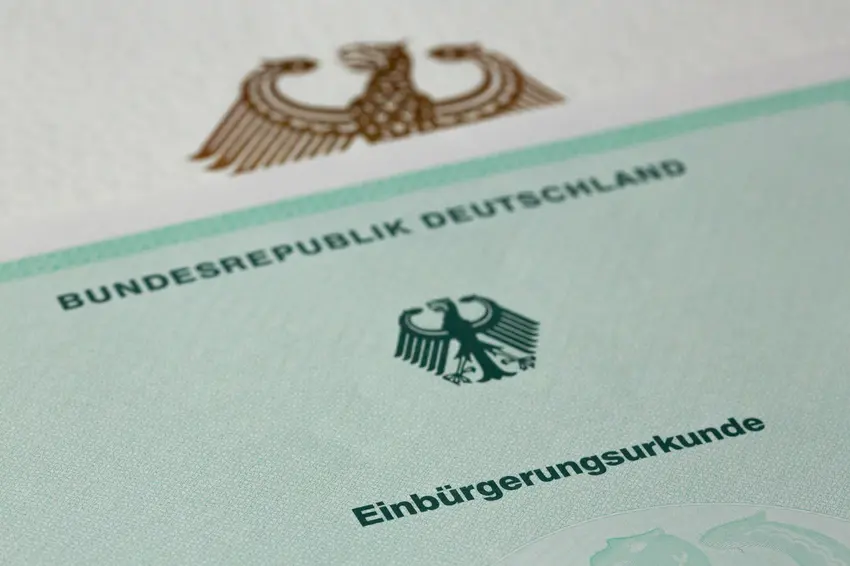
The path to naturalise as a German citizen begins with an application and ends, if all goes well, with an 'interview'.
Assuming you are qualified for German citizenship, with all of the necessary documents to prove it, eventually you should be invited by your local foreigner’s office to make a personal appearance and, hopefully, be given the piece of paper that signifies you have successfully become a citizen of the Bundesrepublik.
So what does this interview for citizenship look like, and what kinds of questions should applicants expect?
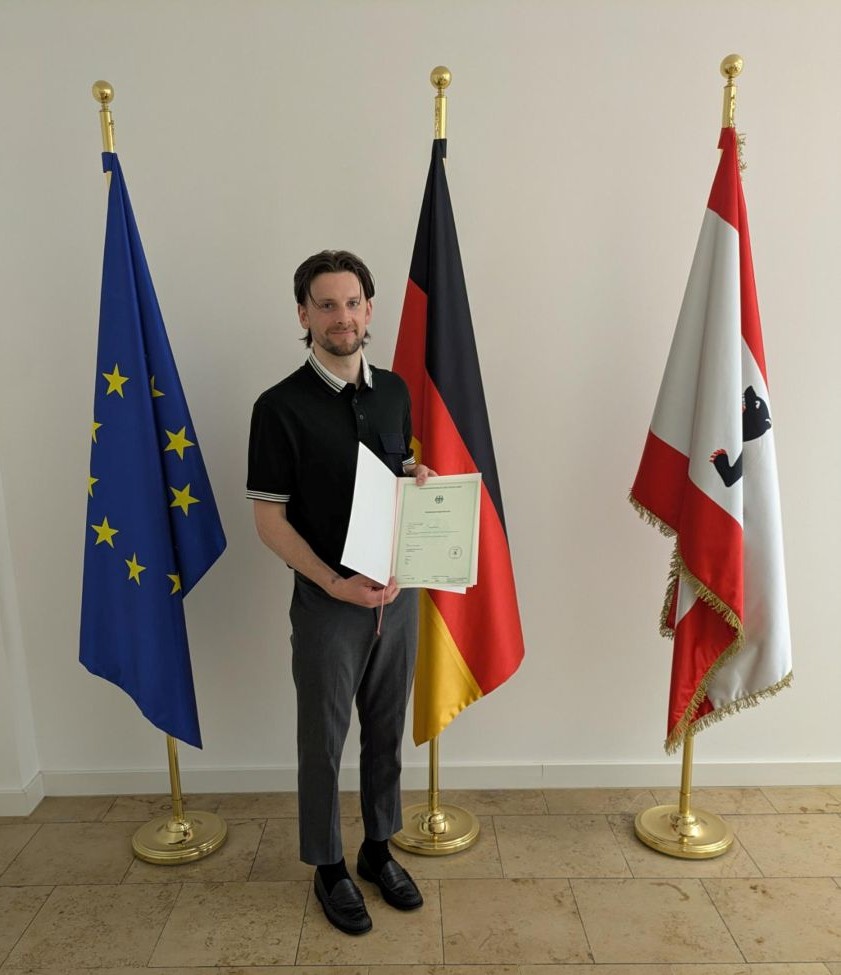
On the day that he picked up his new German passport, The Local spoke to Liam Kelly about his experience with the final naturalisation interview, and what it feels like to finally have conquered the "final boss" of German bureaucracy.
A joyous occasion
If all is good with your application for citizenship, after a number of interactions with the naturalisation authorities, you’ll get a letter inviting you to come to an appointment to swear in and pick up the document that shows you’ve successfully naturalised.
Kelly, who was born in Canada and also holds a British passport, described the atmosphere in the office where he arrived for his final appearance as being completely different from the dreary atmosphere he'd often felt in other waiting rooms at the foreigners' office (Ausländerbehörde).
"Everyone in there was super stoked," Kelly told The Local. "It seemed the only people in that office were about to get [their citizenship]."
"Everyone's kind of nervous and happy and you can tell that the people working there are clearly interacting with another level of joy too… It's almost like they want to say, like, 'Welcome to the club, brother… You’re German now, let's get some sausage together…'"
What it takes to get there
Of course Kelly and the other applicants waiting alongside him had good reason to feel celebratory. This appointment represented the culmination of a significant amount of effort and months, or even years, of waiting.
On paper Kelly was a shoe-in candidate for German citizenship: As of this year he’s lived in Germany for ten years, he’s got certified B1 level German language skills, and (until now) has maintained full-time employment as a journalist.
Still – from the day he turned in his application to the day he received his German passport – the process took one year and two months.
READ ALSO: 'Indispensable' - Experts explain how to speed up your German citizenship application
Kelly did an immense amount of research ahead of, and throughout, the naturalisation process and felt relatively confident that his application would succeed. (He cited this article in particular as being helpful for preparing his application.)
But there were still moments during the process when he found himself worrying about ‘what ifs’.
“You’ve fired this prayer into the void, and then eventually you get some notes back, some sort of minor guidance,” Kelly said. “You can’t tell if it's automated or written by a human, you know?”
“And then you get [a reply] where you can tell there's someone there… and you think, ‘I must be closer’...and then nothing.
“And then finally like this beautiful email just lands in your inbox, and it's like, ‘Are you ready to be German?’”
Cautious until the end
Around the same time that Kelly had received an invitation to his final interview for German citizenship, he also received some negative news about his employment: the publication he had been employed with was going under, and he was set to lose his job.
Being able to support yourself financially is a key aspect to qualifying for citizenship in Germany, and therefore being or becoming unemployed can disqualify candidates in some cases.
READ ALSO: 'I've always had jobs' - Woman's German citizenship bid blocked by unemployment
“[The officer] asked me, ‘Has anything changed in your life?’ and so I answered, ‘I’ve actually just lost my job’,” Kelly said.
“So I explained that my company had gone bankrupt, and she asked if I had told them about this, and I said ‘No, because technically I’m still employed by them until the 31st’.”
(Kelly’s interview took place on the 20th of the month, just 11 days ahead of the official termination date of his job.)
“And then she's like, ‘OK, whatever happens in the future, that's that, but today you're still employed?’ And I said ‘Yes’ and she said, ‘Good, because if you weren't, we would have to stop this process now’.”
The swearing-in process
Beside clarifying his major life changes, Kelly suggested that the “interview” was really more of a face-to-face checking-over of his documents, followed by a swearing-in procedure.
He said the officer asked him about which other passports he held, and explained that he could now go to a German consulate for assistance while travelling.
Lastly, he was told that joining Pro-Russian, extremist or terrorist organisations could result in his passport being revoked.
READ ALSO: How many newly naturalised Germans have their citizenship revoked each year?
The last part of the naturalisation process is a declaration, which involves signing a document of “Commitment to the free democratic basic order” (Bekenntnis zur freiheitlichen demokratischen Grundordnung).
The document outlines Germany’s legal and social system, and declares commitment to Germany’s democratic ideals, including the rejection of all forms of extremism, antisemitism and discrimination.
Kelly was also instructed to make an oath to the same effect. He described standing up, being told to put his hand on a laminated piece of paper with the declaration, and then reading it out whilst the officer held the paper up in one hand, and typed with the other.
Getting the passport
The process completed, Kelly received a paper signifying that he had become a German national.
Crucially, he was warned that the document is not a travel document and that it cannot be reproduced.
“I was told ‘keep this really safe’ because it cannot be replaced,” Kelly said.
He added that the authority collected his residence permit (Aufenthaltstitel) when he received his citizenship document. Which is why it’s generally advised that new citizens apply for their passport or new ID card immediately after receiving citizenship.
Kelly had pre-emptively made an appointment at a Bürgeramt for the occasion. But he noted there was also a sort-of mobile Bürgeramt kiosk in front of Berlin's LEA where he could have walked-in and waited to do the same.
His passport was ready for pickup six days later.
'Final boss bureaucracy'
Looking back on the entire process, he said it felt "like the final boss of German bureaucracy".
"There's so much opacity, and it's so difficult to know exactly what's happening," Kelly said. "It really feels like it's sort of out of your control...and the timeline is so long and you have no feedback...you're just sort of waiting and hoping."
"There's like Facebook groups on the topic where it gets almost spiritual, you know? There's people dropping koans, like, 'Time is a flat circle, just be patient, you'll get your answer,' and it's like...that's insane."
Now, safely on the other side, Kelly suggests the struggle made the reward all the sweeter.
"It's a total unlock," he said. "I can live anywhere in Europe, and work anywhere."
Kelly told The Local that he had celebrated his new nationality with a meal and a few beers at an old-style Kneipe. Next he's excited to vote in the next elections in Berlin in September.

Comments (5)