
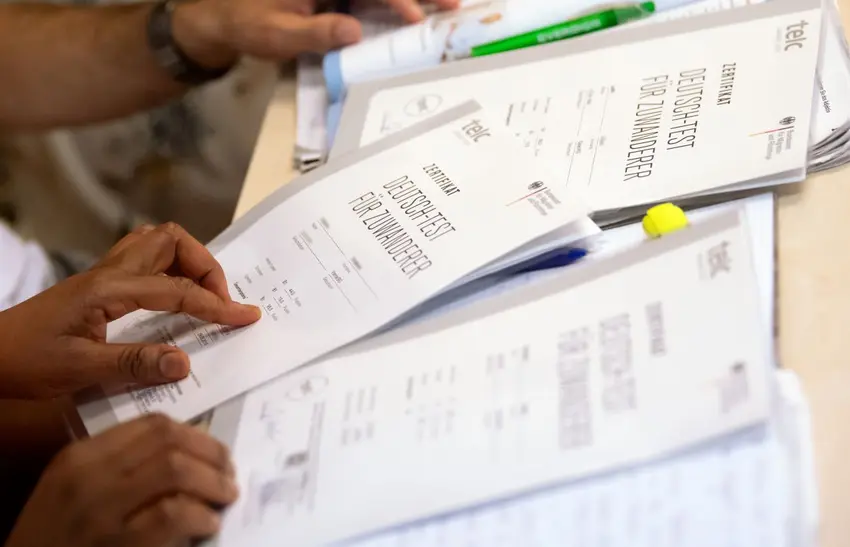
After months of controversy, Germany’s coalition government has agreed to partially reverse plans to restrict access to free integration courses.
From June 1st, some migrants who had been excluded earlier this year will once again be able to join courses at state expense.
But the system is being reshaped rather than restored. Access will now be capped through quotas, prioritised for certain groups and tied to the federal budget.
What is the new plan?
Until recently, integration courses were a reliable part of settling in Germany, offering hundreds of hours of language and orientation lessons to new arrivals from abroad.
But late last year, the Federal Ministry of the Interior, led by the conservative CSU, imposed a freeze on new admissions, citing sharply rising costs – now over €1.3 billion annually.
The move excluded many voluntary participants, who had previously made up more than half of all attendees.
This decision triggered widespread criticism from course providers, labour-market experts, politicians and media outlets like The Local, who warned it would slow integration, worsen labour shortages, and increase long-term costs.
READ ALSO: ‘Short-sighted’ - Cutting access to integration courses in Germany doesn't make sense
Reports showed the immediate impact: nearly 30,000 applications were rejected in the first weeks of 2026, and even those legally required to attend faced cancellations and delays.
After months of pressure, the government has responded with a compromise.
From June this year, some access will be restored, but under a quota system tied to the federal budget. This means places are limited and competition is likely, leaving newcomers facing longer waits, reliance on private classes and less predictable routes into work or training.
Who can benefit under the revised system
The compromise on integration courses is designed to prioritise those with “special integration needs,” but the criteria for access are now expected to be much stricter than in the past.
Who is prioritised?
Ukrainians with temporary protection: This group, many of whom arrived following the war in Ukraine, is once again eligible for state-funded integration courses. Their inclusion recognises both humanitarian needs and the scale of recent arrivals.
EU citizens important for the German labour market: Nationals from other EU countries who are considered essential for filling gaps in the German workforce are also prioritised. This reflects Germany’s ongoing need for skilled workers and the desire to integrate those likely to contribute economically.
READ ALSO: LISTED - The best free websites and apps for German language learners
Selected individual cases: Going forward, local authorities are expected to have some discretion to admit individuals who may not fit the main categories but are deemed to have special integration needs.
This could include, for example, people with particular vulnerabilities or those whose circumstances make integration especially challenging.
Who is still excluded?
Asylum seekers and people with temporary status are likely to find access to full integration courses very limited.
In many cases, they may only be offered shorter “orientation courses” (typically around 300 hours, compared to the standard 700 hours for full integration courses), which provide basic language and cultural knowledge but do not offer the same depth or long-term benefits.
And because the number of places is now tied to federal budget quotas, even those who qualify may face long waiting times, uncertainty and the possibility of being turned away if funding runs out.
Comments