
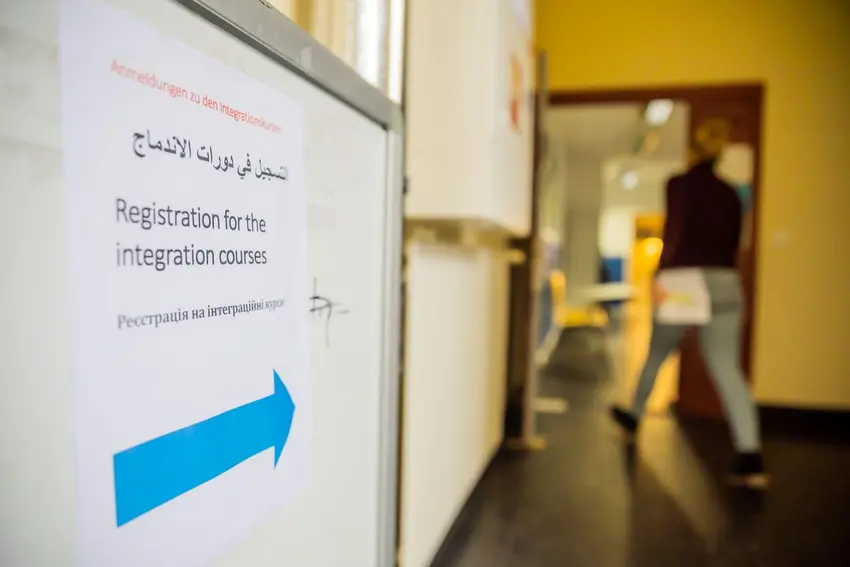
According to media reports, the Federal Office for Migration and Refugees (BAMF) quietly stopped issuing approvals for integration courses since at least the beginning of December.
While courses already underway have continued, new applicants – particularly asylum seekers, tolerated residents and Ukrainians with temporary protection – have been unable to access the lessons they rely on.
Integration courses are intended to help migrants gain the language skills and practical knowledge needed to participate fully in German society. They support newcomers seeking work, parents adjusting to daily life and refugees trying to make a home in Germany.
For many, attending such a course is not only useful but also a legal requirement under the Residence Act.
‘Not informed in advance’
The halt in approvals appears to have begun in late November, before becoming fully apparent in December. By late January, still without any explanation from the authorities, course providers issued an open letter.
“No new authorisations for integration courses have been issued nationwide since December,” the letter, dated January 22nd, said. Integration course providers added that they were “not informed of [a change in policy] in advance”.
A lecturer from the Cologne Adult Education Centre told Correctiv that scheduled courses were not being filled and had to be postponed because new authorisations were no longer being issued.
READ ALSO: EXPLAINED - Who is entitled to free language lessons in Germany?
Sascha Rex of the German Adult Education Association (DVV) told the Frankfurter Rundschau that entire courses may now be cancelled, affecting even those students who had already been granted approval.
Rex noted that people “willing to learn are forced to wait”, a situation that places additional pressure on job‑centre clients who risk missing mandatory courses because they cannot enrol in time.
There are also concerns about longer‑term consequences.
Gerd Heymann of the Institute for Languages and Communication warned that migrants risked losing “time, prospects and connections” during a period already marked by a shortage of skilled workers, while several providers spoke of growing financial strain as courses failed to start.
'Be patient'
In response to the open letter from course providers, officials have so far only said that applications are “currently being reviewed”.
At the same time, they declined to offer any information on why the review was taking place, what exactly was being assessed or when approvals might resume.
Providers were asked to “refrain from further inquiries and be patient,” according to a BAMF letter shared with the Frankfurter Rundschau.
READ ALSO: 'Catastrophic' - German state of Saxony to cut integration budget in half
The ministry responsible is headed by Interior Minister Alexander Dobrindt of the conservative Christian Social Union (CSU). His spokesperson similarly declined to provide reasons for the freeze or an estimated timeline, stating only that an “examination of applications for admission” was under way.
Criticism, however, has not been limited to course providers. Natalie Pawlik (SPD), the Federal Government Commissioner for Integration, described the halt as “irresponsible” and “sociopolitically wrong”, warning that slowing access to language and work was “fatal for the labour market”.
Comments