
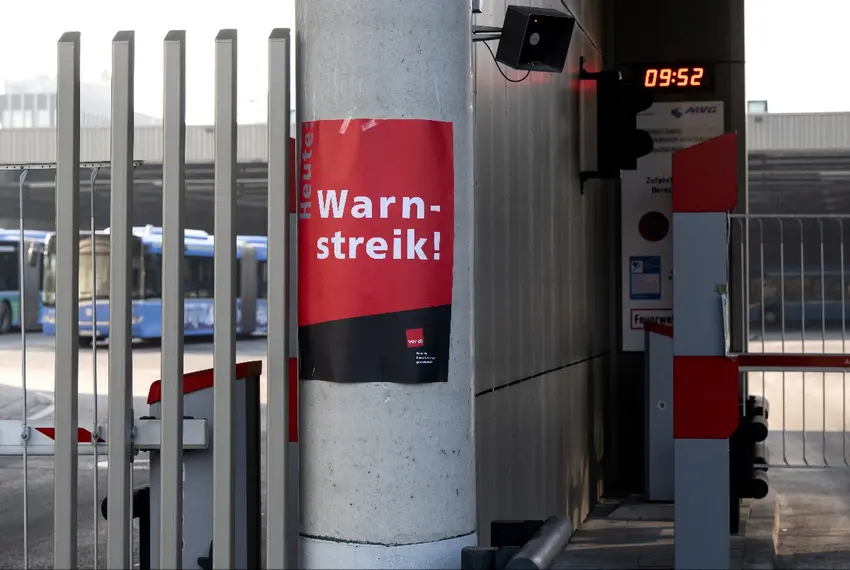
Verdi has struck agreements with public transport operators in several states including Berlin, Baden-Württemberg and Hamburg, meaning there is no longer a threat of strikes in these areas.
But people living in Augsburg, Nuremberg and Landshut in Bavaria are affected by industrial action on the transport network this week. As are those in Dresden, Meissen and parts of Saxony.
There are no transport work stoppages planned in Munich, at least this week. Verdi said it would not stage a warning strike in the city while construction work on the S-Bahn is ongoing.
However, other local authorities could face strikes later in the week, Verdi said.
Traffic at a standstill in several Bavarian cities
Bavaria's second largest city, Nuremberg, saw the employees of its local transport company, Verkehrsaktien-Gesellschaft Nürnberg (VAG), begin their latest round of strikes on Tuesday, April 7th. However, impacts were initially limited to maintenance work.
The union had pre-emptively warned that more severe impacts for passengers were expected to be felt on Wednesday, when the U-bahn, tram and bus traffic around the city would be restricted.
Excluded from the strike, both in Nuremberg and other affected cities, is the S-Bahn, which is operated by Deutsche Bahn.
Strikes also affected passengers in Landshut on Wednesday.
On Tuesday April 7th, services in Augsburg were hit. Verdi union's representative in Augsburg, Michael Maier, told local broadcaster BR24 the city had "virtually come to a standstill", with no trams and almost no buses on the roads.
Saarland: is a prolonged stoppage on the cards?
While the wave of strikes in other states has subsided, an indefinite strike by bus drivers could soon take place in the southwestern state of Saarland.
Despite new negotiation dates, Verdi intends to decide on industrial action via a ballot of its members.
Strikes in Saxony, and possible in Lower Saxony
According to Verdi, the city of Dresden and the districts of Görlitz, Bautzen, Meissen and Saxon Switzerland-Eastern Ore Mountains are affected by strikes that are set to begin on Thursday, April 9th, and last until at least Saturday, April 11th.
DVB trams, buses and ferries in Dresden, on the other hand, should continue to run regularly. However, a significant expansion of the strikes in the coming weeks is already planned.
In Lower Saxony, a no-strike clause was in force until March 31st, ruling out work stoppages.
With the end of this period, strikes are once again possible in this state, home to major cities including Hanover and Wolfsburg. The next round of negotiations takes place on April 13th.
Q&A: What are the rules in Germany for being late to work due to strikes?
What are the other options during a strike?
Deutsche Bahn is not involved in these disputes so regional and ICE trains, as well as S-Bahn networks, run as usual during industrial action. However, S-Bahn trains may be overcrowded, especially during peak commuter hours.
Other options include walking (if the distance is manageable), taking a bike, renting an e-scooter or getting a taxi or Uber.
Where have deals been reached?
In Baden-Württemberg, Brandenburg, Schleswig-Holstein, Hesse, North Rhine-Westphalia, Hamburg and Berlin, no new strikes are planned following agreements.
Negotiations are still ongoing in other states, meaning further stoppages are possible in the coming days and weeks.
The Verdi trade union is aiming to negotiate better working conditions for the nearly 100,000 local transport workers across Germany.
Demands include shorter weekly working hours and shift lengths, longer rest periods, as well as higher allowances for night and weekend work.
Comments