

A recent Insa survey for Bild am Sonntag found that 55 percent of people in Germany agreed with the statement “people can no longer afford to have children”.
This may come as a surprise to many foreign residents in the country, as Germany maintains a reputation for being an affordable country for raising kids – especially compared to countries like the US or UK.
Among those considering having kids, finances are often among the most important deciding factors. So how much should would-be parents expect to pay to raise a child in Germany?
Total monthly costs
Starting with the big picture, on average parents in Germany can expect that the total cost to raise a child up to the age of 18 will cost somewhere in the range of €150,000 to €200,000.
That’s based on figures from Germany statistics office (Destatis), which were based on voluntary income and consumption surveys.
Destatis calculated that child rearing costs for parents in Germany break down as follows:
- €679 per month for a child under six years old (totaling €48,888 over six years)
- €786 per month for a child between six and 12 years old (€56,592 over six years)
- €953 per month for a child between 12 and 18 years old (€68,616 over six years)
Altogether this amounts to approximately €174,100 over 18 years, for couples with one child - or roughly €10,000 a year.
Destatis calculated slightly lower costs for single-parent households, presumably due to lower housing and energy costs, which came to €149,100 in total.
These figures include total costs for basic expenses like food, clothing, housing and leisure activities, but they do not include additional expenses for higher education, tuition at private schools or for special medical care.
It’s also worth noting that Destatis’s latest figures on this topic are from 2018, so it can be expected that costs today have risen somewhat.
Therefore a total expenditure of around €200,000 per child in their first 18 years is probably a more accurate estimate. This would amount to about €926 per month.
‘Three-hundred a month’ plus childcare
Of course real world costs can be significantly higher or lower than averages, and the true cost to raise a child will depend hugely on a family’s personal spending decisions as well as factors like where they live.
Liam Kelley, who lives in Berlin with his wife and son, carefully tracks his household’s spending. In the first two years of his son’s life, Kelly calculated that he and his wife spent an average of €309.34 per month on child-related expenses.
“The largest expense we had was when we hired a full-time babysitter for two months,” Kelly told The Local.
Kelly works a full-time job and his wife runs a business, so they needed a babysitter for some weeks as they returned to more regular working schedules. This amounted to a hefty expense, around two-and-a-half-thousand euros.
After that, however, they were able to enrol their son in a daycare (Kita), where he is taken care of on weekdays during most of their working hours.
Parents in Berlin enjoy one of the most generous childcare systems in Germany. In the German capital children are entitled to free daycare or preschool from the age of one until they reach grade school age.
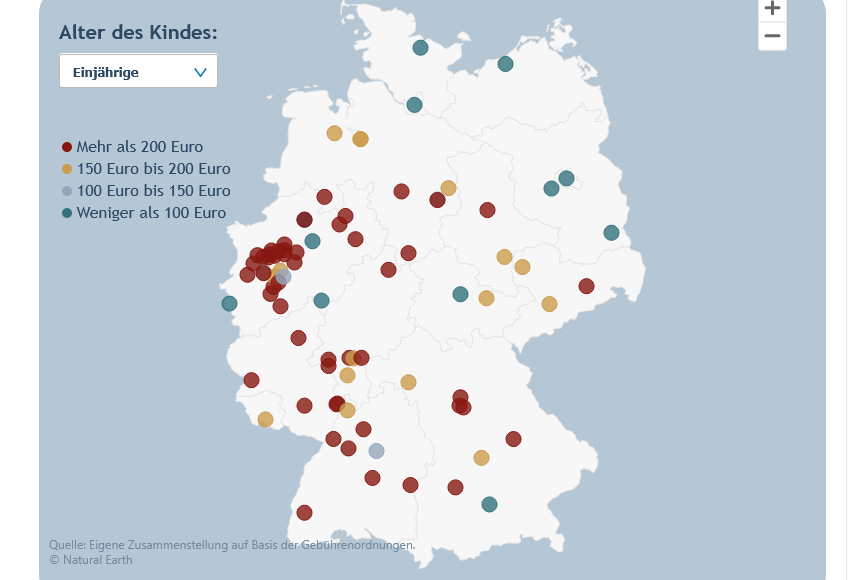
Free childcare is not guaranteed in every German state, however. Depending on where they live, parents in other German states may need to budget significantly more for childcare.
READ ALSO: What parents can expect to pay for daycare in all 16 German states
With childcare costs now taken care of, Kelly estimates their monthly spend is now closer to €120 to €150.
He added that his figures include most basic costs like baby food, diapers, medicine, a car seat, toys and the occasional activity like a trip to the museum, but not food.
“Groceries have steadily increased, but I can’t separate what part of that increase is from my child or inflation,” he said.
READ ALSO: What changes for families in Germany in 2026?
Additional surprises
Beyond the basics, parenthood comes with some additional expenses that may at first come as a surprise, and tend to increase as kids get older.
The Local reporter, Tom Pugh, has an 11-year old and a 14-year-old at home. Asked about some of the bigger costs he's noticed as his kids get older, he named school lunches and fees for schools trips.
He suggests that food is actually among the bigger monthly costs for parents of older kids in Germany. "They eat enormously at this age," said Pugh.
School trips amount to around €1000 annually for two kids, he estimated. And he added that after school activities are perhaps the next largest budget item, though he suggests they are "very reasonable" (at about €20 per month for his son's football club or €40 per month for karate).
Benefits
There's no question that these costs, altogether, add up to a significant amount of money. But in Germany parents also benefit from tax breaks and other social benefits, that can helping to reduce this financial burden significantly.
This starts even before birth, with all "medically necessary" pregnancy prep and care covered by public health insurance.
READ ALSO: What German health insurance benefits can you get during pregnancy?
Public health insurance holders in Germany typically see their children covered up until their 18th birthdays at no additional charge as well, or longer if they're still in full-time education.
Parents are also entitled to a number of monetary benefits meant to ease the financial burden of parenthood. For example, Germany's child benefit (Kindergeld) is €259 per child per month, amounting to €3,108 per year per child.
How does Germany compare?
"My feeling is that it's cheaper [in Germany] than having kids in other countries in Germany," Pugh said. "There's no need for private school. They have decent health and dental coverage [for free], they even get to travel for free on public transport in Berlin."
READ ALSO: The words you need to understand Germany’s childcare benefits
According to a report published by Wa.de, the total cost of child rearing in Germany lands in the "upper midfield" of an international comparison.
Citing statistics by various national agencies, the comparison found that the costs in Germany were significantly less than those in the US or the UK, and roughly similar to France. Costs in Germany were found to be about double those in Poland.
Comments