
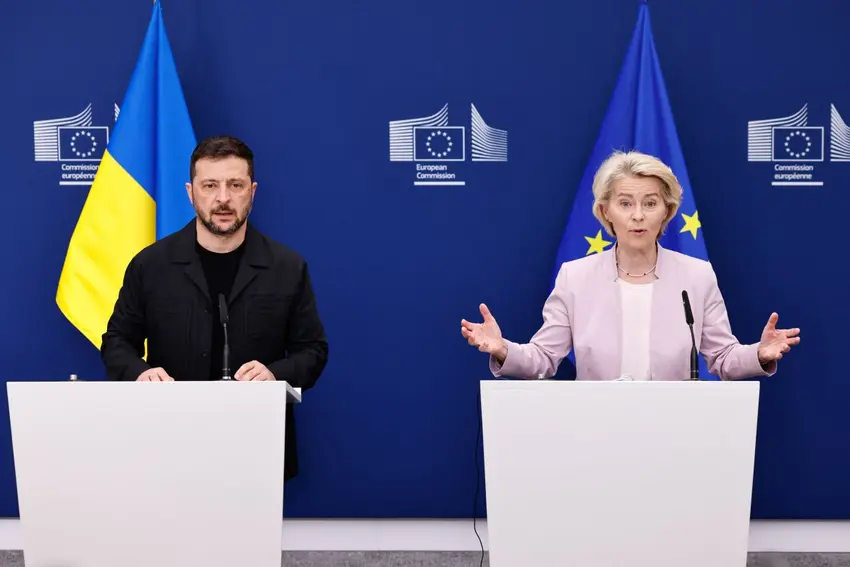
Merz to join Zelensky for Washington talks
Germany's Chancellor Friedrich Merz will travel to Washington on Monday to join Ukrainian President Volodymyr Zelensky for talks with US President Donald Trump, the German government said Sunday.
Merz will attend alongside EU Commission President Ursula von der Leyen and other European leaders, including Italian Prime Minister Giorgia Meloni and French President Emmanuel Macron, to express "interest in a swift peace agreement in Ukraine", the government said in a statement.
The meeting comes on the heels of a summit between Trump and Russia's Vladimir Putin in Alaska on Friday, which failed to yield a ceasefire breakthrough but produced promises from both leaders to provide "robust security guarantees" to Ukraine.
US President Donald Trump said reclaiming Crimea or entering NATO were off the table for Ukraine, as President Volodymyr Zelensky arrived in Washington for Monday talks aimed at ending the war with Russia.
There is concern in Europe that Washington could pressure Ukraine to accept Russia's terms.
It will be the first time Zelensky visits Washington since a bust-up with Trump and Vice President JD Vance in February when the two men berated the Ukrainian leader for being "ungrateful."
On Sunday night, after arriving in Washington, Zelensky said: "We all share a strong desire to end this war quickly and reliably."
Germany to get break from extreme heat this week
The heat that's been dominating Germany in recent days has come to an end (for now at least), according to the German Weather Service, which is predicting a sunny, but less hot, start to the week.

Monday was expected to bring more typical sunny summer weather across the country, with temperatures mostly ranging from 23 to 28C, with the Upper Rhine seeing the warmest weather with highs of 29C, DWD said.
Tuesday would be slightly warmer, around 26 – 32C, while the mercury was unlikely to hit 30C anywhere on Wednesday, according to the forecaster.
READ ALSO: Inside Germany - A shake-up at Deutsche Bahn and tips for the summer heat
Four percent of Germans eat vegetarian diet
Germany is known as a country of meat-eaters, but four percent of the population now say they are vegetarian and eat no meat or fish, the Max Rubner Institute (the government's research institute for nutrition and food) said at the weekend.
A smaller proportion – one percent – are vegan and therefore eat no eggs or dairy products, according to the data, which comes from the National Nutrition Monitoring (nemo) survey, for which more than 3,000 German citizens aged 18 to 80 were questioned about their eating habits between September and November 2024.
Two-thirds of respondents reported a mixed diet of plant-based and animal-based foods, while over a quarter described themselves as flexitarians, meaning they would eat meat no more than twice a week.

Around 80 percent of those who followed a mixed diet said they had been eating this way for at least ten years.
In contrast, only around 20 percent of vegans said they had been living without animal products for at least a decade.
When asked about how healthy their diet was, almost half of those surveyed rated their diet as very or fairly healthy.
But only 35 percent of all respondents said they ate fruit and vegetables daily. The German Nutrition Society (DGE) recommends at least five portions of fruits and vegetables daily.
READ ALSO: The foods getting more expensive in Germany this summer
Survey shows 68 percent expect AfD state premier in 2026
The far-right AfD party has continued to gain popularity in Germany, and a new survey shows that more than half of the country expects a politician from the extremist party to head up at least one of the five German states holding elections in 2026.
Forty-three percent of respondents expected an AfD minister-president in at least one state, while 25 percent anticipated there would be AfD state premiers in several states, the survey of 1,005 people by opinion research institute Insa for Bild am Sonntag showed.
However, 19 percent don't believe this will happen and 13 percent said they didn't know or didn't answer.
When asked whether the CDU/CSU should continue to rule out cooperating with the AfD, 47 percent said they should continue to rule it out, but 40 percent were against the Union parties' ban on working with them.
State elections are planned for 2026 in Baden-Württemberg, Rhineland-Palatinate, Saxony-Anhalt, Berlin, and Mecklenburg-Western Pomerania.
READ ALSO: 'Discrimination and exclusion' - AfD in Brandenburg confirmed as far-right extremist
German cities still lack dedicated bus lanes
There is still a lack of dedicated bus lanes in Germany's major cities, according to a survey by the German Environmental Aid (DUH), RND reported Sunday.
The survey showed that only five of 40 German cities have set up dedicated bus lanes on more than one percent of their road network, despite new road traffic regulations making these easy to create.
Berlin leads the way with 121 kilometres of bus lanes and a share of 2.3 percent of the total road network. Aachen and Mainz follow with 1.4 percent each, and Munich and Hamburg are close behind.
All other cities are well below one percent, according to the data with Halle (Saale), Krefeld, Magdeburg, and Oberhausen having not one single dedicated bus lane.
"Buses are only allowed free access to dedicated lanes in exceptional cases," DUH director Jürgen Resch told RND, explaining that this led to traffic jams, delayed buses, poorer air quality, and unnecessarily high CO2 emissions.
"Pop-up bus lanes have an immediate effect and are inexpensive," he added.
With reporting from AFP and DPA
Comments