
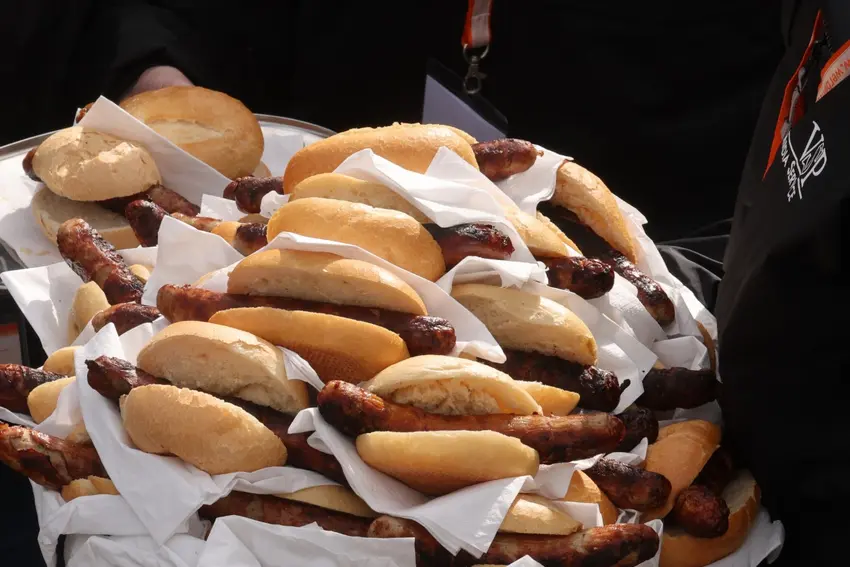
You've probably eaten it everywhere; at Christmas markets, festivals and cafes – both in Germany and abroad.
It's fair to say that the humble Bratwurst, usually served in a bun and often with mustard or covered with sauce and fried onions, is Germany's most famous snack, not to mention a cultural icon.
But now a fresh dispute has emerged over its roots. And the question is: is it a Thuringian or Bavarian invention?
The 'Wurst' origins
Until recently, the Regensburg restaurant ‘Wurstkuchl’ has boasted the title of "oldest bratwurst stand in the world".
The first documented mention of a cook preparing Bratwurst at this location dates back to 1378.
But now researchers from Erfurt claim to have found evidence of a Bratwurst stand that dates back more than 100 years earlier.
A document from 1269 mentions a hut (Hütte) and a roasting pan (Bräter) at the famous Krämerbrücke bridge, according to Martin Sladeczek, World Heritage Project Manager for the Thuringian capital, and historian Karl Heinemeyer.
The document was found by chance during research into the history of the bridge.
Experts have pointed out, however, that the document does not mention the item of food that was fried there.
But Sladeczek said: "We know what people ate in the Middle Ages: sausages and fried meat."

What does Regensburg think about it?
The city of Regensburg pointed out that the oldest documented evidence of Bratwurst dates back to 1378. They said that there's a possibility it existed before this time, and could have been eaten by workers building the bridge in Thuringia.
"After all, the many workers had to be fed," said the city spokesperson. They added: "However, there is no written or archaeological evidence for this as yet."
Meanwhile, regional German broadcasters BR24 asked staff at the Wurstkuchl restaurant to comment on the latest discovery.
"To be honest, it doesn't bother us at all," said Wurstkuchl's manager Alexandra Meier. She added that she's proud her family makes the sausages and that people come because of the quality of the products.
Meier said: "I don't think people will say, 'I'm not going there anymore because it's only the second oldest.'"
READ ALSO: Beer to Bratwurst - how stereotypes about Germany are changing over time
Thuringia vs Bavaria
There have been plenty of debates over the origins of the famous sausage over the years.
The Bavarian towns of Regensburg and Nuremberg both used to claim they had the oldest Bratwurst stand. But Regensburg was able to defend its title.
Yet, according to Thomas Mäuer from the German Bratwurst Museum in Mühlhausen, an invoice in Thuringia dating back to 1404 is actually the first evidence of a Bratwurst.
The invoice states that "1 groschen" was paid for Bratwurst casings in the city of Arnstadt.
Mäuer argues that a Nuremberg document from 1313 which, he says, describes loin meat being chopped up for sausages makes no mention of the word 'Bratwurst'.
For Mäuer, the case is straightforward: the first recorded appearance of the word Bratwurst is in the Arnstadt document.
As for the recent discovery in Erfurt, he’s sceptical.
“I think it’s very risky to conclude that Bratwurst was fried there,” he said.
Expect the debates to continue...
Comments