
What’s happened?
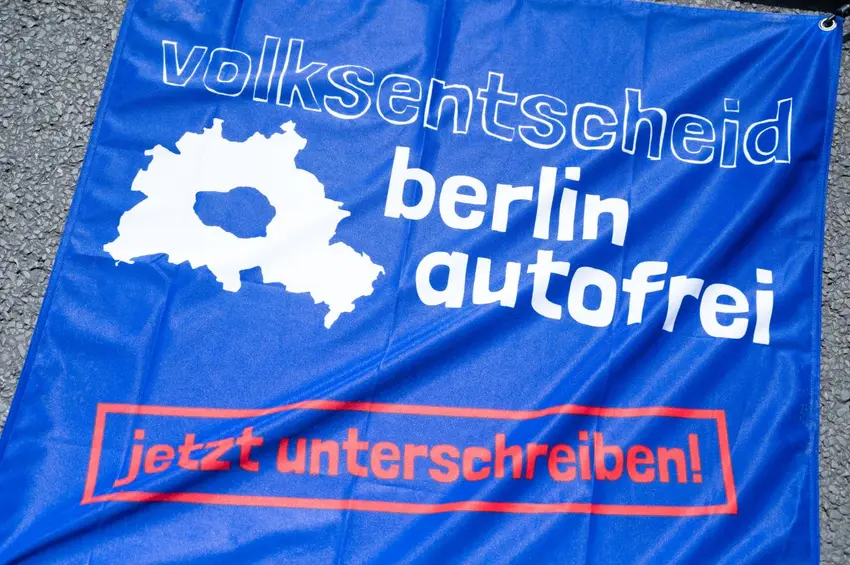
An initiative called Volksentscheid Berlin autofrei (Berlin Car-Free Referendum) has spent the last few years trying to meet the conditions for a city-wide referendum on a draft bill to dramatically reduce the number of cars in Berlin.
In the summer of 2021, the initiative collected more than 50,000 signatures for the launch of a referendum on a traffic turnaround. The initiative only needed 20,000 signatures at that point to establish the viability of a referendum.
The Berlin senate blocked the next step in the collection process from taking place, however, by claiming the draft bill ran counter to Berlin’s constitution.
Now, having spent three years debating the arguments, Berlin’s Constitutional Court has ruled that the draft bill is in fact compatible with the Berlin Constitution, the Basic Law and federal law, representing a significant step forward for the initiative.
What does the draft bill propose?
Among other things, the “Berlin law for road use based on the common good” proposes that all streets within the S-Bahn-Ring (except federal highways) become car-reduced streets, limited to walking, cycling and public transport. Private journeys will only be permitted twelve times a year per person, for example for moving house or transporting bulky goods.
This will happen after "an appropriate transition period", during which public transportation will be significantly expanded so that it can accommodate the many new passengers expected.
What is a People’s Referendum (Volksentscheid)?
Newcomers to Germany are often surprised to learn that direct democracy – where citizens directly shape laws and policies through referendums – plays a significant role in decision-making, especially at the state and local levels.
Unlike regular elections, referendums allow the public to decide on concrete questions – often initiated by citizen petitions.
READ ALSO: Why a German town has held a referendum on pigeons
The right to petition for referendums first appeared in the 1919 Weimar Constitution after World War One, as a measure designed to strengthen democracy after the collapse of the monarchy and prevent any single branch of government from becoming too dominant.
The right was excluded from Basic Law (Grundgesetz) for the Federal Republic of Germany, introduced after World War II, and then subsequently reintroduced in individual states, especially after reunification in 1990.
How do referendums work?
At the national level, referendums are only possible in two cases: adopting a new constitution or changing the borders of federal states.
The real action happens at the state and municipal levels. The exact rules and procedures vary from state to state but generally begin with a Volksinitiative - when citizens propose or “initiate” a new law or policy change, then move on to a petition (Volksbegehren), and conclude with the referendum itself (Volksentscheid) if enough signatures have been collected and the proposal is legally valid.
The topics eligible for referendums vary by state. Some states like Bavaria and Berlin allow referendums on a wide range of issues, while others are more restrictive. Nearly all are careful to exclude issues like budgets and taxes.
Within the last 30 years, People’s Referendums have brought about the abolition of Bavaria’s second legislative chamber (in 1997) and the introduction of the Berlin Mobility Act (2018), which mandated major improvements to cycling infrastructure in the capital.
Can I vote in a People’s Referendum?
Not unless you have a German passport. Eligibility rules also differ from state to state. On the whole, however, only German citizens aged above 16 or 18 who have lived in the relevant area for a minimum period can participate
What happens now with Berlin's car-free initiative?
Now that Berlin's Constitutional Court has declared the application to initiate the referendum admissible, the Initiative can begin collecting signatures.
Under Berlin's rules, signatures must be collected from at least seven percent of Berlin's eligible voters within the next four months (currently around 170,000 people).
If successful, a referendum would follow, in which the draft law would be voted on as in an election.
The referendum would be successful if a majority vote in favour of the motion and, crucially, if more than 25 percent of eligible voters in the city vote "yes".
So will Berlin become car free?
It's not likely.
While the initiative has a good chance of collecting the necessary number of signatures within the next four months, the chances of persuading enough Berliners to vote, and to vote in favour of the proposal, appear slim.
In 2023, a referendum to enshrine Berlin's climate neutrality goals in law failed because fewer than 25% of all eligible voters voted “yes", even though a majority of voters who did cast a ballot supported the proposal.
READ ALSO: EXPLAINED: Why Berlin is voting on going climate neutral by 2030
Even if Berliners turn out in favour of the proposal in sufficient numbers, the Berlin Senate would almost certainly continue trying to block it.
In 2021, Berliners voted in a high-profile referendum calling for the expropriation of large private landlords (those owning more than 3,000 apartments), aiming to bring over 240,000 homes into public ownership to address the housing crisis.
Nearly 60 percent supported the measure, but it was non-binding. The Berlin government has since established a commission to examine the legal and financial implications, and as of 2025, no expropriations have occurred. The issue remains under intense political and legal debate.
Comments