
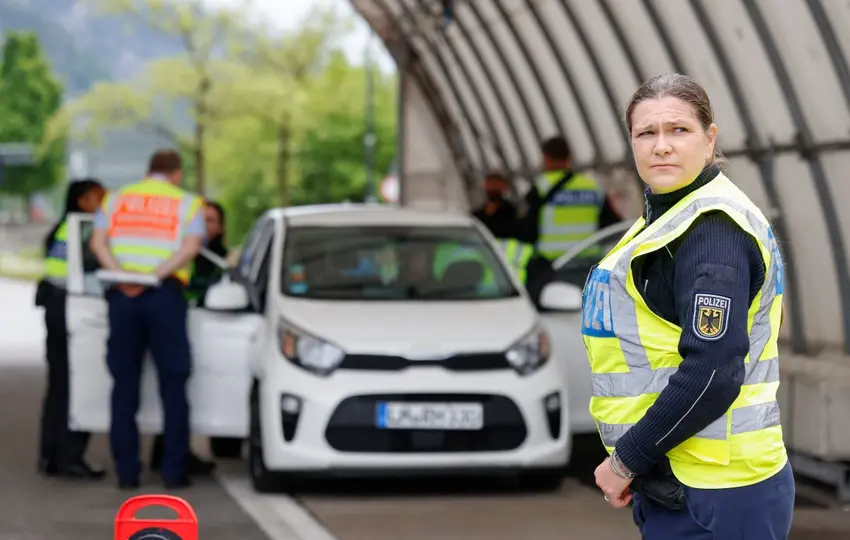
Germany has further increased the police presence at its land borders since the new government stepped into power, following campaign promises by Friedrich Merz and his conservative CDU/CSU alliance to crack down on the number of asylum seekers entering the country.
But the police union (GdP) has warned that they only have the resources to maintain the increased patrols for a few weeks, and there are concerns that Germany’s new tactics for dealing with migration could disrupt Europe’s hard-fought asylum reforms.
"One thing is clear: the police can only maintain intensive controls for a few more weeks," GdP chairman Andreas Roßkopf told the Funke media group.
He added that over 1,000 riot police had been deployed at the borders for days, but that doing so had meant that training had to be paused and attempts to reduce overtime had to be lifted.
The police chairman’s comment follows reporting by Der Spiegel at the beginning of May. The report cited a police memo expressing doubts about the capacity for maintaining border controls at the level ordered by Interior Minister Alexander Dobrindt (CSU).
Roßkopf said the police union stands behind the efforts of politicians to "reduce irregular migration to Germany, including with border controls by the federal police".
Just a few hours after taking office, Dobrindt ordered police to step up controls at the German border and reject the majority of new asylum seekers, with the exception of some vulnerable minorities such as children and pregnant woman.
READ ALSO: New border checks stir old memories on Polish-German border
How successful have the added patrols been?
Following the Interior Ministry's order, an additional 3,000 federal police officers were reportedly assigned to border zones, bringing the total number of border officials up to 14,000.
According to the minister, the number of rejections at Germany’s borders rose by almost half within a week. He cited 739 attempts to enter the country that had been blocked - an increase of 45 percent compared to the previous week.

However, looking at the number of incoming asylum applications, Der Spiegel reported that the added controls have not had a significant effect.
Europe needs coordination on migration policy
Not everyone in Germany’s new black-red coalition government agrees that policing the borders more intensely is a viable way to tackle migration.
Lars Castellucci, the interior expert for the SPD party, suggests that these tactics could undermine European cooperation on migration.
"With tightened border controls and uncoordinated rejections of asylum seekers, we are running the risk that our European neighbors will abandon the common course of asylum reform," Castellucci told the Funke newspapers.
He added that in migration efforts, Germany can "only be successful together with our neighbours".
Isn’t the Schengen zone supposed to be border-free?
Europe’s Schengen area was designed to be free of internal borders, ideally allowing EU citizens and residents freedom of movement between different nations without border checks.
But the Schengen Borders Code does allow member states to reintroduce border controls temporarily in the event of serious threats to public policy or security. The controls are supposed to be used only as a last resort and for a limited time.
READ ALSO: Can Germany turn back asylum seekers at Austria's border?
Controls at Germany's borders were brought in by the previous traffic-light coalition and extended to each of the country's nine land borders in autumn last year. At the time, the government cited concerns about irregular migration, extremism and cross-border crime.
The more recent expansion of controls, as well as Dobrindt’s orders to reject asylum seekers at the border, has been received somewhat sceptically.
Austria’s Ministry of the Interior, for example, has pushed back firmly and some European law experts have questioned the legality of the move.
Comments