
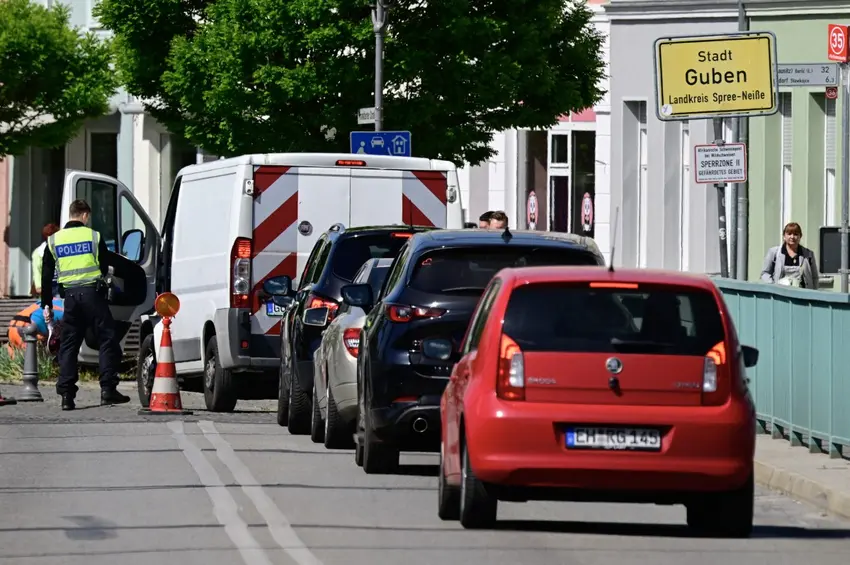
On the bridge over the Neisse river separating the small German town of Guben from its Polish counterpart Gubin, a police officer can now be found periodically raising a red-and-white stop sign and inspecting vehicles.
The checks are aimed at enforcing the new government's policy of pushing back anyone trying to enter Germany without the necessary documents, including most asylum seekers.
READ ALSO: Germany's new government orders border police to reject most asylum seekers
For Gubin resident Bartlomiej Bartczak, 47, "it brings back old memories" of when travel between the two countries was not as easy.
"Suddenly, we've gone back to that time," he said. "Now if I want to go to do some shopping in Guben I have to think about whether to take my passport. I didn't have to before."
"We went through all this when we were children, then we experienced this period with no border checks, no papers," Bartczak, mayor of Gubin until last year, told AFP.
Nevertheless, traffic over the bridge remained largely fluid on Friday afternoon, with police allowing most cars to pass while stopping larger vehicles.
Similar checks could be witnessed at several points along the border with Germany's biggest eastern neighbour.
'Important to act'
Even though Merz's government was at pains to say the new checks would not be an inconvenience to its neighbours, Poland was quick to express its irritation, urging Berlin to instead "concentrate on the EU's external borders".
Nevertheless, 64-year-old Fred Mahro, the mayor of Guben on the German side, said "it was important to act" on the immigration issue.
Mahro, who hails from Merz's conservative CDU party, said he hoped the new measures would "stay in place until the EU's external borders are secured".
Even though many Polish workers cross every day to their jobs in Germany, Mahro does not anticipate much disruption.
"The police are so experienced that they can tell from the number plate whether they need to carry out a check," he said.
Merz, who took office this week at the head of a coalition with the centre-left Social Democrats (SPD), made a crackdown on immigration a central part of his campaign in February's general election.
Germany was shaken in the months leading up to the vote by a string of violent attacks blamed on foreign-born suspects.
Merz views a tougher immigration policy as an integral part of stemming the rise of the far-right Alternative for Germany (AfD), which scored its best-ever result of over 20 percent in February's vote.
Since then it has continued to climb in opinion polls, running neck-and-neck with Merz's CDU/CSU alliance and occasionally overtaking it.
Economic fears
Guben and Gubin, which have around 15,000 inhabitants each, used to be a single town but were divided by the German-Polish border put in place along the Neisse river after World War II.
After Poland's entry into the Schengen open-borders zone in December 2007, the checks disappeared.
But in recent years the principle of a borderless Europe has come under strain, with controls being re-established during the Covid-19 pandemic to prevent infection, and also being used by governments to combat irregular migration.
The previous German government of SPD Chancellor Olaf Scholz already provoked the ire of Germany's neighbours last year with a temporary re-introduction of some border checks to limit flows of undocumented migrants.
Bartczak remembers accompanying a delegation of Chinese investors thinking of building a factory in the region and being caught in a traffic jam caused by the checks.
He frets about the possible economic impact of the new border measures but sees a need for a "balance" between "free movement... and protection".
More than a million migrants, the bulk of them Syrians and Afghans fleeing war, arrived in Germany during the crisis of 2015-16.
However the number of asylum applications has fallen sharply from its peak of almost 900,000 in 2015.
Last year the figure stood at 250,945, a drop of 28.7 percent compared with the previous year.
Comments