

Deutsche Bank to cut 2,000 jobs: CEO
Germany's biggest lender Deutsche Bank said Wednesday it planned to cut 2,000 jobs this year in its retail banking division due to falling profits.
"Where we have to turn around the ship from a profitability point of view is clearly in the retail personal bank in Germany," the group's chief executive Christian Sewing told a conference in London.
"We will take out almost another 2,000 people in the personal bank this year" in Deutsche Bank and its subsidiary Postbank, he added.
He said the move is "already provisioned in terms of restructuring costs" in the company's 2024 books, "but is executed now".
Deutsche Bank laid off 3,500 support staff last year to lower costs. It employs 90,000 people around the world.
It announced in September that it would close 50 of its 400 Deutsche Bank local branches this year and more than 200 in Postbank.
Unemployment is slowly rising in Germany as firms cut jobs
Unemployment in Germany is rising as numerous large firms continue to announce job cuts.
A survey by the Cologne Institute for Economic Research (IW Köln) shows that only 17 percent of German companies are hiring more employees this year, while 38 percent want to reduce employment.
The outlook is particularly poor in the industrial sector: Here, 44 percent of the companies surveyed want to cut jobs, while only 14 percent are planning to hire new employees.
"Germany is in a stubborn economic downturn, and this is now also having an impact on the labor market. Unemployment is rising for the third year in a row.," Enzo Weber, a researcher at the Institute for Employment Research in Nuremberg, told Tagesschau.
READ ALSO: Is Germany really on course to cut 140,000 auto industry jobs in a decade?
However jobs are being added in the service sector.
Lufthansa, for example, has just announced more than 10,000 service jobs to be added worldwide, with more than half of those new hires to be made in Germany.
Environmental group sue five companies for deceptive advertising
German Environmental Aid (DUH) is taking five well-known companies to court, accusing them of greenwashing.
The companies Coty, L'Oréal, Deichmann, Tchibo and Toom are being sued, the environmental association told the DPA.
The injunction actions was filed earlier this week with the respective competent regional courts in Darmstadt, Düsseldorf, Bochum, Hamburg and Cologne.
For example, DUH accuses the US cosmetics company Coty, based in Darmstadt, Germany, of advertising sunscreen as "ocean friendly" without explaining what exactly that means. Tchibo and Deichmann have also described their shoes and clothing as "sustainable" without giving any further reasons.

As part of the Unfair Commercial Practices Directive, companies are not allowed to market their products as sustainable or environmentally positive without backing up such claims with solid evidence. They are also not allowed to use intentionally vague terms that can't be determined.
Since December 2024, the DUH says it has initiated 19 proceedings for possibly unjustified advertising with environmental benefits - including the five new cases. In total, the association has obtained cease-and-desist declarations against companies in 64 cases due to misleading advertising with climate or environmental benefits.
READ ALSO: Wasserwende - Germany urges more people to drink tap water to protect environment
German FM rejects 'any permanent occupation' by Israel on Lebanon visit
Top German diplomat Annalena Baerbock, on a visit to Beirut on Wednesday, said her government rejected "any permanent occupation" of Lebanese territory by Israel, whose troops remain in the country's south despite a November truce.
The November 27 ceasefire agreement ended a war between Israel and Lebanese militant group Hezbollah, but Israel has since continued to carry out strikes and maintained a military presence in five locations in southern Lebanon, near the border.
"As Europeans, we reject any permanent occupation of Lebanese territory by Israeli troops, because Hezbollah will only use this as a further excuse for terrorist activities and its so-called 'resistance'," the German foreign minister said.
Baerbock met with Lebanese President Joseph Aoun, who according to a statement said that Israel's "continued occupation" of areas of southern Lebanon "runs counter to the agreement of last November".
He also said the Israeli presence "hinders the implementation of (UN Security Council) Resolution 1701", which ended a 2006 war between Israel and Hezbollah and served as the foundation for the November truce.
"Israel has refused all Lebanese proposals to evacuate the five hills still occupied" by its troops and "to replace them with international forces", Aoun told Baerbock according to the presidency's statement.
Peruvian farmer's case against German energy giant RWE faces setback
The judge in the symbolic case of a Peruvian farmer suing a German energy giant for "climate justice" said Wednesday that he sees "no present danger" to the farmer's property, casting doubt on the success of the lawsuit.
Saul Luciano Lliuya, 44, argues that German electricity producer RWE -- one of the world's top emitters of carbon dioxide -- must pay towards the cost of protecting his hometown, Huaraz, from a swollen glacier lake that is at risk of overflowing from melting snow and ice.
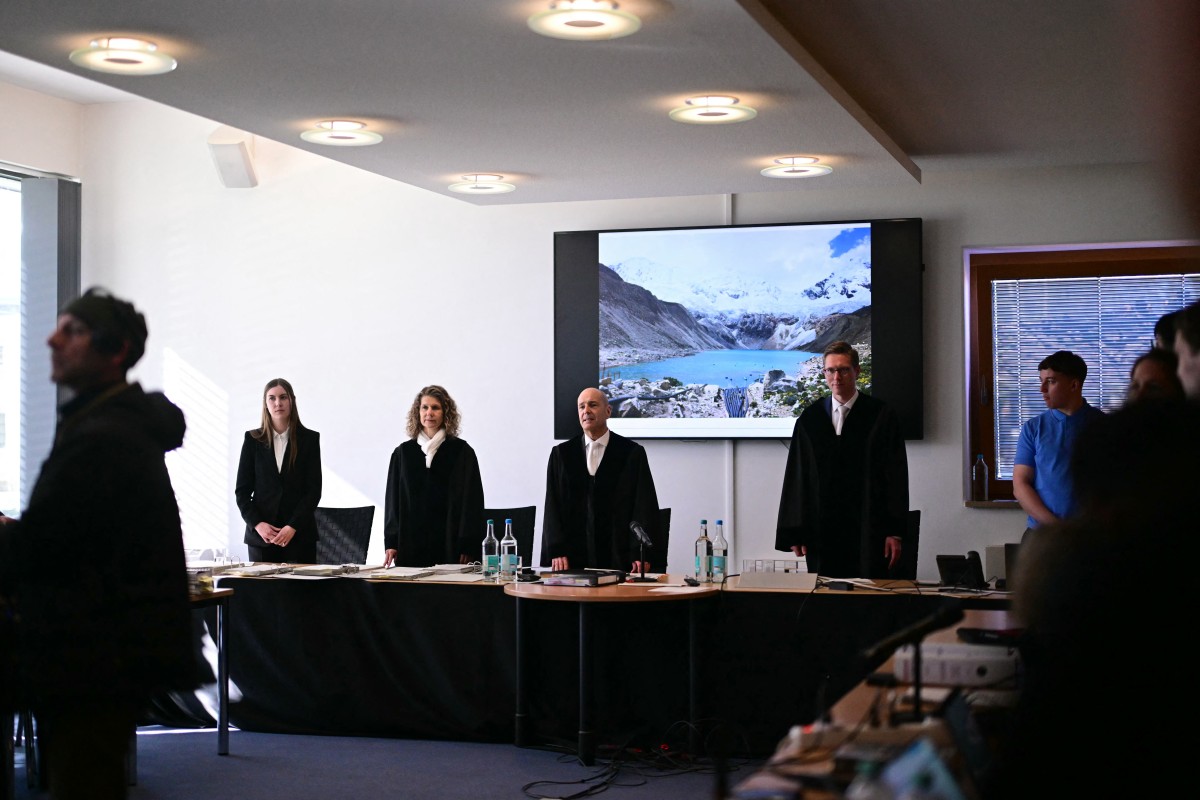
According to German civil law, he first has to persuade the court that his property is at substantial risk of damage before the court could turn to the question of RWE's responsibility.
But on Wednesday, court-appointed expert Rolf Katzenbach put the probability of the lake flooding at some time in the next 30 years at about one percent, having earlier put it at three percent.
That prompted the presiding judge in the case, Rolf Meyer, to say that any danger to the plaintiff's property would need to be "tangible" and "comprehensible" for the case to succeed, adding that he saw "no present danger" for the moment.
Lukas Arenson, an expert called for Lliuya, said Katzenbach's estimates relied too much on historical trends and did not adequately factor in the effects of future climate change.
The court's ruling on whether the flood risk is concrete is expected on April 14th.
With reporting by AFP and DPA.
Comments