
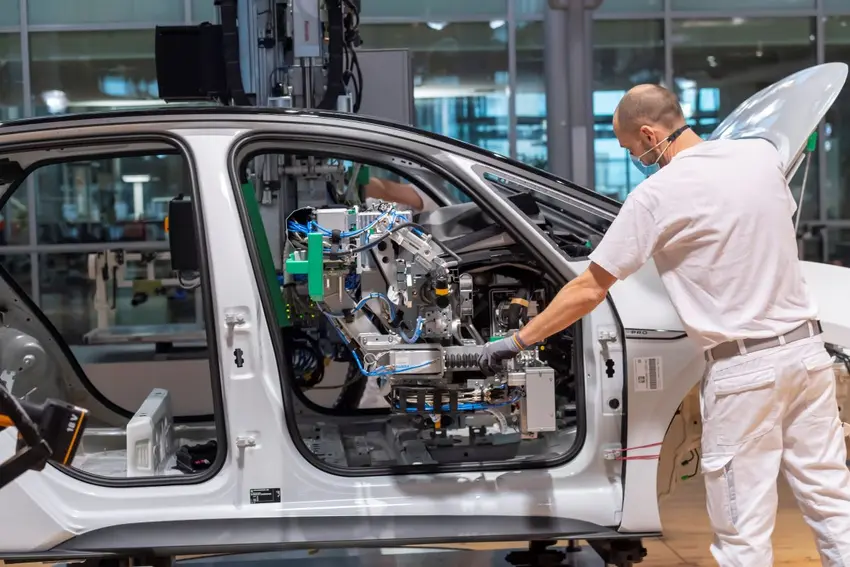
A new study found that 140,000 jobs in the German automotive industry could be cut over the next 10 years.
The study, carried out by the German Association of Automobile Manufacturers (VDA), looked at 700 occupations in the automotive sector, and how these occupations are expected to be impacted as carmakers continue to switch to manufacturing electric vehicles.
This comes on the back of industry leader Volkswagen recently announcing plans to close down at least three factories in Germany, which is expected to result in the loss of tens of thousands of jobs. This, on top of near constant updates that Europe’s biggest economy is on the verge of an economic recession, is enough to make both investors and workers in Germany understandably worried.
Enzo Weber, a professor of Economics and Head of Forecasts and Macroeconomics at the Institute for Employment Research (IAB), however, tells a different story.
There will be job losses in certain sectors, like automotive production, Weber told The Local in a recent interview, but he suggests that a lot of the skills that have been useful for making cars will soon be needed for other applications.
Over one hundred thousand jobs expected to be lost
Firstly, there's no getting around the dismal situation. A loss of 140,000 jobs - which will affect individuals as well as their families and regions - as is forecast by the VDA study, corresponds to a net loss of about 15 percent of the automotive jobs that currently exist in Germany. That’s a huge cull of jobs expected to occur over the next decade – until 2035.
Between 2019 and 2023, as the production of electric vehicles in Germany was just beginning, 46,000 jobs were already cut.
“Volkswagen is the most prominent example now, in a row of several big German firms who announced coming job cuts,” Weber said.
READ ALSO: Biggest German trade union calls warning strike over pay
While dismissals are certainly increasing in the automotive sector, Weber notes that they are still currently at a lower level than they were before the Covid pandemic. That said, he does acknowledge that a lot of job losses are coming. And his figures aren't far off from those suggested by the VDA study.
Citing IAB studies from a couple years prior, Weber said, "we could lose about 100,000 jobs in Germany..." considering the isolated effect of switching from producing combustion engines to E-mobility.
“[But only] taking the isolated effect is not sensible, because there's a broader package also of developing new business fields,” he added, including new infrastructure projects, battery production and battery tech, for example.
Auto industry in a ‘transformation crisis’
According to the VDA's figures, the automotive industry is currently seeing a net loss in jobs. Since 2019, the study found that 75,000 employees were cut across the industry whereas 29,000 new jobs were created.
Germany’s big industrial manufacturers “are in a transformation crisis”, Weber said, noting that industrial production is 16 percent lower than pre-Covid levels.
Mechanical engineering and metalworking jobs that are specific to producing combustion engines are at particular risk. These jobs are not only at big producers like Volkswagen but also spread between hundreds of small parts manufacturers .
“Volkswagen can switch to producing electric cars,” Weber said. “But if you produce screws for a combustion motor then you really get into problems.”
He noted that many of these so-called original equipment manufacturers (OEMs), employ around 100 employees or so, but that historically they have offered good, high-paying jobs that are important to local regions in Germany.
Germany needs ‘targeted development’ in its labour policy
“You always have the bad news in the headlines,” Weber told The Local.
It’s common to read about good jobs being lost but much less common to see headlines about new jobs developing.
“The crucial thing now is to further develop those workers on the old jobs toward the areas that are developing…”
The VDA report also notes coming shifts in roles within the automotive industry. New jobs are being created, particularly in IT professions within the automotive industry but also in technical research and development for the car makers.
These jobs aren’t one-to-one equivalents for the metalworking and engineering jobs that currently exist in the automotive sector, but many of them do have some considerable skill overlaps.
Additionally, Weber suggests that many of the jobs that are needed for the ecological transition are what calls “typical German occupations”, that is to say jobs related to energy and electrical engineering, as well as machine building.
“This is what we do have in Germany,” Weber argues, “It’s not about [workers] learning totally new jobs, but it's about really targeted further development.”
If labour market policy focuses on encouraging workers to learn the right skills so that they can transition into the jobs that are needed now, Weber thinks that, on balance, German manufacturing can continue to perform well.
Comments