
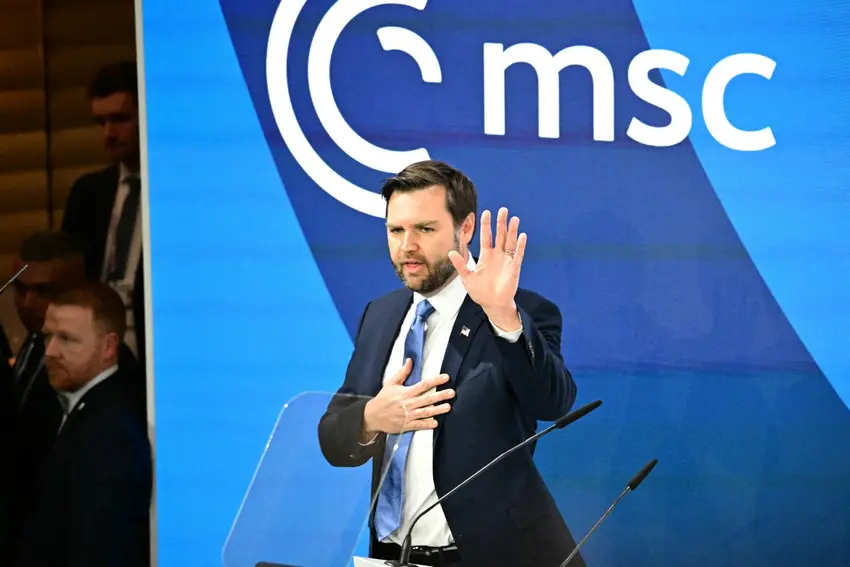
"Democracy rests on the sacred principle that the voice of the people matters," said Vance in a speech to the Munich Security Conference.
"There's no room for firewalls," he added, referring to the long-standing position of Germany's established parties not to work with the far right.
Friedrich Merz, leader of the opposition Christian Democrats and tipped as Germany's next chancellor, was last month accused of breaching this taboo when the far-right Alternative for Germany backed a proposal he put forward to toughen up immigration law.
Earlier Friday, German government spokesman Steffen Hebestreit criticised similar comments that Vance had made in an interview with the Wall Street Journal.
Outsiders should not be "meddling in the internal affairs of a friendly country", he said, adding they "may not have a full overview of the political debate" in Germany.
The comments come amidst a German election campaign that has been dominated by immigration and security.
There have been several high-profile attacks blamed on asylum seekers and migrants, prompting the AfD to further intensify its anti-migrant campaigns.
Most recently, an Afghan asylum seeker is suspected of ramming a car into a crowd in Munich on Thursday, leaving 36 people injured.
'Stricter approach'
The AfD looks set for its best ever result of around 20 percent in the election on February 23, according to current polling.
The party has received enthusiastic backing from Elon Musk, the world's richest man and a key ally of US President Donald Trump.
READ ALSO: How would a strong AfD result impact foreigners in Germany?
Merz insists he would not govern with the AfD or actively seek its support.
Vance also told the Wall Street Journal that the threat to European democracy from online disinformation - including narratives pushed by Russia - had been overstated.
"If your democratic society can be taken down by $200,000 of social media ads, then you should think seriously about how strong your grip on or how strong your understanding of the will of the people actually is," he said.
However Hebestreit insisted that disinformation was something that had to be "closely observed".
"And when it goes against our laws, then we will act," he said.
He added: "We here in Germany have a stricter approach to free speech than in the US, on account of our historical experience."
He gave as an example Nazi ideology which, he said, "can be freely expressed there but which would be strictly forbidden here".
READ ALSO: What protection does Germany have against future dictatorships?
Comments