
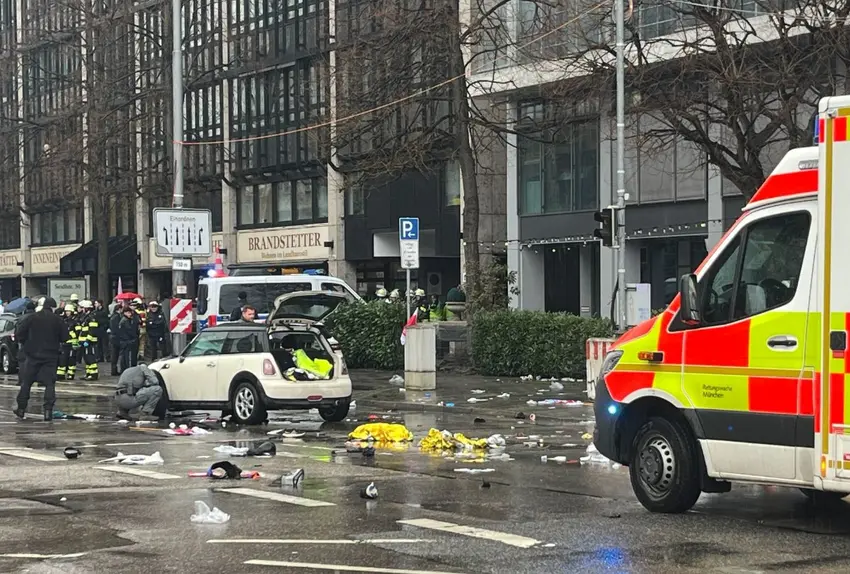
A car was driven into a crowd of people in central Munich on Thursday, injuring around 36 people.
Bavaria's state premier Markus Söder said the incident is a suspected attack, and an asylum seeker from Afghanistan has been arrested.
It comes 10 days before Germans head to the polls in a key election on February 23rd where immigration issues are at the top of the agenda. It also happened one day before the city is due to host the high-profile Munich Security Conference.
READ ALSO: Several injured after car drives into crowd in Munich
Who is among the injured?
The suspected ramming happened at Stiglmaierplatz in the Maxvorstadt area of the Bavarian capital at around 10.30am.
Around 28 people are confirmed to have been injured, including two seriously. One person has life threatening injuries, police said.
Munich mayor Dieter Reiter confirmed that children were among the injured. "I am deeply shocked," said Reiter.
Gerhard Peschke, spokesman for the Munich fire and rescue service added that it was not possible to give an exact number of casualties as some of the injured had sought shelter in neighbouring buildings.
The group of people hit were participants in a strike organised by the Verdi trade union. The car reportedly followed the demonstration, weaved past police vehicles and drove into the back of the group of people.
Police who rushed to the scene fired a shot at the battered car and detained the driver, a 24-year-old Afghan asylum seeker who was named by German media as Farhad N.
Germany is seeing several public sector strikes at the moment during a period of collective bargaining. The president of the Verdi union Frank Werneke said in a statement: "We are deeply upset and shocked at the awful incident during a peaceful demonstration by our Verdi colleagues."
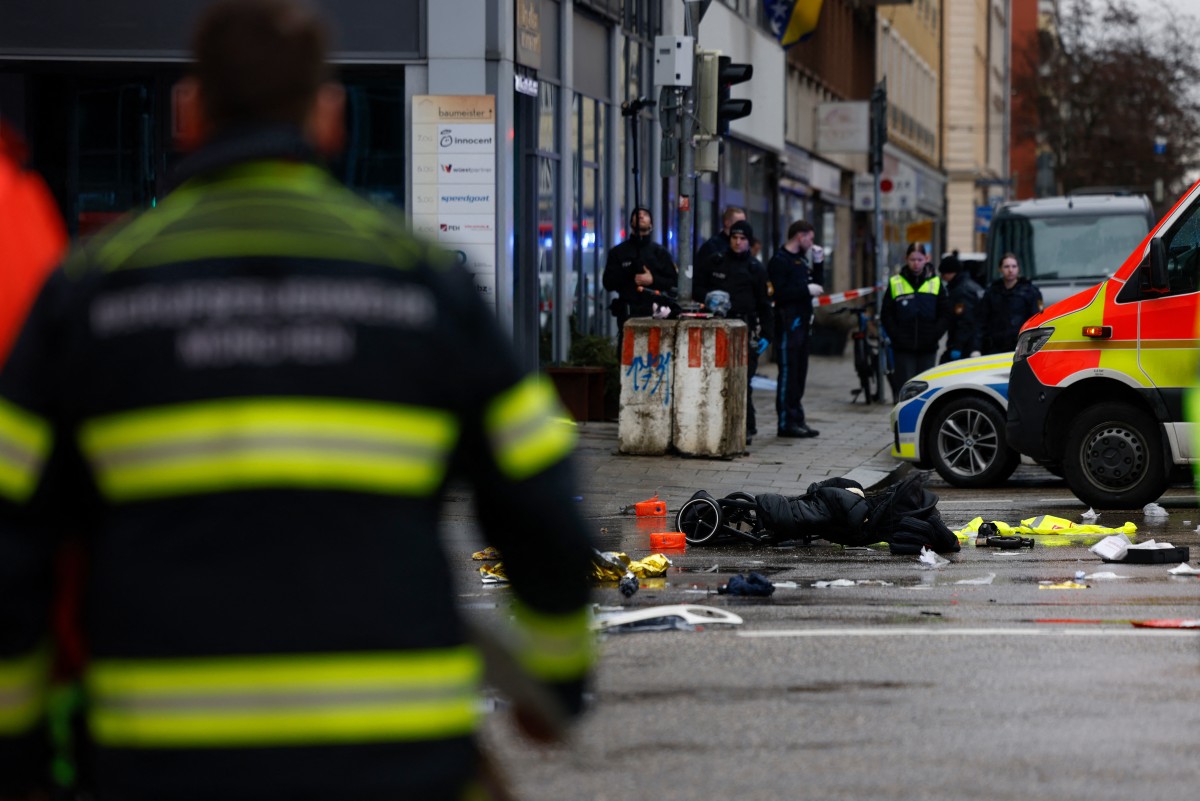
Ambulances and rescue helicopters rushed to the scene, while officers were on the site as investigations got underway.
Eyewitness Alexa Graef said she was "shocked" after seeing the car drive into the crowd "which looked deliberate".
"I hope it's the last time I see anything like that," she said.
An eyewitness who was among the striking workers told the regional broadcaster BR24 that he "saw a person lying under the car" after it drove into the crowd.
Police have set up a witness collection point in the Löwenbräukeller on Stiglmaierplatz. Anyone who can provide information about the events is asked to report there.
Was this an attack?
It was not entirely clear immediately but Bavarian state premier Söder, of the Christian Social Union (CSU), said it appeared the driver acted intentionally. He said the incident was "just terrible", adding: "I must tell you it looks like this was an attack."
The suspect was said to have arrived in Germany in 2016 at the height of the mass migrant influx to Europe.
His asylum request was rejected by German authorities but he found work and was able to remain legally in the country, according to officials.
Police said there were "indications of an extremist motive" and the investigation has been handed over to the regional prosecutor's office.
Tensions high in Germany
Germany has seen a number of high profile attacks involving migrants in recent months which have fulled a bitter debate over immigration and internal security.
In January two people were killed - including a two-year-old child - in a stabbing that took place in a park in Aschaffenburg. Police arrested a 28-year-old rejected asylum seeker from Afghanistan in connection with the attack, who reportedly slipped through the fingers of authorities. It later emerged that he had a history of mental illness.
In December, a car ramming attack on a Magdeburg Christmas market killed six people and injured hundreds of others. A 50-year-old Saudi man who had lived in Germany since 2006 was arrested after that attack. He reportedly held anti-Islam and far-right views. Authorities said he also appeared to be mentally disturbed.
In August, three people were killed and eight wounded in a stabbing spree at a street festival in the western city of Solingen that was claimed by the Islamic State group. The revelation that authorities had missed the opportunity to deport the suspect, a Syrian asylum seeker, stirred outrage in Germany.
How are these attacks affecting the election campaign?
These horrific attacks - among others - have understandably rocked Germany.
It has led to politicians calling for tougher measures, particularly concerning immigration.
Meanwhile, support for the anti-immigration Alternative for Germany (AfD) has increased - the party is currently second in election polls with around 21-22 percent, behind the conservative CDU/CSU (29-30 percent).
READ ALSO: How would a strong AfD election result impact foreigners in Germany?
Following the stabbing in Aschaffenburg, CDU leader - and election frontrunner - Friedrich Merz called for "fundamental changes" in asylum policy.
At the end of last month, a motion calling to close borders and end illegal immigration passed in the Bundestag - controversially with the support of the far-right AfD.
That led to protests across the country over concerns that the 'firewall' of working with the far right was being broken down. However, a recent survey suggested that half of Germans viewed the cooperation with the AfD on migration policy as acceptable.
READ ALSO: What is the CDU's immediate action plan that targets citizenship law?
Meanwhile, Chancellor Olaf Scholz, of the Social Democrats, announced this week that temporary border controls would be once again tightened for six months.
Following the suspected car attack on Thursday, Scholz said: "What has happened is awful. From my point of view it is quite clear, this attacker cannot count on any mercy, he must be punished and he must leave the country."
Bavarian leader Söder said: "This is not the first incident... we must show determination that something will change in Germany. This is further proof that we can't keep going from attack to attack."
With reporting from AFP and DPA
Comments