

During the long and arduous process of reforming Germany's outdated citizenship laws, the former traffic-light coalition had one major thorn in their side: the centre-right conservatives.
The Christian Democrats (CDU) and Bavarian sister party, the Christian Social Union (CSU) - collectively branded the Union - were vehemently against the plans to permit dual nationality and were horrified by the idea of offering 'fast-track' naturalisation for migrants.
In one particularly scathing speech at the bill's first reading, CDU immigration spokesperson Alexander Throm slammed the reform as a "citizenship devaluation law".
The reduced years of residence would "endanger the peace" in Germany by allowing foreigners to become German before they had properly integrated, he argued. What's more, the reforms would likely fuel the rise of the far-right.
Since June 27th this year, Germany has allowed people naturalising to hold multiple nationalities without exception and foreigners can apply after five years of residence instead of the previous eight years under the standard route.
The new law also benefits Germans, allowing them to keep their nationality when gaining a citizenship abroad.
CHECKLIST: What do I need to apply for citizenship under the new law?
While the CDU and CSU were in opposition, they were powerless to stand in the way of the reforms. But with a new set of federal elections scheduled for February 23rd, the Union could be set to head up the next governing coalition and have a chance at enacting their plans.
In their election manifesto released on Tuesday under the title of 'Political Change', the parties set out exactly what these plans were.
Here's what you need to know about the Union's proposals for German citizenship.
What do the CDU and CSU say about citizenship in their manifesto?
The Union mention the topic of naturalisation five times in total in the 81-page document - mostly to take aim at the traffic-light's dual nationality law.
In a section on integration and cohesion, the parties promise to end the general right to hold multiple nationalities once they re-enter government. They would like to see a return to the days of dual nationality only for EU citizens - or in exceptional circumstances.
READ ALSO: German elections - The key party pledges that will affect foreign residents
In their 16 years at the head of coalition governments, the CDU and CSU repeatedly blocked reforms of Germany's dual nationality laws, citing fears that such a move would encourage split loyalties from migrants who didn't share the country's core values.
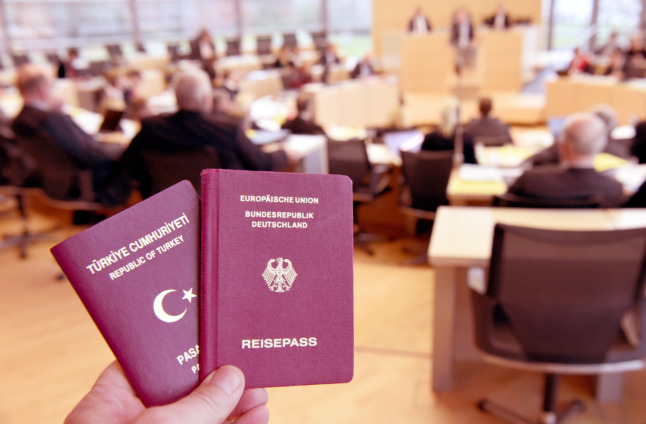
In the manifesto, the parties also say they want to reverse the fast-track route to citizenship, stating: "The German passport is the end of integration, not the beginning."
This route allows exceptionally integrated foreigners with at least C1 German to naturalise after just three years.
In another section of the manifesto dealing with uniting society, the CDU and CSU expand on these plans.
"Integration is not a rush job," they write. "That is why we reject the traffic light's express naturalisation after only three years of residence just as decisively as the general possibility of dual citizenship. We are cancelling it."
How else would the CDU/CSU amend German citizenship laws?
As well as scrapping key parts of the dual nationality law, the CDU and CSU want to tighten up rules around extremism and anti-Semitism and allow for an easier revocation of citizenship.
In particular, the parties say they want to "combat immigrant anti-Semitism" by refusing asylum or residence to anyone convicted of an anti-Semitic hate crime. In such cases, people with dual nationality could also be stripped of their German citizenship.
Passports could also be revoked from people who openly support terrorist groups or who want to abolish the "free democratic order" in Germany, for example by calling for an Islamist theocracy.
In addition, the parties want to make naturalisation dependent on a commitment to Israel's right to exist. Currently, only applicants in Saxony-Anhalt have to sign such a declaration. Others simply answer questions on Israel, Jewish life and anti-Semitism as part of the citizenship test.
READ ALSO: Do new German citizens have to affirm Israel’s right to exist?
Could these plans come to fruition?
That all depends on whether any future coalition partner would be willing to go along with the Union's plans.
Currently, poll numbers are pointing to a convincing win for CDU/CSU in February's elections - though a lot can change in the two months of campaigning that remains.
Even if they do emerge as the largest party, however, they will likely have to work with at least one of the traffic-light coalition parties: the Social Democrats (SPD), Greens or Free Democrats (FDP).
In a rare show of unity, all of these parties were in favour of comprehensive citizenship reform and would be unlikely to want to revoke it. Instead, they could compromise by watering down some elements of the law, or tightening up other areas of immigration law instead.
Members of the Bundestag who helped pass the law have also told The Local repeatedly that it is unlikely that the CDU/CSU could gain enough support to reverse the law.
READ ALSO: Can Germany's CDU scrap the dual nationality law?
There would likely be less opposition to tightening up rules around anti-Semitism and acknowledging Israel's right to exist. However, stripping foreigners of their German passports would likely be a bridge too far for many of the more liberal parties.
 Ben McPartland, Editor, The Local Europe

Comments (3)