
A major poll by the European Council on Foreign Relations (ECFR) has revealed that a majority of EU citizens are keen to foster deeper ties with the UK almost a decade after the Brexit vote.
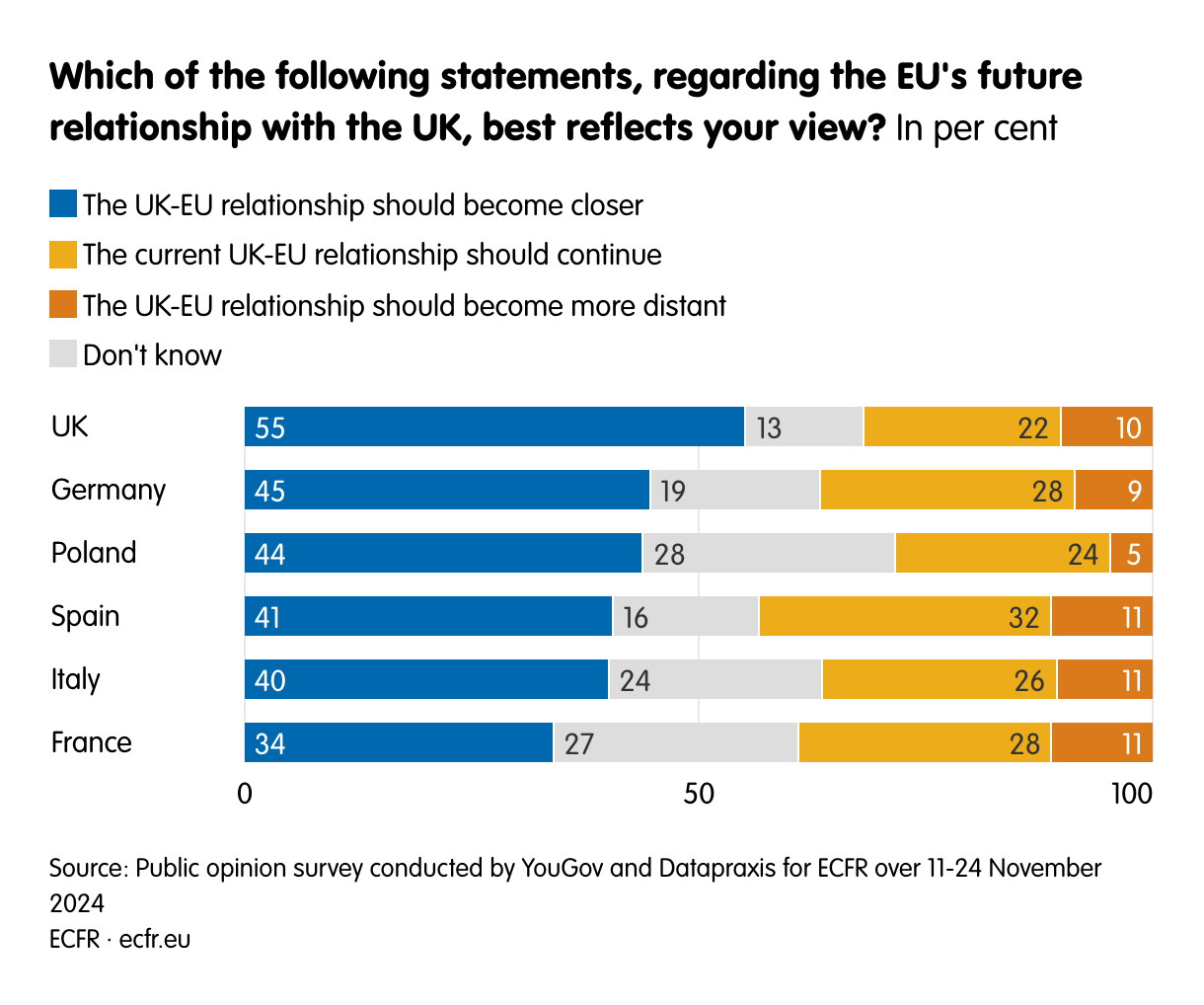
The think tank's survey saw 9,278 respondents across six countries - including the UK and the EU's five most populous countries Germany, France, Spain, Italy and Poland - asked for their opinions on EU-UK relations in November 2024.
It found that on both sides of the Channel, citizens are keen to re-build bridges between the two sides, with closer cooperation on issues such as migration, foreign policy and national security.
Across the EU countries surveyed, a significant number of respondents said they believed the UK and Brussels should move closer to one another in future.
In Germany, 45 percent said they wanted the relationship to get closer, compared to 9 percent who preferred a more distant relationship.
READ ALSO: What Labour's UK election win could mean for Brits in Europe
The figures were similar in Poland (44 percent to five percent), Spain (41 percent to 11 percent) and Italy (40 percent to 11 percent).
France was the least supportive of a closer UK partnership, but even there, 34 percent of people would prefer a closer relationship compared to just 11 percent who prefer more distance.
In all five EU countries, a plurality of respondents also believed that closer UK-EU relationships could help with boosting the European economy, strengthen European security and manage the flow of migration.
"While the British government and the European Commission are edging only slowly towards closer cooperation, public opinion is far ahead of them," the authors of the study wrote.
The UK and EU should seize the opportunity to embark on a bold "reset of relations", they said.
'A new world'
According to the authors of the study, a feeling of global instability has changed the way that EU and UK citizens view their relationship with one another.
In particular, Russia's full-scale invasion of Ukraine in February 2022 and the recent re-election of Donald Trump as President of the US have had a profound impact on attitudes to UK-EU cooperation.
"When British voters decided to leave the EU, Barack Obama was still in the White House. The UK was enjoying a much-hailed 'golden age' in its relations with China. The Covid-19 pandemic had not yet struck. And Russian president Vladimir Putin had yet to launch his full-scale invasion of Ukraine," the authors of the survey wrote.
"But our poll shows that in the minds of many voters, we are in a new world."
READ ALSO: INTERVIEW - 'A lot of people think Brexit is done, but it's not for Brits in Europe'
In the UK, 53 percent were against following the US' lead on Ukraine, while just 13 percent were in favour.
In each of the European countries surveyed, a large proportion of those polled said the EU should grant the UK special access to certain parts of the European single market in exchange for a closer security relationship.
In Germany and Poland, clear majorities of 53 percent and 54 percent support this position, compared to 25 percent and 19 percent opposing it.
In Spain, 43 percent supported special access to the single market in return for closer security co-operation, while 37 percent opposed it. In Italy, the figures were similar, with 42 percent in favour and 35 percent against.
Even France - which tended to take a more sceptical view of EU-UK cooperation - 41 percent support giving the UK greater market access compared to only 29 percent who oppose it.
Brits prepared to ditch Brexit red lines
EU citizens weren't the only ones looking to rebuild ties in the post-Brexit era: in the UK, pollsters also tracked overwhelming support for a closer EU relationship.
Asked whether the UK should build stronger ties with the EU, 55 percent said it should, compared to just 10 percent who preferred a more distant relationship.
READ ALSO: Thousands of Britons still moving to EU countries despite Brexit
In terms of whether the UK should prioritise its relationship with the EU or US, meanwhile, 50 percent of respondents opted for the EU, while just 17 percent wanted to prioritise the US.
Most strikingly, many Brexit-era "red lines" also appear to have faded in importance for voters.
More than two thirds - 68 percent - of respondents would now favour reintroducing cross-Channel freedom of movement in return for access to the EU's Single Market.
This includes a majority (54 percent) of people who voted to leave the EU in 2016.
Comments