
The news that auto giant Volkswagen is mulling closing three factories and cutting tens of thousands of jobs is a major headache for the German government - and the latest blow as the country heads further into an economic downturn.
On Tuesday, Scholz, of the Social Democrats (SPD), was set to hold crisis talks late in the afternoon with representatives of industry associations, trade unions and large companies to thrash out ways out of the economic slump.
The talks are being held behind closed doors, reportedly because Scholz wants to keep the drama within the coalition government out of it. "We have to get away from the theatre stage," he said at the weekend ahead of the meeting, adding that the goal was "great cooperation" on the issue.
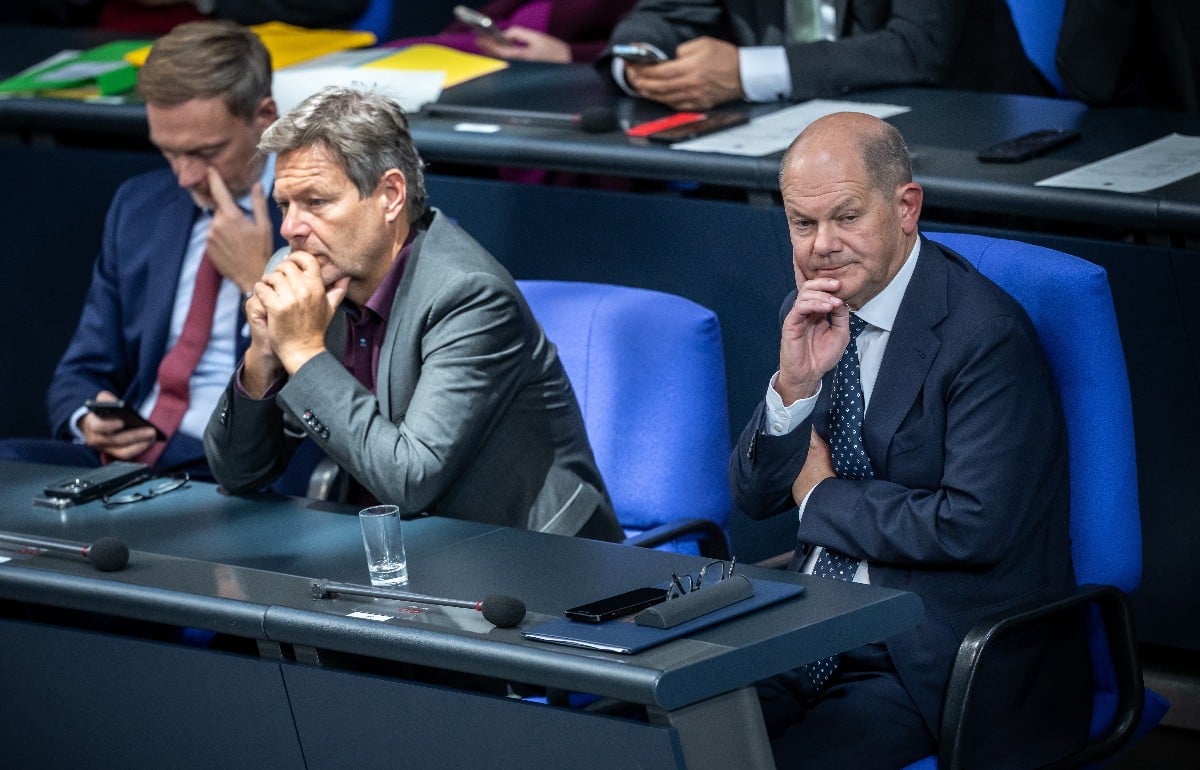
However, two players who are not entirely unimportant for the cause remain excluded for the time being: Economics Minister Robert Habeck from the Greens and Finance Minister Christian Lindner from the Free Democrats (FDP) - Scholz's two coalition partners.
According to reports in DPA, the pair are not happy about their head of government going it alone and are reacting in different ways.
Habeck promptly presented a paper calling for a fund worth billions for more investment. Meanwhile, Lindner's FDP parliamentary group quickly organised a kind of counter-summit.
Now as well as dealing with the troubled economy and job outlook in Germany, the future of the already struggling coalition is on the line.
Is politics influencing the economic situation?
Things are not looking great at the moment on the economy front. The second recession in a row is expected this year - meaning that Germany is lagging behind other western industrialised countries. According to forecasts, economic output is shrinking, partly because companies and private individuals are holding back on investments due to the geopolitical situation.
Many experts also point to Germany being much more exposed to China than other western economies. China now buys less from Germany due to now being able to produce a lot of the goods it used to import from Germany itself.
READ ALSO: Why is Germany's economy so sluggish and what does it mean for you?
Three weeks ago, Habeck admitted that disputes within the coalition government were also contributing to the uncertainty. Leading economic research institutes have complained that there is a "significant increase in political uncertainty". They added that the partners in the so-called 'traffic light' coalition - the SPD, Greens and FDP - were clearly pursuing different political goals.
What do businesses want from the government?
Business associations have long been calling for comprehensive structural reforms: lower energy prices, less bureaucracy, measures to combat the shortage of skilled labour, lower social security contributions, more money for infrastructure, some of which is ailing. The traffic light coalition has announced a ‘growth initiative’ with many measures. However, none of these have yet been implemented and some of them are controversial.
READ ALSO: Kindergeld and tax relief - How Germany's planned budget could affect you
Ahead of the summit, business associations urged the government to take unified and swift action. "The economic data calls for haste," said Jörg Dittrich, President of the German Confederation of Skilled Crafts, who is attending the FDP summit. "A joint, coherent and coordinated government plan is needed - not fragmented party or election campaign tactics."
What is Scholz pushing for?
The Chancellor is entering the consultations with business and trade unions without a concrete plan. He instead wants to take his time and it is clear that further meetings will follow. In a government statement in the Bundestag a fortnight ago, Scholz said his goal is: a "new industrial policy agenda" with concrete measures to boost the economy and secure jobs. "I will propose to this parliament what comes out of this, and I will get it off the ground so that Germany can move forward," he promised.
At the summit, Scholz is focusing on sectors in which a particularly large number of jobs are at stake. As well as the Federation of German Industries (BDI), the German Engineering Federation (VDMA) will also be present. The employees are represented by the German Trade Union Confederation (DGB), IG Metall and IG Bergbau, Chemie, Energie. In addition to VW, BMW and Mercedes will also be represented.
The FDP says the chancellor's approach falls short. "Because the German economy is not just industry, it is also SMEs (small and medium-sized firms), skilled trades and the liberal professions," said Lindner. The FDP has invited different groups to the Bundestag building for its separate summit. "We want structural reforms that help everyone," parliamentary group deputy leader Christoph Meyer told the Funke Mediengruppe.
Although Habeck has not convened his own economic conference in response to the chancellor's summit, he has made a substantive proposal. He wants to set up a fund to reimburse companies for 10 percent of their investments and for it to be financed through debt. He hasn't given the financial picture of that yet. However, the BDI has calculated that a ‘mid three-digit billion figure’ would be necessary over the next few years.
So what happens next?
To achieve a result, Scholz, Habeck and Lindner will have to get their act together and work with each other - but it's unclear at the moment whether this is possible.
In any case, it is unlikely to happen before the budget showdown in the Bundestag. On November 14th, the Budget Committee will hold a meeting to iron out the spending plans for the coming years, which have already seen months of bickering among political leaders. If the coalition cannot agree on that, the future of the 'traffic light' isn't bright. The FDP is rumoured to be considering pulling out of the coalition if a deal isn't reached then - which could trigger early elections.
READ ALSO: Could Germany face an early national election?
With reporting from DPA
Comments