
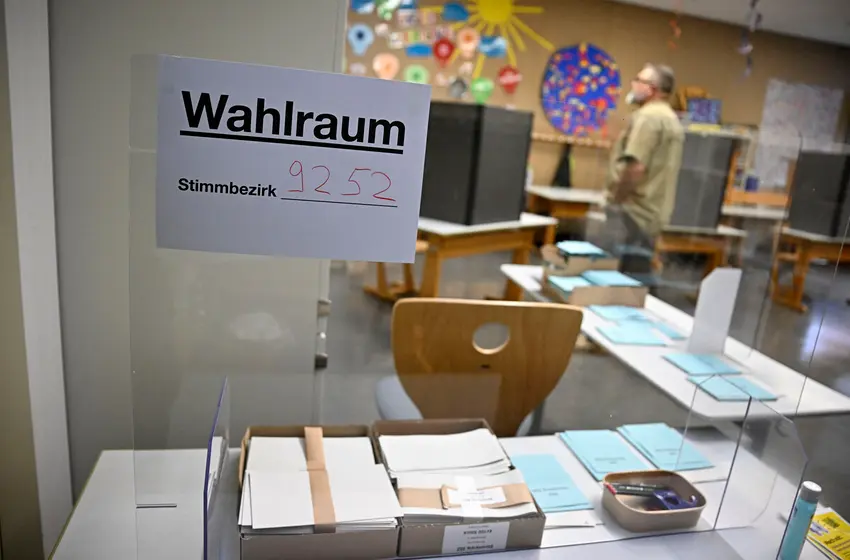
There's just under a full year left to go until Germany is scheduled to vote in 2025 federal elections, and the current traffic light government of Chancellor Olaf Scholz's Social Democrats, the Greens, and the liberal Free Democrats is at record levels of unpopularity - polls earlier this year showing only about 18 percent of Germans were satisfied with its work.
Chancellor Olaf Scholz is now the least popular Chancellor is post-war German history, with even a majority of SPD voters saying he shouldn't run again.
All three government parties put together are polling roughly the same as the opposition Christian Democrats - who would likely win if an election was held tomorrow.
So with numbers this bad, can the current coalition last another year? One of the three governing parties is said to be seriously considering pulling out beforehand.
Why might we see early elections in Germany?
A string of disappointing state election results in eastern German states saw fringe parties like the populist left Sahra Wagenknecht Alliance (BSW) and the far-right Alternative for Germany (AfD) make big gains. The traffic light - or Ampel - parties, lost big. The FDP failed to make the five percent threshold in all three states - leaving them with no seats. The Greens were booted out of two of the three state parliaments.
The results prompted the federal Green co-chairs - Ricarda Lang and Omid Nouripour - to tender their resignations. The FDP reportedly spent three hours on the day after the Brandenburg state election debating whether they should pull the plug.
Although they decided to stay in - for now - the FDP has reportedly decided it will leave the coalition if it doesn't get an agreement on next year's budget by November 14th. That's the date the Bundestag's Finance Committee will need to discuss an agreement in order to put it to the full Bundestag two weeks later. Otherwise, it may exit the coalition, according to reports in Bild, Germany's largest newspaper.

The leak to the newspaper may also be a negotiating tactic to get a better budget deal for the FDP. Nevertheless, FDP leader and Finance Minister Christian Lindner is said to be open to the option of leaving the coalition early.
READ ALSO: Who are the winners and losers of Germany's key state election in Brandenburg?
What happens if the FDP leaves the coalition?
If the FDP leaves the governing coalition, a number of outcomes are possible - only one of which is a new election.
Based on the results of the last election in 2021, the FDP and the Greens could negotiate a new coalition agreement with the Christian Democrats and hold a no-confidence vote in Olaf Scholz as Chancellor.
A coalition without Scholz's SPD would require the CDU, Greens, and FDP to have a majority in parliament - potentially requiring long negotiations. With less than a year to go until new elections, the parties may well decide such effort isn't worth it - but it is theoretically possible.
The second possibility is that the SPD and Greens remain in government after the FDP leaves it and govern with a minority in parliament. They would, however, have to secure at least one opposition party's support for each vote in the Bundestag - which could end up being unwieldy and time-consuming.
The third possibility is an early election, which the Chancellor can request the Federal President to call if it becomes clear that the government doesn't have the necessary votes to function.
READ ALSO: Who is the conservative leader hoping to become Germany's next chancellor?
Have early elections happened in Germany before?
At both the federal and state level, elections have fixed dates that are sometimes known years in advance. Politicians often have campaigning timetables structured around these dates.
Yet early elections can and do happen in Germany - at both the federal and state level - especially when a governing coalition breaks down.
In 2012 in Saarland, the CDU walked out of a coalition it was in with the Greens and FDP to try and negotiate a new one with the SPD. When those talks failed, the state held an election two years ahead of schedule.
The 2005 election that saw former Chancellor Angela Merkel win power for the first time was originally scheduled for a year later - in 2006. Other early elections nationally have included the contests in 1972 and 1983. Notably, the 1983 election was spurred on by an FDP leaving its coalition with the SPD to negotiate a new one with the CDU.
If Germany votes early this time around - it'll be the first time it's done so since 2005. But it's hardly an unheard of event.
Is the FDP really serious about this threat?
We'll find out by mid-November.
Again, the FDP's leak that it's considering leaving the coalition could be a negotiation tactic for a better budget deal. But University of Mainz political scientist Kai Arzheimer tells The Local the FDP has little to lose - and may be willing to try risky tactics.
"Under normal circumstances I would say that the prospect of the FDP (or any of the other two parties) leaving the coalition is very low," says Arzheimer. "At the moment, the FDP is consistently polling below five percent. Unless they believe that crashing the coalition would make them wildly more popular within days or weeks, triggering new elections right now would look like political suicide. Things can hardly get any worse for them."
But Arzheimer added that a chunk of their MPs and most of their voting base are "simply fed up with being stuck in this coalition and would rather lose their place at the cabinet table (and possibly their seats in parliament) than carry on like this".
He added: "Lindner might feel that it is necessary to give in to these voices to secure his position as party leader."
Whether the FDP stays or goes, it's tactic is to portray itself increasingly as a voice of opposition - either within or outside of the government - in order to campaign for votes, according to Arzheimer.
That's why when it comes to the possibility of early elections in Germany - we shouldn't be surprised either way.
Comments