
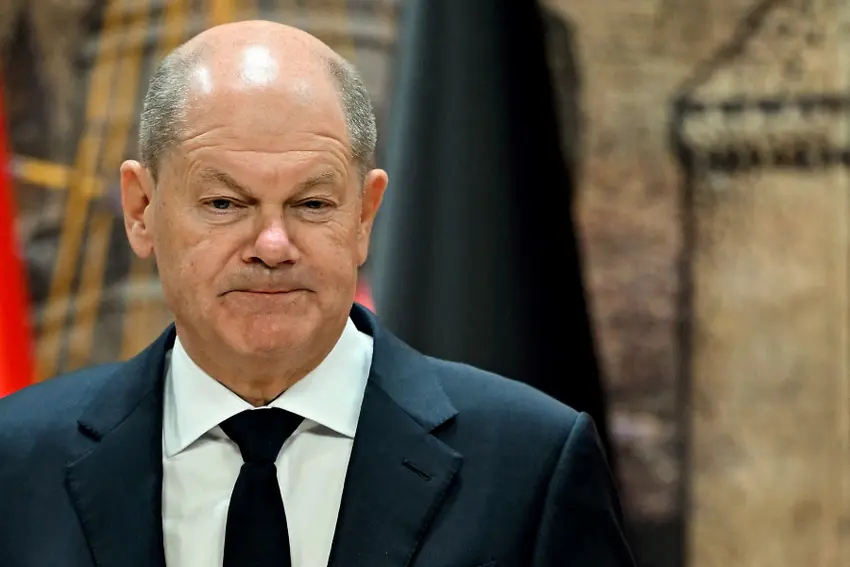
As the clock ticks towards the parliamentary vote in September 2025, the trio of ideologically disparate parties has entered into campaign mode and openly traded attacks.
The chaos has weakened Scholz and seen all three parties dive in the polls as formerly fringe far-right and far-left parties have made gains.
Tensions could peak next month when the three governing partners must agree to pass a tight state budget for 2025, after similar talks almost collapsed the coalition in July.
Scholz of the centre-left Social Democrats acknowledged this week that the infighting has been hard to take.
READ ALSO: Why is the AfD picking a fight with the German Bauhaus art movement?
It is "sometimes very difficult to get through all the many disputes and do everything to ensure that good results come out of it," he said Thursday, with characteristic understatement.
The next morning he was greeted with more bad news when mass-market tabloid Bild predicted a looming "showdown" between Scholz and his finance minister Christian Lindner.
Scholz is planning talks with corporate and union leaders Tuesday on reviving the sluggish economy. Lindner, who was not invited, has announced a rival event with heads of major business groups on the same day.
For his part, fiscal hawk Lindner of the pro-business Free Democrats had just slapped down the idea of a multi-billion-euro investment bonanza proposed by Economy Minister Robert Habeck of the Greens.
Lindner also pointedly told his two more free-spending coalition partners that "new spending requests cannot be met" and warned of tough budget choices ahead in an "autumn of decisions".
'Face the ballot box'
News weekly Der Spiegel summed up Germany's dysfunctional government alliance with the headline "Now everyone is fighting against everyone".
In the looming budget talks, all three parties will be "even less inclined to compromise," said Yann Wernert, a political scientist at the Jacques Delors Centre in Berlin.
"Making sacrifices seems complicated," he said, as the parties will soon have to "face the ballot box and explain themselves to the electorate".
The Scholz government was launched in 2021 and initially booked some successes, steering Germany through the pandemic and weaning it off cheap Russian gas as the Ukraine war broke out.
But recent years have been bad for what in Germany's colour-coded political language has been dubbed the "traffic light coalition".
Red is the colour of Scholz's Social Democrats, the traditional home of workers, and yellow stands for Lindner's liberal Free Democrats, who want low taxes and less red tape.
The third coalition party are the Greens, a left-leaning environmentalist party that has long fought for minority rights and multiculturalism.
Fringe parties rise
In recent years, the coalition has taken a heavy hit as the economy, long considered Europe's engine room, is set to shrink for a second year in a row.
The conservative opposition Christian Democrats (CDU) of ex-chancellor Angela Merkel charge Germany is turning into the "sick man of Europe".
Germany has also been rocked by a heated immigration debate, fuelled by a series of attacks committed by asylum seekers.
This has boosted the far-right Alternative for Germany (AfD), especially in the formerly communist east where the hard-left and Russia-friendly BSW party is also popular.
A recent nationwide poll placed Scholz's Social Democrats at 16 percent, while the Greens scored 11 and the Free Democrats just three percent, below the threshold for staying in parliament.
The CDU/CSU alliance, whose candidate for chancellor is former BlackRock executive Friedrich Merz, is marginally ahead of the trio with 31 percent, according to the ZDF survey from October 18.
The poll placed the AfD second with 18 percent, although other parties' vows of non-cooperation should keep it in opposition for now.
Nonetheless, the rise of the populist parties has further fragmented the political landscape, likely forcing the mainstream parties into more uncomfortable coalitions in the future.
Amid the gloom, Lindner has flirted with the idea of bolting the coalition.
This week he denied concrete plans to do so but placed the ball in the court of the other parties.
"If everyone wants to stick to the coalition agreement and its spirit," he said, "then I certainly have no intention of ending a government coalition."
Comments