
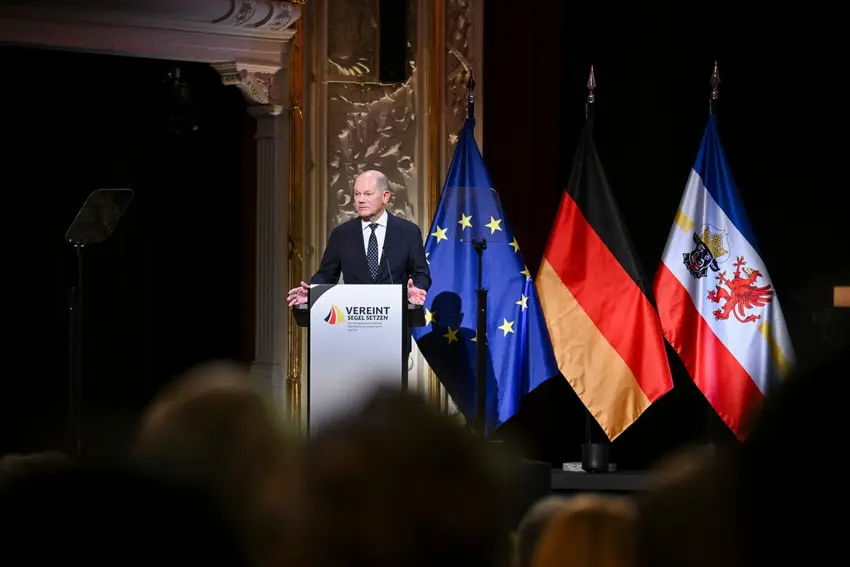
"For millions, the upheaval in the years after unification was above all a collapse," said Chancellor Olaf Scholz (SPD) on Thursday at the official Unity Day ceremony, which commemorates German reunification.
"A collapse of their entire life up to that point as they had known and lived it. A devaluation of their knowledge, their experiences, their life's work," said Scholz at the ceremony in Schwerin in Mecklenburg-Vorpommern.
These experiences should "never be forgotten or swept under the carpet," said Scholz. "This is probably one of the reasons for the still particular mood - the particular resentment - and for the political peculiarities that characterise East Germany today."
Mecklenburg-Western Pomerania's Prime Minister Manuela Schwesig (SPD) expressed similar views.
"For most people in the western German states, not much changed as a result of German reunification," she said, "but for us in eastern Germany, for our families, almost everything changed."
In view of these experiences, it is "understandable that the concern that what has been achieved could be lost again is more pronounced in eastern Germany," she said.
The east "remains different: with its expectations and experiences, with its attitudes and life plans," Schwesig said, adding that these differences had been too often ignored in the past.
Ongoing disadvantages
She said there were ongoing disadvantages "which we cannot accept", citing different wages, fewer assets and not as many major companies in the east.
In an interview with Politico magazine, Linke party politician Gregor Gysi also criticised ongoing disadvantages for people in the East who he says "still have to work longer hours, and receive lower wages for the same work," he told Politico on Thursday.
"They receive a lower pension for the same work," he added.
East Germans make up 17 percent of the population, but only seven percent of managers, Gysi said.
The speeches came as a new survey commissioned by daily Bild and carried out by Insa found that the majority of Germans were still critical of the country's state of unity.
Published on Thursday, the survey found that 56 percent of those polled believe that Germany has only been reunified somewhat, weakly, or not at all.
Just over a third – 38 percent – think the country is strongly reunified.
'No such thing as a unified west'
"Deep disappointment in the establishment of German unity" could also explain the different voting behaviour in the East, Gysi said.
Scholz earlier expressed concern about the recent results in state elections in the eastern states of Saxony, Thuringia and Brandenburg, "in which sometimes up to a third of voters opt for authoritarian and nationalist radical politics."
READ ALSO: Who are the winners and losers of Germany's key state election in Brandenburg?
"This is damaging our entire country - our economy and our reputation in the world."
Nevertheless, the political centre is "much larger than the radicals on the fringes," he added.
But according to Scholz, the fact that there are still differences between east and west should not just be seen as a flaw.
"The idea that German unity will be 'complete' when the east is one day exactly the same as the west - when there is no such thing as a unified west - this idea really does not help us in a united Germany," he said. "It only causes bitterness and frustration because it is not attainable or desirable," the Chancellor added. "Our internal diversity is not a deficit - it is a particular strength of our country."
Thursday 3rd October marks the 34th anniversary of German reunification.
Comments