
Inside Germany is our weekly look at some of the news, talking points and gossip in Germany that you might not have heard about. It’s published each Saturday and members can receive it directly to their inbox by going to their newsletter preferences or adding their email to the sign-up box in this article.
How are citizenship offices coping with the new law?
Most foreigners in Germany were hugely excited to see the new dual nationality law come into force on June 27th this year - but many people also had some justified concerns.
With the notoriously slow bureaucracy at many citizenship offices around Germany, it seemed like the new law could stir things up even more and lead to even longer delays. In fact, most authorities The Local spoke to ahead of the rule changes said they had already seen a huge spike in Syrian refugees applying to become German and expected the number of applications to double or even triple under the new law.
So, how are they faring two months later? Have fears about overwhelm at citizenship offices turned out to be true?
Though it’s still early days, it certainly seems like one prediction has held up: the number of people applying to be German has shot up significantly.
In Bavaria, BR24 recently reported that 8,400 people submitted an application for naturalisation in June alone, smashing the previous average of around 5,600 per month this year. The number for July was expected to be even larger.
In Berlin, meanwhile, 26,000 applications have been submitted since the start of the year. In comparison, only 9,000 were processed last year. Though things are moving much faster under the new digital system, SPD political Orkan Özdemir told us the goal was still to avoid major delays in the coming months.
READ ALSO: Can Berlin handle surge of German citizenship applications?
While the situation seems tense, it’s heartening to know that many citizenship offices are already taking steps to digitalise and streamline processes, as well as hiring as many new staff as they can to cope with the influx. Of course, if you are worried about delays, we’ve got some tips for you here that could help speed things up.
Do you have an experience of applying for citizenship under the new law you’d like to share with us? We’d love to hear from you at news@thelocal.de.
Tweet of the week
The concept of Brückentage - bridging days between bank holidays and weekends - is a genius one, but it does make it strange for those keen employees who actually decide to turn up to work.
Working on Brückentag is a special experience. It's almost as if there's a work event, that everyone was invited to, except you.
— Matt (@MattEvans) August 16, 2024
…I'm wondering how many people would notice if I simply didn't go into work today. https://t.co/OPlv570Ow8
Where is this?
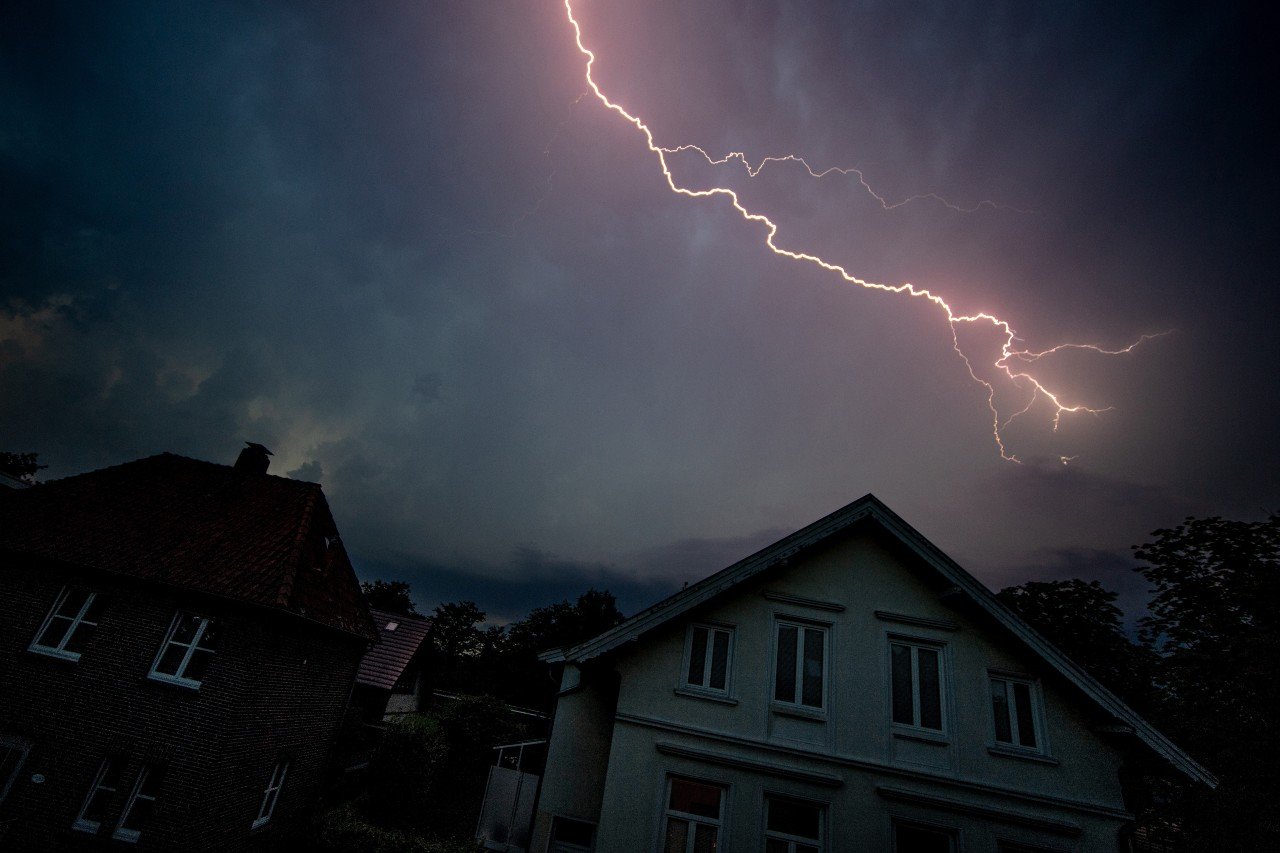
It may look like something out of an eerie ghost movie, but this striking snap was actually taken on Tuesday in the German town of Oldenburg in Lower Saxony.
When it comes to the summer weather, there’s been no shortage of drama this week, with soaring heat giving way to explosive thunderstorms, torrential rain, and even devastating ‘100-year’ floods.
Did you know?
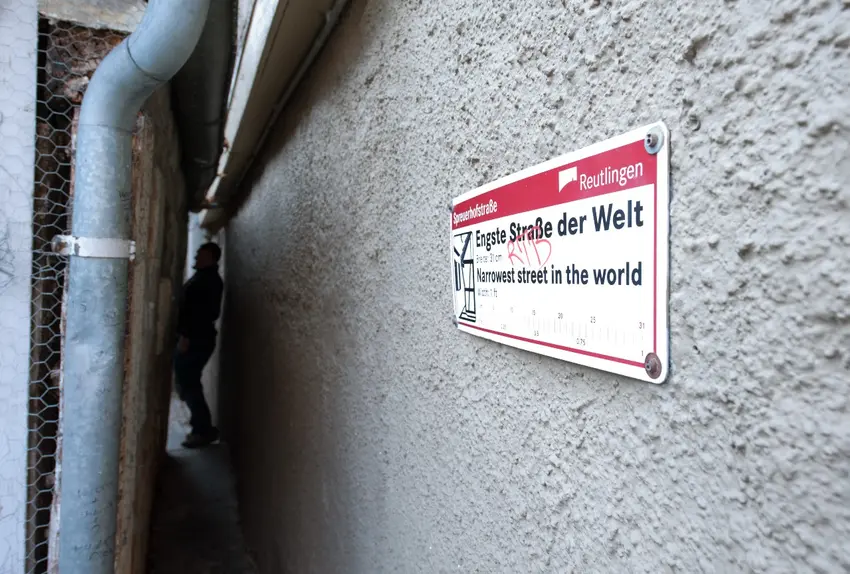
Europe’s historical city centres are known for their small, meandering alleyways and slender streets. But did you know that an little known city in Baden-Württemberg is home to the world’s smallest street? Spreuerhofstraße, located in Reutlingen, holds the Guiness World Record for smallest street in the world.
Thirty-one centimetres wide at its narrowest, and just 3.8 metres long, Spreuerhofstraße appears more like an alley (and a small one at that) than a street to many visitors. But since the entirety of the passageway, which runs between two closely built houses, is on municipal land it technically qualifies as a city street. Besides, it's got straße right there in the name.
READ ALSO: 10 odd tourist attractions in Germany you shouldn't miss
Spreuerhofstraße itself is perhaps not the most impressive sight. Anyone who decides to stroll through the world’s smallest street will inevitably find themselves squeezing, quite intimately, between two blank walls. And, if you do so on a rainy day, you’ll probably catch a few drops of water spilling over from an overhead gutter along the way.
Still, the prospect of taking a gander at the world’s most miniature of roads, is enough to bring tourists from near and far to the humble town of Reutlingen – roughly 35 kilometres south of Stuttgart. Beside the smallest street, the city is home to an established textile industry, and machinery, leather goods and steel manufacturing facilities.
It’s also known as “gateway to the Swabian Jura”. So should you be compelled to visit the region’s picturesque limestone cliffs, valleys, and vast meadows, you could consider a quick stop by the world’s smallest street on the way.
With reporting by Paul Krantz
Comments