
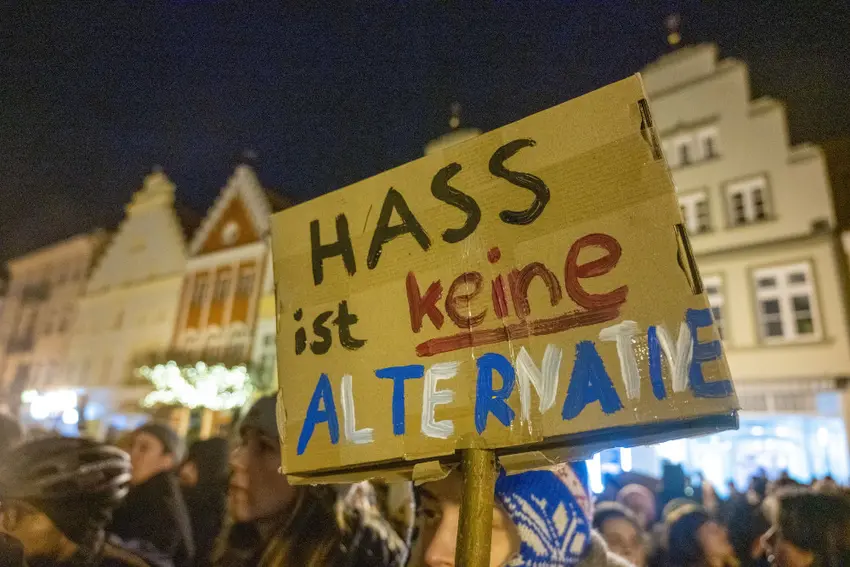
It’s been two weeks now since an investigative report by the German media outlet Correctiv first revealed details of a secret meeting held by right-wing extremists in a Potsdam villa late last year to discuss, in the event of their taking power, how to deport millions of people living in Germany – foreigners, foreign-born German citizens, and indeed native Germans who don’t get with their programme.
Fascists gathered around mahogany tables with lakeside views hammering out inhumane plans? Anyone who knows anything about the 1942 Wannsee Conference will, quite rightly, feel a familiar chill running down their spine.
Important things to remember
I write ‘familiar’, because, in some ways, this kind of thing is unsurprising. Nazism was a powerful ideology into which millions of Germans bought whole-heartedly; it – and those millions – didn’t disappear overnight in May 1945. Quite to the contrary: elements of Nazism have persisted, as have those fascinated by it and those who actively espouse it.
What is more, besides the specifically German problem with hateful ideology, fascism is ever-present in other parts of the world, too, always ready to rear its head when it sees the time come. In 2016, a far-right terrorist murdered Jo Cox, a British MP then campaigning against Brexit; when Britain then voted to leave the European Union just weeks later, violent BNP supporters like Tommy Robinson took to the streets in triumph.
Later that same year, Donald Trump was elected as President of the US, bringing with him far-right activist Steve Bannon as chief strategist.

The UK and US examples are illustrative because they show that, even in countries without a history of industrial mass-murder, the veneer of constitutionality is always thin. Within months of Brexit, hard-line Home Secretary Theresa May – responsible for the ‘hostile environment’ policy which led to the deportation of British nationals from the UK (a.k.a. ‘the Windrush scandal’) – had become Prime Minister. And within days of being inaugurated in January 2017, Trump had already implemented Bannon’s “Muslim ban” by executive order.
Although later declared unlawful, these policies were actually implemented – by civil servants, police officers, and border guards who were simply doing their jobs. For those of us with the potential to figure on fascists’ deportation lists – and as a London-born left-liberal journo with a big mouth, but without several generations of ‘German genes’ to my (Celtic) name, I am not a wholly unlikely target. Neither are you, if you're a non-native German – it’s important to remember these simple facts.
Nevertheless, the openness with which deporting even those of us who have taken German nationality is being discussed remains surprising. Some Potsdam participants were people with influence. Big-name businessmen, including a major investor in high-street food chains BackWerk and Hans im Glück, were reportedly among the participants. So it isn’t just the fringe nutcases who are plotting against us. Now that this has had a couple of weeks to sink in, we immigrants need to examine our position – without succumbing to panic, but with a watchful eye for the risks we face.
READ ALSO: How worried should Germany be about the far-right AfD after mass deportation scandal?
Reasons not to panic
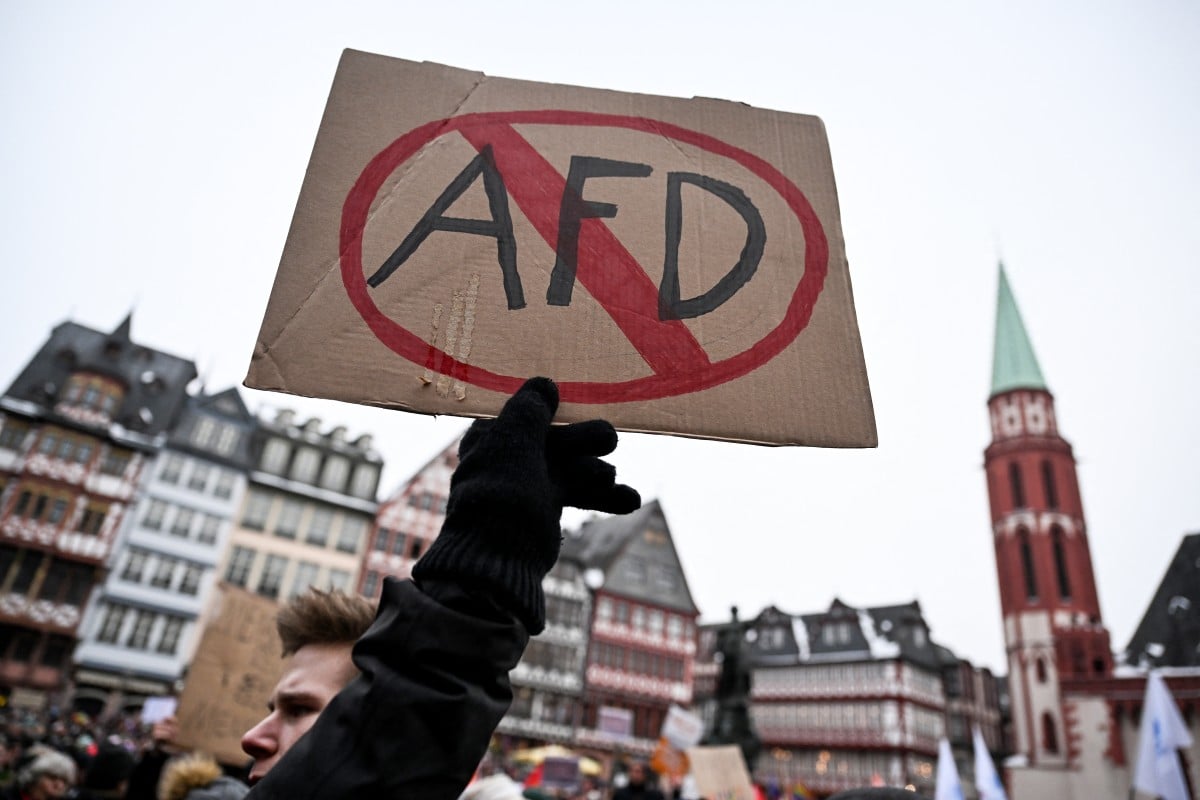
To start, here are some reasons not to do anything rash. Firstly, although it’s easy to conflate things now that everyone is demonstrating against the Alternative für Deutschland (AfD), currently polling 20 percent-30 percent, the revelations concern an informal far-right grouping, not the party itself.
In fact, the AfD is seeking to distance itself from some functionaries who attended the meeting, primarily for tactical reasons (their involvement gives security services good cause to up surveillance), but also because a few AfD politicians do actually believe that their party is not fascist and see themselves as traditional conservatives. That they’re fatally misguided is no reason to impugn their motives, just their analytical abilities.
As it stands, these ‘moderate AfD’ people agree that deporting people with established residency – and especially German citizenship – would be unconstitutional.
Moreover, the AfD is still, despite its current polling, quite a long way from the levers of power. With an electoral, party-political, and parliamentary system broadly comparable to ours and the rise of the far-right populist Sverigedemokraterna setting in around a decade earlier than that of the AfD, Sweden is a useful guide here. And on a Swedish timetable, we could expect an unstable governing coalition formed against the AfD after the 2025 Bundestag election before, in 2029 at the latest, the CDU goes for a confidence-and-supply agreement with it in order to get back into the chancellery.
Reasons to keep your guard up
That brings us on to reasons to be wary longer term. Many are overlooking the presence of two CDU members at the Potsdam meeting, and while the party leadership is taking a zero-tolerance approach in this specific instance, much like the British Tories or the US Republicans, the CDU is drawn to right- wing populism like a moth to a lightbulb. Chairman Friedrich Merz loves nothing more than using an evening political talk-show to indulge in a spot of dog-whistle racism and, in Bavaria, sister-party CSU has gone full maverick, in coalition with unsavoury right-wing populists as it chases an increasingly xenophobic electorate.
By the end of the year, the likelihood is that something similar will have happened in at least one eastern German state – potentially in unstable Thuringia, where the regional CDU has long been eyeing up the potential for a minority administration supported by the AfD. Then there’s Saxony, where the AfD is knocking 40 percent ahead of the autumn’s regional election, and which will probably be ungovernable without some kind of pact. Worryingly, the Thuringian and Saxon wings of the AfD are both considered by security services to be genuine, out-and-out extremists – i.e. even further right than the party at federal level.
READ ALSO: Why the far-right AfD's victory in an east German district is so significant
Reasons to have a contingency plan
This, not the Grand Plans of Potsdam, is the clearest and most present danger to us as immigrants: a Germany in which, first at state level, then nationwide, around a third of the population votes for a party which is, in parts at least, fascist. This, in turn, draws the entire political spectrum further to the right – so expect much more than recent populist pronouncements by (supposedly left-of-centre) Chancellor Olaf Scholz about the importance of “finally starting to deport [failed asylum seekers] at scale” and the matching legislation which recently passed Bundestag. (What’s the German for “hostile environment” again...?)
At least, after some performative scapegoating of refugees, Scholz’ government has been liberal enough to finally allow dual nationality for regular non-EU immigrants looking to become German.
In a worrying sign, this is a change the CDU has already said it would reverse in government; luckily, of course, the reform means those now taking German citizenship will still have their original one as a back-up. Indeed, anyone who gave up a passport to become German in recent years would now be well advised to take steps to getting it re-issued. And people living here with assets abroad or existing claims to residency elsewhere ought to do everything possible to keep them. Just in case…
In case… Well, what? In case, for instance, in 10 years’ time, German society has turned into a distinctly hostile environment in which being foreign-born will be an additional risk factor even if you hold a German passport.
The most probable xenophobic policy (already being floated in some parts of the CDU) will be something like revoking citizenship in case of a criminal conviction. So if you’re a non-native German national, keep your options open – and your nose clean as a whistle from now on. (No crossing the road on a red light anymore!)
Because, to be frank: all the demonstrations in support of people like us are all very well and good, but what would be even better would be a country where almost a third of the population aren’t actively considering voting for a party in which barely-reconstructed Nazi Björn Höcke holds sway. If it ever comes to that, well-meaning demonstrators won’t be there to stop you getting deported.
Sure, a few police officers with principles might resign in protest (or be suspended for not carrying out orders), but there’ll be plenty more to take their place and put the handcuffs on. This isn’t a dig at overly-obedient Germans, by the way: just ask the British nationals sent ‘back’ to Jamaica after a lifetime in the UK in the 2010s.
Or indeed anyone who’s ever experienced deportation – like some of the 14,200 Holocaust survivors still alive in Germany today. Do I think we’re in for a re-run of humanity’s darkest chapter? On balance: no. But then few people in Germany in January 1924 could envision that, just 10 years later, the Nazis would have seized power on around 30 percent of the popular vote.
What would be happening by the early 1940s was, of course, simply unimaginable. Except to those who, in conspiratorial groups, were already talking about it.
Comments (1)