
In just under a month's time, on September 23rd, the current Infection Protect Act will expire – only to be replaced with an even more complicated and pointless successor. Yes: the new act made it through cabinet on Wednesday and looks likely to pass Bundestag in a few weeks. But it will only actually enter into force on October 1st, leaving a potentially 7-day gap in which what happens is unclear, but will – this being Germany – probably involve excessive amounts of mask-wearing and lateral-flow-testing.
READ ALSO: What we know so far about Germany’s autumn Covid rules
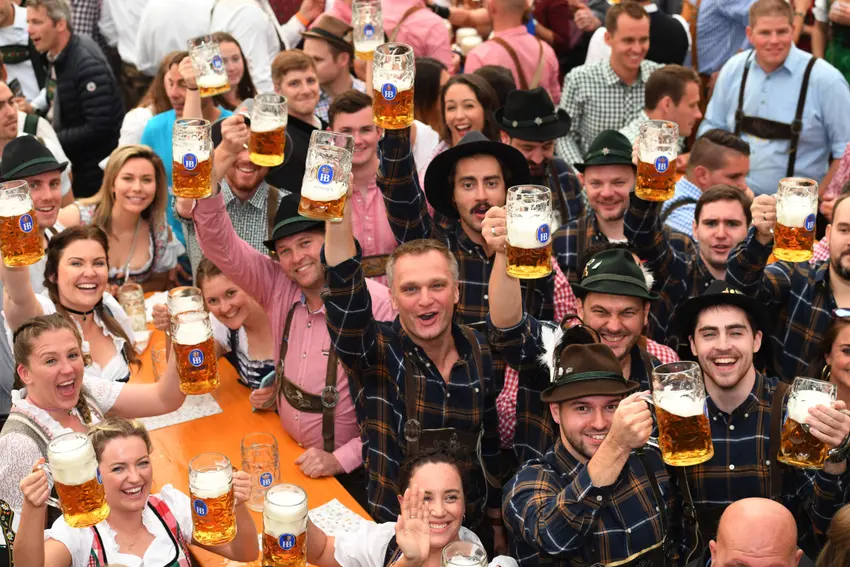
Whatever happens, though, Munich will, after a two-year hiatus, be celebrating a bumper Oktoberfest, from September 17th to October 3rd. Over the course of these two weeks, an estimated six million people will crowd into the tents and beer gardens of the city’s Theresienwiese, consuming an average of 1.13 litres of beer with 0.08 roast chickens per head and exchanging quadrillions of virus particles every minute. All of which will be legal under the current set of legislation – and will remain legal under the replacement.
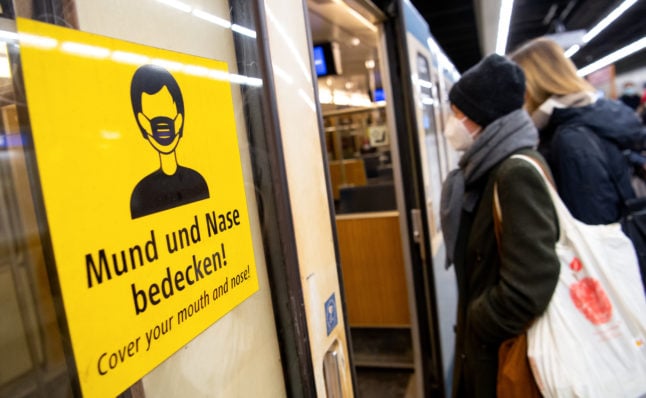
What probably won't be legal (who knows quite yet with the confusing set of rules proposed), is to use the Munich U-Bahn without wearing a mask on your way to and from Oktoberfest. At the same time, statistically speaking, you are quite likely to be among the 92 percent of people in Germany who already, as of late July, carried antibodies against Sars-COV2 (see this study by the RKI) – a figure which, if the number of people I know who have just had Covid is anything to go by, is likely to have increased further to almost 100 percent by mid-September. This makes a mockery of the term ‘Infection Protection Act’ – and also explains why hospitalisations from Covid are low, intensive care bed occupation even lower, and deaths half of what they were six months back.
This is all very good news, and forms part of a Europe-wide success story based on an unprecedented vaccine delivery programme and the fortuitously mild Omicron variant. In all of our neighbouring countries, it has been taken as such. Denmark, for instance, has now been living (and living very well) without any form of Covid restrictions for nearly six months. Later in spring, every country around us that had not already done so quietly confined coronavirus to the realm of regrettable endemic illness. Has the sky fallen in on them? No. Are their health services on their knees? No. Are ours? Also no. Yet in Germany, we are still intent on replacing one set of vestigial busy-body public health rules with another set of even more convoluted ones.
READ ALSO: Opinion - Why Germany can't break out of its Covid rules rut
'Beyond parody'
Without going too deeply into the details of what the tripartite coalition has planned (neither you nor I have all day, and said details are still subject to change), suffice to say that the new Infection Protection Act is so stereotypically German that it’s beyond parody.
Federalism and buck-passing? Check! As ever, the 16 states will be able to more or less set their own rules while demanding that Berlin does the dirty work. Fiendishly complex systems destined to fail on first contact with reality? You bet! As of September, states will be able to reintroduce compulsory mask-wearing indoors – but can make exceptions for people who have just had a booster jab or get a negative test result (but only in restaurants, bars, and other leisure settings); the same might apply in hospitals and care homes, but definitely not in primary schools (although maybe in secondary schools); states may also choose to drop mask requirements on local transport, but they will be ramped up to FFP2 on all intercity train services and flights (unless, of course, you’re flying Olaf Airways and have Frequent Habeck Status…)
If, however, the situation deteriorates (as defined by criteria yet to be announced) these exceptions will all be removed and we go nuclear (i.e. outdoor mask-wearing). This is a phase shift which, to complete our round of German Bullshit Bingo, is explained/further muddied by a niche automotive analogy: summer tires (“Go about your business as usual, but don’t forget your FFP2.”) vs. winter tires (“Oh no…”), with an optional escalation to snow chains (“We’re all doomed! Doomed, I tells ye!”). Want to laugh-cry? Try Karl Lauterbach’s overly complicated PowerPoint slide (pictures below in a tweet) or Marco Buschmann’s half-hearted attempt at defending the madness yesterday morning on Deutschlandfunk.
Der Entwurf für neues Infektionsschutzgesetz ist fertig. FFP2 Masken im Innenraum von Anfang an. Ausnahme: Nachweis Tests, frische Impfung oder frisch Genesen in Gastro oder ähnlich. Wenn Fallzahl stark steigt: Masken auch draußen wo Abstände nicht reichen und Obergrenzen drinnen pic.twitter.com/7JQRxWlOBL
— Prof. Karl Lauterbach (@Karl_Lauterbach) August 3, 2022
In short, the new law pours all of our quirks and foibles into a form so perfectly potty it looks like satirist Jan Böhmermann brought Harald Schmidt out of retirement before teaming up with the ghost of that great observer of German national neuroses, Loriot, to poke fun at us.
Which begs the question: why are we about to do this? And why are we going to do it in such a patently crazy, borderline unenforceable way?
The two sides of Germany's Covid rules
First: why are we doing this? The short answer to that is: Federal Health Minister Karl Lauterbach (SPD). For whatever reason (and I don’t think it’s fair to speculate too much about personality traits), Lauterbach is more afraid of what Covid might do to the population – and less afraid of the corrosive societal effect of lasting restrictions – than other ministers with his brief in comparable countries. It could turn out, of course, that Lauterbach is right: if the “killer variant” he prophesises does surface this autumn, I and a lot of others will be doing public penance.
My hunch is, though, that the German Health Minister doesn’t have a direct line to a secret source of Covid wisdom and can’t see into the future: his change of position on whether everyone should get a fourth jab or just the over-60s proves as much. Instead, he and a few others around him (notably the Green’s health spokesman Janosch Dahmen) are probably seeing exactly the same facts and figures as their counterparts in France, Belgium, the Netherlands, Denmark, Sweden... (as well as many German virologists and epidemiologists in favour of scrapping restrictions), but drawing wildly different conclusions.
Second: if we’re doing this, why are we doing it in such a complicated way? The short answer to that is: Federal Justice Minister Marco Buschmann (FDP). He and most of his party – the (emphasis on) Free Democrats – are not in favour of endless restrictions without justification. And, as it turns out, neither is our constitution. And I for one am pleased that, after being first ignored and then laxly interpreted for over two years, our cherished Grundgesetz is now once again being taken seriously.
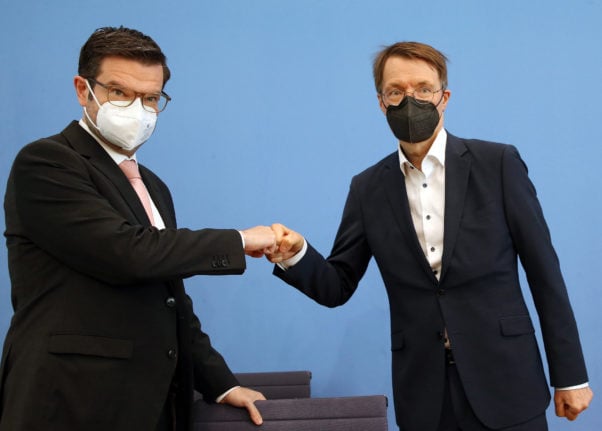
One of its guiding principles is that curbs to the freedoms it guarantees must be a) proportionate and b) appropriate: as Buschmann has argued, forcing people triply-vaccinated against and twice recovered from Covid to cover their mouth and nose when entering a restaurant is, at this stage of proceedings, no longer proportionate nor appropriate, and so states will be allowed (read: encouraged) to keep restrictions light here. Why the same doesn’t apply to trains or planes is anyone’s guess – here’s mine: political horse-trading to reach a compromise; or perhaps a shrewd FDP move to finally see off restrictions by making them so inconsistent that they represent easy prey for complaints to the Constitutional Court this autumn.
Ah yes, this autumn. What a wonderful place Germany will be, with the lights switched off in high streets and those who can no longer afford to heat their flats being held up on the doors to bars as they desperately search for the long-neglected CovPass app so that they can at least gain access to the warm fug without having to run back home for their grubby FFP2… So if you weren’t yet planning to head to Munich for the Oktoberfest this year, my advice would to hightail it down there for one last blow-out before things get really unpleasant.
Comments (3)