
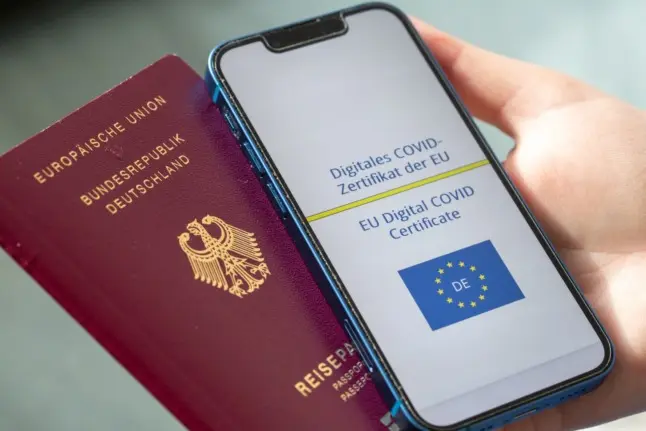
Being vaccinated against Covid-19 will no longer be enough for many travellers to visit Germany from February 1st 2022.
German authorities have followed the EU’s recommendations to Member States, meaning that the travel rules regarding Covid-19 certificates and the required vaccinations have changed.
From February 1st, if you were fully vaccinated more than 270 days ago (about nine months), you will need to show you’ve had a Covid booster shot to be able to visit Germany while using the EU digital vaccination pass.
After this period, people without a booster shot will be treated as unvaccinated when crossing EU borders.
Instead, they should be asked for a recent negative test and may even have to quarantine for a short period when travelling across borders in the EU.
"This reflects the declining protection of the vaccine and underlines the importance of a booster," said EU Justice Commissioner Didier Reynders.
The EU decided on nine months to allow people to get a booster shot within six months after their last jab, with a three month grace period.
In Germany, authorities recommend that people get their booster jab three months after they were fully vaccinated.
A German Health Ministry spokesperson confirmed to The Local that the EU Council had "established a recognition period of 270 days for the EU digital vaccination certificate for travel purposes".
"This regulation will apply from February 1st 2022. As a regulation, it is directly applicable EU law and therefore does not require transposition into national law."
READ ALSO: EU countries agree to simplify travel rules with Covid certificates
The spokesperson said there is no time limit on the validity of the booster jab.
"For entry into Germany - and other EU member states - EU digital Covid vaccination certificates are therefore valid for 270 days after completion of the first vaccination series (basic immunisation), and indefinitely in the case of booster vaccination," said the spokesperson.
"The check-apps will be adapted accordingly so that it is recognisable in travel whether someone is considered fully vaccinated according to EU requirements."

"The new rules for travel within the EU harmonise the different rules in the Member States," said the EU Commission. However, the rules on how long basic immunisation is valid in EU countries - for example for visits to restaurants or events - can still differ from place to place.
Do these rules apply to all vaccinated arrivals to Germany?
Apparently not. There is no indication that people arriving in Germany with a foreign vaccination certificate (for example, with a CDC card from the US, or a digital vaccine certificate from India or the UK) have to get a booster shot within nine months to be allowed into Germany.
The Local asked the Health Ministry directly if this was the case. They did not answer our question, but we'll chase it up.
Unvaccinated people from non-EU countries are generally not allowed to enter Germany unless they are from a so-called 'safe country' or they have an exceptional reason to come to Germany.
READ ALSO: What you should know about travel to Germany during the Omicron wave
Does this apply within Germany too?
Germany has several strict Covid-19 health pass rules, such as the 3G, 2G and 2G-plus restrictions.
2G-plus, for instance, means that people have to show proof of vaccination/recovery and a booster shot or a negative test for entry into places like restaurants, bars and cafes in most states.
However, the 'nine month validity rule' does not apply in Germany for restrictions like this, even though many people use their EU digital vaccination certificate as proof.
"For other purposes within Germany (2G and 3G), the time limit does not apply," the Health Ministry spokesperson told us.
In fact, in Germany, there is currently no regulation that limits the recognition period of vaccination certificates.
However, people with booster vaccinations can be exempt from testing requirements under certain circumstances which is aimed at encouraging people to get a booster.
What about if I've recovered from an infection?
Germany recently changed the rules on the recovery status of people who've had Covid.
People in Germany are now classed as 'recovered' in Germany if they had a Covid infection within the last three months instead of six months.
This is also the case for travel into Germany.
"The validity of the 'certificate of recovery' has already been limited to 90 days for Germany since January 15th," the Health Ministry spokesperson told us. "This period also applies to entry into Germany."
Health Minister Karl Lauterbach recently brought in this change of rule, however, it has been controversial - not least because there are exceptions for politicians while in the Bundestag debate room.
It also means Germany has veered away from the EU line on this topic.
At the EU level, countries agreed that the recovery status should be recognised for travel for six months.
How do I get the EU digital vaccination certificate?
The vaccination certificate consists of a QR code that is generated after the vaccination by doctors' offices or vaccination centres. It can also be given out in pharmacies if you provide proof of your jab.

People can upload it into their smartphone and onto an app such as the Corona Warning app or CovPass app, or use the QR code paper.
The codes are recognised everywhere in the EU despite the different apps of the individual countries, and make it easier to prove your Covid-19 status when travelling in the bloc.
One issue in Germany is that the EU digital vaccine certificate is only for people who are based in Germany so tourists are not meant to get it. However, some people have reported to The Local that they have been able to get the digital pass in a pharmacy.
READ ALSO:
Comments (8)