
1. “Späti”
Ah, the classic Spätkauf. No matter how new you may be to Berlin, you will definitely have seen them around. They are essentially newsagents that are open to very late (or spät, meaning late), although many are open 24/7. They are most famous for being a constant source of alcohol for Berliners at anytime.
“Ist die Kneipe noch offen?”
“Keene Ahnung, aber wir können zum Späti gehen.”
“Is the pub still open?”
“No idea, but we can to the 24/7 newsagents.”
SEE ALSO: More than a corner store: Spätis struggle for survival in a changing Berlin
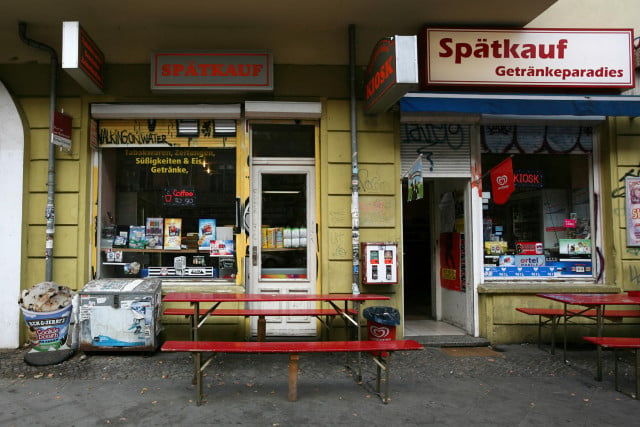
A typical Späti with long benches and late opening hours. Photo: DPA
2. Schrippe
Schrippe is just another word for Brötchen or in English, bread roll. The word comes from the fact that part of the roll is ripped out or “geschripft” during the baking process.
“Ick geh mal uns n’ Paar Schrippen holen.”
“I’m going to get us some rolls.”
SEE ALSO: 10 ways to pass yourself off as a true Berliner
3. “Fatzke”
A weird looking person is called a Fatzke. The term originates from the old German word “Fatz”, which means “mockery” or “cruel joke” in German.
“Wie siehtn’ der Fatzke aus?”
“Look at the head on that weirdo.”
SEE ALSO: Berliner Schnauze: The 'rude' German attitude that foreigners can learn from
4. “Ick”
Ick or icke is the one true Berliner way for referring to oneself. It is said to have originated with along with the modern Berlin dialect in the late 1800s.
“Juten Morgen! Ick bins!”
“Good morning! It’s me!”
5. “Imchen”
If for whatever reason you happen to be talking about someone behind their back, you could use this piece of Berlin-speak to refer to them. Be careful with now you use it though; in a positive context it is usually used for affectionately, while in a negative context it is quite pejorative and condescending.
“Watt hat Imchen heute widder gemacht!”
“What did they do this time!”

The colleagues of this poor Imchin are talking about him behind his back. Photo: Depositphotos/lightwavemedia
6. “Ische”
Coming from the languages Hebrew and Yiddish, Ische is another word for a girl or young woman. However it is frequently used to describe one’s girlfriend or wife of any age.
Even for a German word it is quite a strange one, and has roots in the Hebrew and Yiddish languages.
“Ne ick kann net, sonst schreit die Ische wieder los.”
“No I can't, otherwise my wife will go nuts.”
SEE ALSO: How Yiddish survives in Europe - through German
7. “Jond’l”
Jond’l is a mispronunciation of “Gondel” (meaning gondola) and is used in Berliner Umgangssprache as another word for head. The possible similarities that exist between the human head and a transport compartment are yet to be determined.
“Da hast ja ‘n Ding an de Jond’l wa?”
“Are you not right in the head?”
8. “Junget Gemüse”
“Junget” is “Junges” (meaning young) in a heavy Berliner accent, and Gemüse is simply German for vegetables. The term is used by older Berliner to describe teenagers and children, and usually not in positive way.
“Heh! Pass auf du Junges Gemüse du!”
“Hey! Watch out young one!”
9. “Kaff”
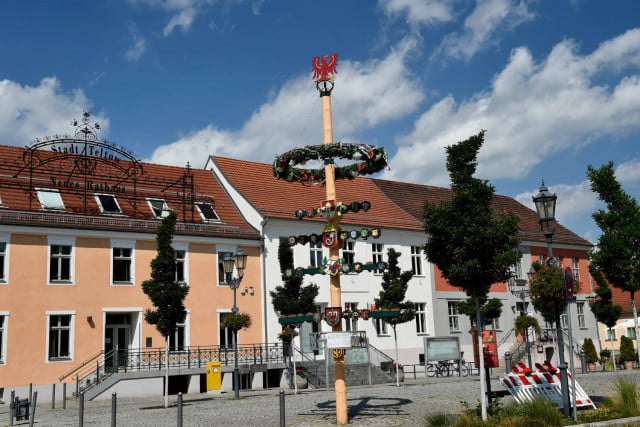
Some Berliner might consider Teltow in Brandenburg a 'Kaff' but we don't think it's such a bad place to visit! Photo: DPA
Probably one of the most condescending words use by Berliner on this list, it is used to describe a small, unattractive and boring place. Berliners often use to describe, well, anywhere just outside of Berlin.
“Teltow? Pfff, dit ist ja nen’ Kaff!”
“Teltow? Pfff, that's a kipp!”
10. “Kiez”
If you live in Berlin, you have most likely heard of this word, but it’s included on this list anyway because you wouldn't sound like a Berliner without it. Kiez refers to a small city neighbourhood and the small community living there. The word is surprisingly old, and dates back to describe German and Slavic communities living side-by-side during the Middle Ages.
“Mann muss schon sagen, diesen Kiez ist echt Hammer!”
“You gotta say, this neighbourhood is awesome!”
SEE ALSO: German word of the day: Der Kiez
Comments