
This article is available to Members of The Local. Read more Membership Exclusives here.
Spend a day in central Berlin and you might begin to wonder what the official language is. There will be the coffee shop with a sign proclaiming “We accept Sofortüberweisung,” or young Germans on the U-Bahn who say “Oh nice!” when hearing about the “highlight” rather than the Höhepunkt of a friend’s weekend. Then they might grumble that a concert got gecancelt.
Is Denglisch becoming so ubiquitous that it is causing the German language itself to go extinct? Not exactly, Free University of Berlin linguistics researcher Dr. Britta Schneider tells The Local.
Rather, it’s causing the language to evolve, bringing in more English words and phrases that simply become part of the Deutsch vocabulary after a while. This causes the original German words to either be used very sparingly, informally or not at all.
Now Germans will say computer rather than Rechner, even though they are aware of the latter word’s meaning. A word like Baby will take the place of Säugling, which might only be used in medical literature describing infants.
And there are some words that most Germans themselves don’t know once carried a very different equivalent, such as Leibesertüchtigung for sport (the word sport was introduced to the German language over 150 years ago by a prince after his trips to England and Ireland).
The phenomenon of Denglisch is not just limited to Berlin, but even the smallest of villages in Germany thanks to TV and media, says Schneider. Commonly it is the media and advertising that introduces Denglisch phrases, or popular TV shows such as Germany's Next Topmodel.
Nowadays on TV talk shows when someone speaks in English - including the increasing number of foreigners who make an appearance on them - their speech is often not translated.

German TV uses, and often introduces, many Denglisch words and phrases. Photo: DPA
In some fields, such as academia and marketing, Anglicisms are becoming so widely thrown around that they are replacing the original German - sometimes without the knowledge of those who use them .“These days many people don't notice if they're speaking English or not,” says Schneider.
SEE ALSO: Germans love English adverts - but don’t understand them
Getting back to the roots
For decades, a prime usage of Denglisch in Deutschland has been “Sale,” yet even now it’s possible to see its German equivalent of Schlussverkauf advertised in stores.
Such usage of an old German phrase in favour of a more modern one is often done for ideological reasons, or as a way to protest the growing use of English, says Schneider. “Sometimes German will be used for purism, for getting back to one’s roots,” the linguistics expert adds.
There have long been attempts to preserve the German language, keeping intact the use of distinctly Deutsch words. In 2001, Christian Democratic (CDU) politician Eckart Werthebach drafted a law for the protection of German, similar to one that already exists in France, where even Internet has its own uniquely French translation.
Only last year, CDU politician Jens Spahn notoriously complained about the use of English at hipster-driven Berlin coffee shops, saying it excludes people who don’t know the language well or are trying to integrate better into German culture.
Companies as well have protested the growing use of Denglisch, with Deutsche Bahn introducing a handbook for its employees on the correct German terms to use, so as not to isolate any customers or make them feel uncomfortable. Employees were instructed to use Handzettel instead of flyer, and Service-Nummer instead of hotline.
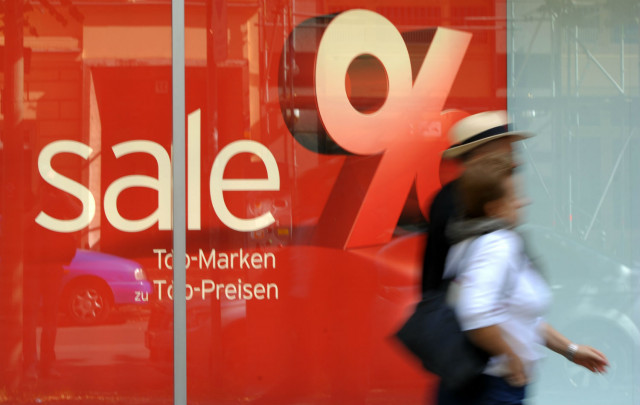
A sale at a department store in Berlin is just one long-time use of Denglisch. Photo: DPA
The spread of Denglisch grammar
The influence of English does not just shift the vocabulary, but also the structure of German, says Schneider. For example, instead of "Weil ich in die Stadt gegangen bin," Germans - even in official contexts such as TV - may say, "Weil ich bin in die Stadt gegangen." Still, the use of this incorrect grammar is stigmatized and usually not done on purpose, says Schneider.
English structure is also woven into German through so-called “calque”, a linguistics term for a loan translation. Words and phrases which once made little sense in German will also find their way into the language, including “Das macht Sinn,” rather than the original “Das ergibt Sinn.” When describing years, Germans furthermore used to say “im Jahr 2018” whereas nowadays they will often express the year similar to in English, saying “in 2018.”
In English, people have long nodded their heads while saying, “I see” to connote understanding. But only recently did “Ich sehe” become used in German among youth. If unfamiliar with the phrase, Germans might wonder what exactly the other person is seeing.
Teenagers will also toss out common constructions in English such as “Oh mein Gott!” which previously would have only taken on a literal meaning in German. When Schneider heard children say the phrase, she thought to herself, ‘We didn’t teach our children to be religious.’
READ ALSO: 10 German words becoming extinct thanks to English
English in work, German at play
Still, German is one of the most widely spoken languages in the world and, as such, unlikely to disappear altogether, says Schneider. Yet in some settings she envisions English becoming the official language at universities and workplaces, while German will remain the language of the private sphere, spoken among friends and families.
In some academic fields such as natural sciences and engineering, it is already expected that researchers only pen their papers in English, posing a disadvantage to non-native speakers. "It's unfair that the publisher expects us to pay for a professional native speaker to edit the published text,” says Schneider.
Yet English education in Germany is becoming better and better, and it’s now expected that anyone with a university degree has the language of the Bard under their belt.
That’s why speaking English is no longer advertised as a requirement for many jobs, particularly in Marketing, as it’s already assumed that a uni-educated applicant will speak it fluently, says Schneider.
The linguistics researcher noticed a greater push-back against Denglisch a decade ago, when there was much less of it than today. But now more and more people are embracing it as a “modern and successful” way of speaking - while still continuing to keep their mother tongue alive.
Denglisch users are simply dabbling in a new vocabulary, she says. "Boundaries between language are socially constructed. Linguists might say that we're not using different languages, but different repertoires."
SEE ALSO: Why some foreigners live in Germany without mastering the language
Comments (1)