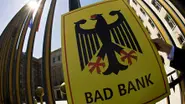
German national debt has been slashed by nearly €56 billion at a stroke, after the books were checked at the ‘bad bank’ of the nationalised Hypo Real Estate (HRE).
Germany's Deutsche Bank was aware of fraud being committed by a US subsidiary that issued thousands of bad mortgages before the 2008 financial crisis, US prosecutors have alleged.
US investment fund Lone Star has begun the process of selling the German bank IKB, the country's first financial crisis victim, which Lone Star bought in 2008, an executive said Wednesday in an interview.
Germany will pump another €2.08 billion ($2.79 billion) into the troubled bank Hypo Real Estate, the financial market stabilisation fund SoFFin said Wednesday in a statement.
Germany’s taxpayers’ association (BdSt) on Monday attacked generous bonus payments for bankers at the nationalised Hypo Real Estate bank, calling them a “scandal.”
Germany's troubled Hypo Real Estate bank, which last year narrowly avoided bankruptcy before being nationalised, will get another €40 billion in state guarantees, a government agency said on Friday.
German prosecutors said Tuesday they had dropped a probe into six bankers from state-owned KfW for transferring some €320 million ($408 million) to Lehman Brothers after it had collapsed.
German Chancellor Angela Merkel would give the nation's banking supervisor extensive powers over struggling banks, including the capacity to dismiss executives, the Financial Times reported on Friday.
The German cabinet approved draft legislation Wednesday that would take risky assets from state-owned regional banks and group them in a "bad bank" in exchange for a serious slimming down of the Landesbanken.
Shareholders in the troubled German bank Hypo Real Estate approved late Tuesday a nearly €3-billion capital increase to be subscribed by the state, one of the last steps in total nationalisation by Berlin.
Germany's representative in the European Commission launched a sharp attack on his own country's banks on Monday, saying they had been "world champions" in investing in risky financial products.
Germany has struck a broad agreement on a plan to clean up toxic assets from banks' balance sheets, Finance Minister Peer Steinbrück said Tuesday after a crunch meeting with key government leaders.
Germany launched Friday its bid to nationalise troubled mortgage lender Hypo Real Estate (HRE), offering to buy 100 percent of the firm's shares at what it termed an "attractive price."
The German state will provide another €12 billion ($15 billion) in guarantees to struggling Hypo Real Estate bank, bringing the total to €42 billion, HRE announced late Tuesday evening.
German state-owned regional bank WestLB is to seek government guarantees worth at least €10 billion under a rescue scheme, the daily <i>Rheinische Post</i reported Saturday.
German property lender Hypo Real Estate expects to suffer heavy charges in 2009 after flirting with bankruptcy this year, the bank said in a statement on Monday.
German property lender Hypo Real Estate (HRE) posted on Wednesday a third-quarter net loss of €3.1 billion ($3.89 billion) and said it expected more bad news by the end of the year.
Troubled German property lender Hypo Real Estate has obtained a €15 billion ($19.3 billion) state loan guarantee under the government rescue plan for the banking sector, a spokesman said late on Thursday.
The German government on Thursday slashed its growth forecast for 2009 – the world’s third largest economy is now only expected to expand by a meagre 0.2 percent next year.
Germany’s leading stock index the DAX surged ahead on Monday, as bank shares were buoyed by the government’s plans to set up a massive rescue package for the financial sector.
German Chancellor Angela Merkel called on Friday for a framework of international market rules – in place of national regulations – to prevent financial crises like the one now threatening the world economy.
The European Central Bank cut its main lending rate by half a percentage point to 3.75 percent on Wednesday in a concerted effort with the world's leading monetary authorities to stem the growing global financial crisis.
Germany’s leading stock index the DAX plunged below the psychologically important 5,000 mark in early trading on Wednesday, as investor flight from equities continued.
German Chancellor Angela Merkel said on Tuesday that the long-term consequences of the global financial crisis were uncertain but that she was confident the "strong" German economy would survive.