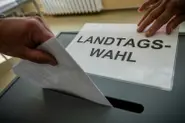
With just over a week to go until Saxony and Thuringia vote on their new state parliaments, we take a look at the scary overlap between the policies of the far-right AfD party and left-wing splinter group BSW.
Hamburg has the highest percentage of SPD voters in Germany, but is increasingly cut off from federal branches of the party. How will this shape the year's state elections on Sunday?
Mainstream parties have ruled out working with the far-right AfD. But now CDU officials in Thuringia say talks with the anti-immigration party shouldn't be ruled out. Is the tide turning?
German Chancellor Angela Merkel faces renewed pressure from within her Christian Democrats after the centre-right party was beaten by the populist, far-right AfD in the Thuringia state election on Sunday.
The Left party won, the far-right AfD scored another major success and the CDU suffered historic losses. What do the Thuringia election results mean for Germany?
Exactly five voters saved the FDP (Free Democrats) from a new electoral flap, and made Thuringia the only east German state where the liberal party has parliamentary representation.
Germany's far-right AfD party faces a key test of support in a state election in former communist east Germany on Sunday, following national outrage over a deadly shooting at a synagogue.
For years after the fall of the Berlin Wall in 1989, the mantra for millions of former East Germans was to "Go
West" for better jobs and opportunities. But now the reverse is often the case.
The AfD is undoubtedly stronger following the Saxony and Brandenburg elections. But it will be shunned by other parties when it comes to forming state governments. What does it all mean?
The latest electoral surge by Germany's far-right AfD highlights the decline of the downfall parties who scored narrow, last-gasp victories thanks mainly to a dwindling band of elderly voters.
In Saxony, the AfD (Alternative for Germany) almost tripled its numbers from 2014, and doubled them in Brandenburg. But CDU and SPD want nothing to do with the right-wing populists in forming the government.
Germany's far-right AfD party surged to new strengths in elections for two eastern states on Sunday, exit polls
said, reflecting anger over Chancellor Angela Merkel's migrant policy and a wealth gap 30 years after the Berlin Wall fell.
On a sweltering hot day in the lead up to two state elections in eastern Germany, The Local visited Brandenburg to find out why the Green party is winning more support – and to speak to voters.
For the first time ever, the AfD could take the top spot in state elections in Germany. How likely is it and what does it mean? Here's what you need to know.
The Saxony state elections, where the AfD is expected to make big gains, take place a year after anti-foreigner protests broke out in Chemnitz. The Local found out how the city is trying to recover.
Feeling ignored and short on resources, many in the east German state of Brandenburg are turning to the far-right Alternative for Germany (AfD) ahead of the September 1st state elections.