The German government on Thursday defended controversial state aid to car maker Opel against complaints by Britain and other European countries, saying Germany would bear the brunt of recently announced job losses.
Canadian auto parts maker Magna will cut more than 4,000 jobs in Germany when it takes over the Opel business of struggling US auto giant General Motors, the <i>Frankfurter Allgemeine Zeitung</i> reported on Tuesday.
Media reports over the weekend suggest that Magna, the new owner of car maker Opel, could begin mass layoffs as early as Monday, starting with over 1,800 jobs at Opel headquarters in Rüsselsheim near Frankfurt.
Belgium has stepped up its offensive against German state aid to auto manufacturer Opel's planned new owners, demanding that the slightest hint of protectionism be slapped down by Brussels.
Canadian auto parts maker Magna said Monday that it planned to cut 4,000 posts at loss-making carmaker Opel once it completes its takeover of the General Motors' German unit.
While top-ranking politicians celebrate the agreed sale of Opel to the consortium headed by Austro-Canadian car parts maker Magna, information has emerged that it will mean the loss of thousands of jobs – and potential legal difficulties.
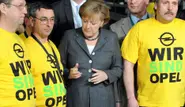
We are the people, we are the Pope – we are Opel. The motto printed on the fetching yellow t-shirts of Opel workers certainly has its charm. But it also shows the ridiculous importance Germans have attached to the fate of one struggling carmaker, argues Moritz Döbler from Berlin’s newspaper <a href="http://www.tagesspiegel.de" target="_blank">Der Tagesspiegel</a>.
General Motors' decision to sell its European unit Opel to a Canadian firm backed by Russian finance raised concerns on Friday about the widespread layoffs.
Chancellor Angela Merkel announced on Thursday that US car giant General Motors is prepared to sell its German unit Opel to the Canadian auto parts firm Magna after all.
General Motors was expected to reach a decision on Wednesday on the fate of European subsidiary Opel after weeks of delays, which have drawn ire from the German government and unions.
US car giant General Motors has reportedly decided not to sell the German carmaker despite months of negotiating with potential buyers for fear of handing technology to Russian competitors.
General Motors, which for months has been trying to sell Opel, is reportedly now trying to keep the ailing German brand, a move that would drive a stake in Berlin's favoured option: a takeover by Magna.
General Motors kept Germans guessing over the weekend over the fate of its troubled Opel unit even as pressure mounted for a decision on a proposed takeover by Canada's Magna International.
The decision on the future of Opel, expected to be made on Friday evening, has again been postponed after managers at General Motors could not agree on which bid to accept for its troubled German unit.
Germany upped the pressure on US auto giant General Motors on Thursday to sell its European unit Opel to Berlin's preferred bidder, setting the stage for a potential transatlantic showdown.
The Austrian-Canadian auto parts company Magna has reportedly worked out an agreement with US carmaker General Motors regarding the takeover of its German unit Opel. But the deal has yet to be inked.
German Chancellor Angela Merkel is prepared to take a personal role in the talks over the takeover of General Motors' embattled subsidiary Opel, her spokesman said on Wednesday.
The race to take over General Motors Opel unit was reduced to a head-to-head duel on Thursday after GM jettisoned an offer from China's BAIC, leaving just Magna and RHJ International standing.
Belgian holding company RHJ International would slash almost 10,000 jobs if it takes over troubled German car maker Opel, executive director Leonhard Fischer said in an interview published on Friday.
Speculation swirled around the troubled German automaker Opel on Monday, with conflicting news about an offer by Beijing-based auto group BAIC and a new overture by Belgium-based investor RHJ International.
Germany fears a "dangerous dependence" on China if Beijing-based firm BAIC is allowed to take over troubled General Motors subsidiary Opel, according to a government report cited by the media on Monday.