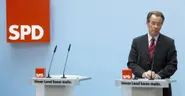
Breaking a longstanding political taboo, Sigmar Gabriel, the designated leader of the centre-left Social Democratic Party (SPD), has said he would consider working with the hard-line socialist party The Left after Germany’s next federal election in four years.
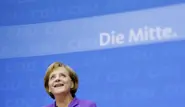
Freshly re-elected Chancellor Angela Merkel begins on Monday what could be prickly negotiations with her new coalition partners over forming a government amid differences over taxes and ministerial portfolios.
Angela Merkel’s conservative Christian Democrats (CDU) and their Bavarian allies have struck and agreement over tax relief ahead of coalition negotiations with the Free Democrats next week, promising cuts but not setting a firm date for their introduction.
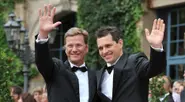
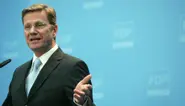
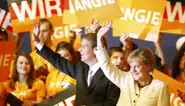
He had his public coming-out five years ago at Angela Merkel’s 50th birthday party and now Guido Westerwelle is in the frame to become Europe’s first openly gay foreign minister.
The Social Democrats suffered a resounding defeat in Sunday’s election. <b>Lorenz Maroldt</b>, editor-in-chief of Berlin daily <a href="http://www.tagesspiegel.de" target="_blank">Der Tagesspiegel</a>, believes the beleaguered centre-left party can now deal with the issues it has neglected for too long.
Guido Westerwelle, Germany’s newly designated foreign minister, refused to answer a question in English for a BBC reporter during his first press conference after the election, news magazine <i>Der Spiegel</i> reported on Monday.
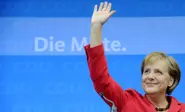
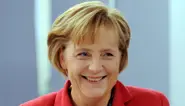
Angela Merkel set to work Monday on a new centre-right coalition after clinching a second term, but warned Germans of a hard road ahead to revive the sickly economy and rescue jobs.
US President Barack Obama and other world leaders hailed German Chancellor Angela Merkel's election triumph - but the international media highlighted the German conservatives' worst vote tally in half a century.
Join The Local for live coverage from the election headquarters of Germany's five main political parties in Berlin. We'll have interviews and insights all evening long. Click your browser's refresh button for the latest updates.
Early exit polls showed Chancellor Angela Merkel's conservatives winning Germany's election on Sunday, with a centre-right coalition with the Free Democrats likely.
German voters have handed Chancellor Angela Merkel another four years in office and a mandate for change. But will the country wake up with an election hangover if she now becomes a vigorous conservative reformer?
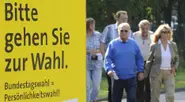
Despite abundant sunshine and mild temperatures across much of Germany, voter turnout for the country's general election on Sunday was shaping up to be much lower than four years ago.
Will it be a Jamaica coalition, the traffic light, black-yellow, or perhaps even red-red-green? There's a kaleidoscope of possibilities for the outcome of Sunday's German election, where every party goes under its own colour.
German Chancellor Angela Merkel made an 11th-hour push for votes on Saturday, the eve of an election expected to return her to power but perhaps not in the new coalition she wants.
Nearly half of Germans favour the introduction of compulsory voting to lift the participation rate as the country heads into an election that could draw the lowest turnout on record, according to a new poll.
German Chancellor Angela Merkel's embattled challenger Frank-Walter Steinmeier has warned of social injustice and unrest if her right-wing coalition of choice wins Sunday's poll and predicted its lead would vanish on election night.
Angela Merkel looks set to remain chancellor after Germany’s general election on Sunday. But as The Local’s Marc Young explains, she could end up governing with a coalition lacking democratic legitimacy.
With less than a week before Germany’s election, Roger Boyes, the Berlin correspondent for British daily The Times, muses that the country’s voters like being bored by Angela Merkel and her political cohorts.
With the September 27 election approaching, The Local's continues its series of interviews with candidates for parliament with non-German backgrounds. Serkan Tören is a Turkish-born lawyer in Hamburg running for a seat in Bundestag for the Free Democrats.
As the federal election approaches, The Local's new series on politicians with non-German roots features Green party MP Omid Nouripour, an Iranian-born Hessian who says his background gives him a special appreciation for democracy.
If no one wins is everyone a loser? The Local’s Marc Young attempts to find the significance of Germany’s muddled state elections on Sunday less than a month ahead of a national poll.
With just over a month left until Germany’s general election on September 27, <b>Dr. Jackson Janes</b> from the American Institute for Contemporary German Studies at Johns Hopkins University offers a political primer of what’s at stake for Chancellor Angela Merkel and her challenger Foreign Minister Frank-Walter Steinmeier.
A government car scandal, an industrial policy paper no one wants to accept responsibility for and plenty of noise: <b>Katharina Schuler</b> from <a href="http://www.zeit.de/index" target="_blank">Zeit Online</a> believes German voters deserve a better election campaign.
Frank-Walter Steinmeier, the Social Democratic Party’s chancellor candidate, announced last week a plan to create full employment in Germany by 2020. Rejecting criticism he’s being unrealistic, he argues his political opponents offer no alternative.