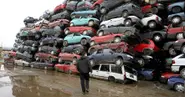
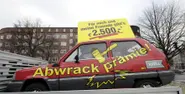
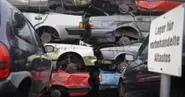
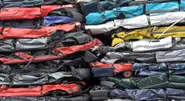
In light of the German auto industry’s buoyant earnings, politicians from the ruling coalition suggested Tuesday that the companies repay the money they earned during the government-sponsored “cash for clunkers” stimulus programme in 2009.
German auto giant Daimler suffered a sharp loss last year that surprised markets Thursday and pushed its share price lower as the group reported results from one of the auto sector's most challenging years.
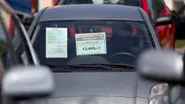
Grappling with the end of the popular “cash for clunkers” government stimulus programme, car dealerships in Germany are offering discounts of up to 42 percent on new vehicles, magazine <i>Auto Motor und Sport</i> reported on Thursday.
Daily newspaper <i>Die Welt</i> on Friday reported that 90,000 jobs are at risk in the German car industry, as the country's spectacularly successful "cash for clunkers" programme draws to a close.
Politicians are calling for tighter controls after further reports of criminal misuse of Germany’s "cash for clunkers" car scrapping premium emerged this week.
Fraudulent claims on scrap cars from Germany have gleaned millions of euros in the Netherlands, and some of the vehicles are coming from the popular <i>Abwrackprämie</i>, or car scrapping premium, Dutch paper <i>De Telegraaf</i> reported on Monday.
The budget for Germany’s popular <i>Abwrackprämie</i>, or car scrapping premium, could be exhausted before parliamentary elections in September, daily <i>Bild</i> reported on Tuesday.
Auto industry experts fear a sharp downturn in sales after this year’s figures have been dramatically boosted by the car-scrapping premium the German government introduced in January, news magazine <i>Der Spiegel</i> reported Thursday.
Germany's cash-for-clunkers auto premium has drawn more women to Europe's biggest car market than ever before, according to a study released on Thursday.
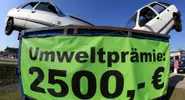
The German cabinet agreed to extend the popular car-scrapping bonus Wednesday morning, earmarking a further €3.5 billion for the scheme. The bonus, which can be claimed until the end of the year, will also remain at €2,500, government sources said.
The German government must still decide if it will prolong a popular €2,500 car scrapping bonus at its current value, a spokesman for Chancellor Angela Merkel said on Friday.
German auto sales shot up 40 percent in March compared with the same month in 2008 in what analysts on Thursday called a "shopping frenzy" that will lighten the recession in Europe's top economy.
The €1.5 billion allotted for the German <i>Abwrackprämie</i>, or scrapping premium, has been spent, according to of the Federal Office of Economics and Export Control (Bafa) on Wednesday.
The German government is planning an extension of its popular <i>Abwrackprämie</i>, or scrapping premium, until the end of the year, a spokesperson said on Monday.
German Chancellor Angela Merkel and Foreign Minister Frank-Walter Steinmeier said Wednesday they would consider extending <i>Abwrackprämie</i>, or scrapping premium, due to its “great success” in helping the nation’s ailing auto industry.
The German government wants to extend its successful <i>Abwrackprämie</i>, or scrapping premium, by up to €1 billion to buoy the nation’s ailing auto industry, daily <i>Rheinische Post</i> reported on Tuesday.
<b>Those who buy new cars with long delivery times can still take advantage of Germany's auto “scrap premium,” or <i>Abwrackprämie</i> by reserving the subsidy before the alloted government funds run out, the Economy Ministry said on Monday.</b>
<b>German officials have changed the rules for the popular new auto “scrap premium,” or <i>Abwrackprämie</i>, because of fraud, an Economy Ministry spokesperson told The Local on Wednesday.</b>
German new car sales leapt by 22 percent in February from the same month a year earlier, mainly owing to a bonus offered to those who turned in old cars, while exports slumped, figures released Tuesday by the sector federation VDA showed.
The <i>Abwrackprämie</i> – a €2,500-premium for junking an old cars to buy a new one – has created record-level discounts at German car dealerships of nearly 50 percent, daily <i>Bild</i> reported on Monday.